Showing posts with label North Carolina Holidays. Show all posts

Saturday, July 19, 2014

A Chef, a TV Show and Flash Fried Collards

My daughter loves Master Chef. It’s charms are somewhat lost on this old curmudgeon. I haven’t been excited about a TV cook since Julia Child - until I was introduced to the award winning public broadcasting series “A Chef’s Life” featuring an eastern North Carolina girl, a Yankee husband*, and a backwater called Kinston that has a real Civil War ironclad the CSS Neuse washed-up in the center of town. Does this sound like the makings of a fabulous TV show? Honey, it’s a cracker.

I was introduced to “A Chef’s Life” by my friend Mase who would send to London DVDS and internet links and promises to take me to Chef and the Farmer, the restaurant featured in the show, the next time I was in North Carolina. And he did.

We arrived on a Tuesday night in July after a long journey with great expectations. Chef and the Farmer sits right across from that famous sinister ironclad across a large parking lot already filling with cars. It was an exciting start. We were early hoping to grab a table before our 7:45 reservation as Mase had a 3-hour drive home. So we started out in the wine bar and shop, had a lovely glass of red, got to study the evening’s menu and met some nice folks who had driven all the way from Raleigh. In my usual “sotto voce” I let it be known that I had come all the way from London and Mase all the way from Greensboro. That impressed the Raleigh folks.

It also caught the attention of Susan, a member of staff from the show who took wonderful care of us. Such is the charm of “A Chef’s Life” that we felt like we already knew her before she appeared, in real life, at our table. And there was a film crew all over the place shooting Season 2. How fun was that.

Throughout the night, Mase and I would spot all our favorite folks from the program. “There’s Vivian!” “Look, it’s Ben.” “Oh, her parents just arrived.” I acted like a complete idiot and boy did I have a good time. The lovely Susan realized we were besotted and brought Vivian and Ben over to the table. We were shameless in our praise. They were just as wonderful as on film.

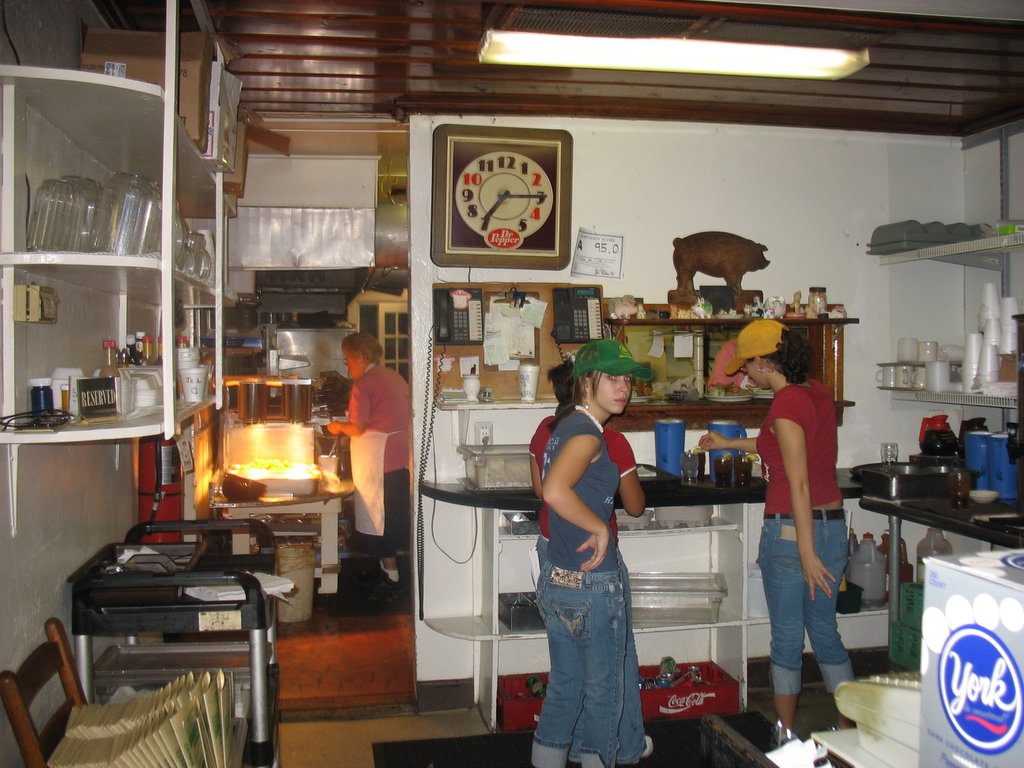
And what about the food? Reader, it blew me away. Describing the cooking as a farm-to-table symphony of local classics just doesn’t do it justice. We had country ham with peaches, pork belly, flash fried collards (incredible), gazpacho (also incredible), squash casserole and tomato pie. We ate our way through the summer gifts of eastern North Carolina. We ate our way through the filming of our favorite TV show. We ate our way through an inspiring direction for a town that had fallen on hard times.

And as the sun set over the ironclad and vast parking lot of Chef and the Farmer, I asked myself, not for the first or last time, what the hell I’m doing in London when my tribe – and flash fried collards – are here in North Carolina. Well, I’ll always have Season 2 of a “Chef’s Life”.  

It’s not home, but for now, it’ll have to do.

* Mase says that since Ben is from Chicago, Illinois, he doesn't really qualify as a Yankee. I say that hailing from the land of Lincoln qualifies him for sure. The Yankee description stands.


Thursday, August 15, 2013

Look Homeward Lightning Bugs


This summer the lightning bugs returned to the farm after a long absence and we were so happy to welcome them home.  We returned too, to the summer places and attractions of our youth.

We returned to historic Tryon Palace in New Bern, North Carolina. We haven’t been there in 20 years when we took our children. We used to go there with our grandparents. But that’s not the reason you should go. This is.

If you’re keen on America’s colonial history, love historic restorations and hate crowds, you could skip Colonial Williamsburg (very crowded) and have a super experience in New Bern. There is a new splendid History Center with interactive exhibits that could convince any recalcitrant child that museums are the coolest thing on this planet.  The Governor's Palace and surrounding gardens and historic houses kept us fascinated and entertained for hours. We had a excellent lunch on the terrace of the History Center overlooking the mighty river Neuse. Oh, and before we forget: George Washington not only slept there, he danced there too.

We also went to Asheville, North Carolina. We haven’t been there in 50 years (not kidding) and were blown away by the culture, nature and ‘joie de vivre’ on offer in this southern mountain city.

If you go, don’t miss the drum circle that takes place downtown every Friday night. Hippies, hiphop grannies, kids, dogs - you name it, they’ll beat it. And try to get in a hike in the Great Smoky Mountain National Park  - think the ‘Last of the Mohicans’ with Daniel Day Lewis that was filmed there. We love the story of the park’s creation. In 1926, although Congress authorized its establishment , there was no federally owned land there. Philanthropists such as John D Rockefeller, and ordinary citizens of North Carolina and Tennessee - and I love this, the travel writer Horace Kephart and photographer George Masa, - campaigned tirelessly to create what is now a 500,000 acre achingly-beautiful preserve.

Also, don’t miss a visit to the homeplace and memorial of Thomas Wolfe, giant of American literature and author of Look Homeward Angel and You Can’t Go Home Again. The experience is so outstanding that it makes you want to run home and read Wolfe’s very, very long books all over again.

Finally, don’t do what we did and miss the Biltmore Estate, George Vanderbilt’s 250-room chateau built in 1895 that at 178,296 square feet, remains America’s largest privately owned house.  Bill Gates’s shack at 66,000 square feet pales in comparison. Alas, we didn’t have the time.

And so our summer of re-visitation came to an end. Last night as we walked up the driveway for the last time, our way was lit by a thousand little flickering lighthouses, lit by the flies we call bugs that are really beetles and I thought of Thomas Wolfe who ended one of the best passages in Look Homeward Angel with the line, “This is a moment."

Friday, November 05, 2010

See America Profonde - Just Like Hannah Montana

I was comparing a trip to North Carolina with an English friend recently. She has a son attending Duke University and is a frequent visitor to the Tarheel State. We were both there during the UK October school break. And what did she describe as the highlight of her visit, besides seeing her son? Going to the North Carolina State Fair. The state fair is an annual exposition that has been running in Raleigh, North Carolina since 1853, with only a few time-outs for the Civil and Second World Wars

Wow, I exclaimed. We were there too. Didn’t you just love it! Such crazy food - deep fat fried ice cream. Weren’t the animals beautiful? I loved the goats, and the cows. Did you go to the pig race? And for the next 20 minutes, we recounted more highlights: the Demolition Derby, the Grand Champion turkey and the record-breaking pumpkins. We agreed. It was extraordinary. We loved it.

In listening to my English friend, I realized that the state fair had given her a real glimpse into ‘America Profonde’ – a view that few foreign visitors get to see. Without irony, she embraced the spirit that enjoys crashing cars, eating ridiculous food and racing pigs. But she also appreciated the young farmers who know a lot about farming and take excellent care of their animals, the bee keepers working hard to maintain healthy hives, the church groups serving up ham biscuits in support of good causes and the local dairies making cheeses the old fashioned way. In short, she found going to a state fair to be a great way to experience what makes America, well, America.

And I like the reaction of one of my daughter’s friends from Singapore when Eloise told her she was going to the North Carolina State Fair.

Oh my God, Eloise, you are just like Hannah Montana!

Monday, August 09, 2010

Will Travel Make You Happier?


The business section of the New York Times ran a major story on consumption and happiness this weekend.  To sum up the findings of a number of prominent psychologists quoted in the article, spending on an experience provides more lasting happiness than spending on stuff.
According to Sonja Lyubomirsky, a professor at the University of California, Riverside with a grant from the US National Institute of Mental Health to study the possibility of permanently increasing happiness, spending on travel experiences is a happiness ‘best buy’. She claims that travel provides longer-lasting happiness because unlike a new jacket or a TV, it cannot be consumed in one go. Travel enhances social relations.  It creates memories that can be savored. Most importantly, Lyubomirsky argues, we edit those memories to put a positive spin on the past. “That trip to Rome during which you waited in endless lines, broke your camera and argued with your spouse will typically be airbrushed with rosy recollection.”
I’m not so convinced about the ‘rosy recollection’ part, I remember a lot of terrible trips very vividly, but I am sold on the idea that travel experiences create the best emotional bang for your dollar – or pound, euro or whatever. I’m thinking, in fact, about this year’s summer trip to North Carolina. I’ve been back in London for almost a week, but I am still happier than when I left. Why? Because I am emotionally satisfied. It’s not so much what we did in North Carolina. In fact, we do the same things every year. We eat barbeque, go to the beach, play tennis and visit Chapel Hill. The reason I am emotionally satisfied is the simple but invaluable pleasure of doing those things with the same people every year, a collection of friends and relations with whom I hope to be forever connected. Whatever it cost to get to North Carolina this summer was money well spent and a much better buy than the new chairs I was considering. I think the New York Times is right. Spending on experiences, particularly travel experiences, does make you happier. 

Friday, October 10, 2008

The Treasure of the Flat Rock


More ideas from Laura Sanderson Healy on ways to enjoy North Carolina with No Crowds.


Do you believe in Shangri-La? I have found mine again -- the blink and you’ll miss it Village of Flat Rock, North Carolina. Set amid crystal lakes, steep mountains, and musical streams, Flat Rock became the preferred refuge of Charlestonians over 100 years ago when they sought the cooler hills when their city steamed up in the summer. Flat Rock is a joy today whether you like quiet nature hikes or art gallery and boutique browsing, and there is also pleasurable gobbling to be had all around.


The place must have incredible ley lines of psychic creativity, because situated alongside one of the huge “flat rocks” in the middle of town is the Flat Rock Playhouse, AKA The State Theater of North Carolina. This thriving establishment boasts a respectable repertory company which produces brilliant work year round.


Across the road is the massive property that holds Connemara, a National Historic Site better known as Carl Sandburg’s home. Do you remember his poem “The fog comes in on little cat feet?” The Swedish-American powerhouse, a compulsively prolific poet and biographer (one Pulitzer for his Complete Poems, one Pulitzer for his LINCOLN biography) came South with several boxcars of his library collections and spent 22 years based in Flat Rock. The tour of his home is 5 dollars and I learned that his wife was the photographer Edward Steichen’s sister. She made Connemara her own dairy goat empire, and the farm is maintained today for the petting zoo types. You can also visit the flat rock that Carl sat on in his chair with pen and paper, never stopping that otherworldly output.


If you just want to roam around the property and take one of several suggested hikes up to Glassy Mountain behind the farmhouse, you are welcome to do so, free of charge.


photo credit: Laura Sanderson Healy


Monday, October 06, 2008

PSSSST! You Can Go Home Again


Today's post is from Laura Healy, writer, southerner and friend.


“All things on earth point home in old October; sailors to sea, travellers to walls and fences, hunters to field and hollow and the long voice of the hounds, the lover to the love he has forsaken” Thomas Wolfe quotes (American short story writer and novelist, 1900-1938)


PSSSST! YOU CAN GO HOME AGAIN


This summer I lingered several days in Asheville, North Carolina, re-acquainting myself with this sublime town of dreamers and artists in the hilly western part of the state. Pubs and eclectic restaurants, music spots, galleries, antique shops and bookstores abound. It is still a quiet place, surrounded by the splendor of the Blue Ridge Mountains.


Number One on my list of attractions was the Thomas Wolfe Memorial, a museum set in Wolfe’s childhood home, a former boarding house his mother ran and which he immortalized in his autobiographical novels LOOK HOMEWARD, ANGEL and OF TIME AND THE RIVER.

Tourists swarm to the chateau-like Biltmore Estate south of town, but I enjoyed taking the $1 tour at the Thomas Wolfe Memorial, expertly led by a knowledgeable young man. The house nearly succumbed to an arsonist’s torch a few years ago but was restored and now boasts an elegant Visitors Center with screening room, shop, and exhibitions. As our small group visited each room and heard its stories, a summer school group of children sat on the front steps doing a writing workshop.

To see the angel sculpture that features in LOOK HOMEWARD, ANGEL, visit the very quiet Oaklawn Cemetery in Hendersonville, NC, just down the less traveled Highway 25 from Asheville, and stop for cool shopping at the Mast General Store on Hendersonville’s Main Street and have an ice cream across the street.


The Thomas Wolfe Memorial
52 North Market Street
Asheville NC 28801
(828) 253-8304
http://wolfememorial.com/


For great barbecue: TWELVE BONES, in the river arts district of town.


Photo credit: Laura Healy

Thursday, September 11, 2008

A Reluctant Yankee at Crook's Corner


When we were growing up in New York, my mother, the transplanted southerner, did a good job of convincing me that as privileged and glamorous as things were “up North”, the real business of life was all happening down in North Carolina. She was never explicit about it, but I got the message.

Take for example, funerals. The funerals for each of my southern grandparents were memorable affairs. They took days. There were tons of relatives and food and stories. By contrast, when my “larger than life” Aunt Carol died up north, the poor old girl got an hour’s slot at the Frank Campbell funeral home on Madison Avenue. Well, that was all I needed to know about the difference between North and South. I am, I confess, a reluctant Yankee.

I am even a more reluctant Yankee when it gets down to food. New York food is fine in many ways. But everyone is in such a rush or on a diet. How come everyone eats at their desk? You usually get only one dessert with your meal. Nothing on your plate was grown, picked or prepared by someone you know.

Southern food, on the other hand, is mythic, defiant and endless. “We’ve raised it and grown it and now we are going to eat it – lots of it - right now!” That was the attitude I remember from my southern summers. I sure did love those platters full of fried chicken and country ham, the corn bread and biscuits, the butter and snap beans and field peas and fresh-picked corn and those glorious pies and cobblers. “Oh yes, I’ll have some of everything, thank you very much.”

And that is why, whenever I am in North Carolina, I love to visit the legendary Crook's Corner restaurant in Chapel Hill.

You’ll find Crook's Corner at the western end of Franklin Street, the main artery of Chapel Hill. It’s in a funny old building with hub cap siding and a pig on the roof. It doesn’t look like much from the outside. When the weather permits, you can choose between the 1950s interior or the outdoor patio. It’s the same choice you would face at any family reunion or church picnic. Inside = air conditioning and noisy southerners talking up a storm. Outside = fat indolent flies made drowsy by the heat. Take your pick.

I was there recently with my daughter and aunt, a mini YaYa Sisterhood convention. The conversation with our charming server went something like this:

“Are the tomatoes good this evening?”
“ Yes Mam.”
“What about those figs with country ham?”
“Yes Mam, they’re delicious.”
“And the jalapeno cheddar hushpuppies?”
“Well, everyone loves those. They’re very popular.”
“OK, we’ll have tomatoes and figs and hushpuppies and shrimp and grits and some crab cakes. Oh, and bring some okra too while you’re at it. By the way, are you married?”
“Yes Mam I am.”
“Too bad, I have a son who graduated from Chapel Hill. He lives in Charlotte now.”
“Yes, Mam”

The evening went on like that. Swatting flies, eating, trying to fix up our sons, and telling stories. The food was all wonderful and nostalgic but kind of expensive. With tip, we spent $112 which is pretty good when you consider how much we ate but pretty expensive when you consider we were eating tomatoes and okra and grits and hush puppies. Never mind. As the New York Times put it, “this is sacred ground for southern foodies.”

Amen.


Crook’s Corner
610 W. Franklin Street
Chapel Hill, NC
919-929-7643
http://www.crookscorner.com/

Monday, July 28, 2008

Anyone Who Don't Sing is a Communist


America. 2008. The summer of $4 a gallon gasoline, a mortgage crisis, expensive groceries and the stay-at-home vacation. As Barack Obama addresses crowds in Berlin, we are in a park in Clayton, North Carolina, a former farming community morphing into a suburb. The small park is full of families sprawled on blankets and lawn chairs listening to beach music. We are a good 120 miles from any beach.

The night is warm, but not too hot, with a soft, nostalgic sky and curiously, no bugs. The band plays the old stuff, the Temptations, the Drifters, and anyone over 50 remembers himself young. We sing along. Teenagers look pained. Little children gyrate and prance before the stage while their parents take pictures of them with cell phones. No one thinks about unpaid bills.

The crowd, as befits a town sitting at the intersection of old and new south, is a casual mix of races and cultures: good old boys and girls, African Americans, Hispanics, Yankees. Most people look like they work at tech companies,  not on farms. You can buy liquor by the glass. There's not a mule in sight. And then, the lead singer announces that everyone must sing along and that anyone who doesn't is a communist. The crowd laughs because communists aren't threatening anymore. The Cold War is over, Senator Jesse Helms is dead and Joe Stalin has been run out of town by Osama bin Laden.

But no one seems to be thinking about politics on this fine night in Clayton, North Carolina. Close to an Interstate, full of new development, commutable to the cities of Raleigh, Durham and Chapel Hill, this is a town that senses it has a bright future, even as the economy collapses around it. New restaurants have opened beside such venerable institutions as the Jones Lunch Room where the finest hot dogs in America can still be had for under $1.75. There's a snazzy new tennis club with beautifully maintained clay courts and top tier instruction. There's a brand new bypass that get the Interstate traffic out of the town. Despite all the problems of this summer, Claytonians are an optimistic, forward looking and friendly bunch, at least that is the way they seem to this insider (related to lots of folks in town) and outsider (she doesn't even live in America).

NoCrowds has written extensively about holidaying in eastern North Carolina. It's not just that we spend every summer here, we think everyone looking for authentic travel experiences would love it too. Entering the United States via Raleigh Durham Airport still beats the socks off JFK or LAX. With new international arrivals facilities opening next summer, it will be even better. Eastern North Carolina barbeque is still the best in the world. Ask anyone. So are the beaches. (North Carolina has the east coast's longest stretch of undeveloped coastline) but the best reason of all to visit North Carolina are the Carolinians. The real ones, not the New York imports, are congenitally hospitable. Even if they have not a clue about where you are from or wonder why you would want to be from there, they will take care of you. It's just their nature.


Thursday, August 09, 2007

The Second Battle of Bentonville


Last Sunday, my new cousin-in-law took us to the Bentonville, North Carolina to visit the battleground where 80,000 soldiers over the course of three days fought one of the last major battles of the American Civil War. We went because my husband, amateur military historian, was making one of his rare appearances in town, and my large Southern family wanted to show him a good time. But if you are not an amateur military historian with a large southern family, why would you want to visit the site of an important but somewhat forgotten Civil War battle in the middle of nowhere?

Well, one reason is to get there before the developers. At the simplest level, if we don’t want our American heritage turned into a CVS pharmacy, we need to visit our monuments and show some solidarity. A sleepy, undisturbed place like the hamlet of Bentonville, population 1,768, close to Interstate 95 and within striking distance of one of the fastest growing urban areas in the country, will be hard pressed to stay undisturbed and rural much longer. Even though worthy groups such as the Bentonville Battlefield Historical Association work hard to protect the site, the ability of rapacious developers, who have been buying up open land throughout the South like the second coming of Sherman, put all our heritage sites at risk. Go now before this “hallowed ground” finds itself next to a WalMart.

But the preservation argument is not the only reason to visit Bentonville. For foreign visitors, or any visitor, trying to understand American history and get under the skin of the American psyche, there is nothing more instructive than a tour of a Civil War monument which noted novelist and poet, Robert Penn Warren, described as the greatest single event in the creation of the American imagination.

At Bentonville, the business of creating America through the blood, guts and glory of this epic conflict begins to comes to life in a small but very well done Visitors Center. Be sure to watch the short audio/visual map exhibit which provides an outstanding orientation and explanation of what happened at Bentonville in relation to what you can still see today.

Visitors also have the opportunity to tour the Harper House, built in the 1850s, which played a key role in the battle, serving as a Union field hospital. The tour was expertly conducted by a fine southern gentleman of the old school who was well versed in his subject and the southern art of storytelling. The ground floor recreates the gruesome field hospital conditions and one can easily imagine amputated limbs being thrown out the window by overworked surgeons. While Union doctors sawed off arms and legs on the ground floor, the Harper family lived upstairs and it is interesting to see how ordinary people carried on their everyday lives in the middle of all that carnage. You can also visit the detached kitchen and slave quarters of the property and learn about ante-bellum life in eastern North Carolina which was light years away from the plantation lifestyle made famous in “Gone with the Wind”.

After our tour of the house and outbuildings, we walked over to the monuments to fallen soldiers and then took the battlefield driving tour having been discouraged about walking through the woods at this time of year due to the ticks and chiggers. How’s that for authenticity? Once we got back into our comfortable, air conditioned 21st century car, I lost that “step back in time” feeling but I enjoyed driving around looking at the open farm land while the military historians contemplated the 29 information plaques along the route.

In the remarkable documentary on the Civil War by Ken Burns, the historian Shelby Foote makes the point that as an outcome of the conflict, Americans stopped saying “the United States are” and began saying “the United States is”. There are plenty of places across the southeast of the United States where you can learn about the price that was paid on both sides for a verb to go from plural to singular, but I think Bentonville is a particularly fine example, with its untouched landscape and low key but thoughtful approach to history to contemplate what America has gained and what, without continued vigilance, can still be lost.

Bentonville Battlefield
5466 Harper House Road
Four Oaks, NC 27524
Phone: 910 594 0789
Fax: 910 594 0070
http://www.bentonvillebattlefield@nchistoricsites.org/
Bentonville@ncmail.net

Hours:

April – October – 9 to 5pm Monday through Saturday, Sunday 1-5pm
November – March 10 to 4pm Tuesday through Saturday, Sunday 1-4pm

Admission is Free
Photo courtesy of the Bentonville Battlefield Historical Society website

Wednesday, July 25, 2007

Go to America - Eat in a Shack


No, this is not a Michael Moore movie about poverty in the land of plenty but Europeans, listen-up, no matter how counter-intuitive it may seem, some of the finest dining in America can be found in shacks. Sometimes, there isn’t even a shack, just some old tables by the side of the road and most of these roads, as Michael and Jane Stern, authors of Road Food, point out, are “near the ocean, the lake or river – in other words, near the home of what they serve”. A good fish shack in America is a “finger lickin”, “sleeves-up” “flip-flop” kind of place which can reconfirm ones faith in American food and the joys of America’s peerless informality.

The Shark Shack, on Atlantic Beach in North Carolina is just such a place. It’s both a “Drive-In” restaurant (where you can experience the unique American phenomenon of eating meals in your car) and a place where you can park your surf board, sit at picnic tables and eat “the catch of the day” either in the form of a sandwich or a platter. There are clams strips, grouper (a local fish) bites, fish tacos and a shrimp burger. For non-fish eaters, there are hot dogs, hamburgers, steak sandwiches and lots of chicken.

We ate lunch there last week and everything was delicious, plentiful, inexpensive and served by a blond, long-legged friendly college student with perfect teeth.When we asked if we could have our fish grilled, not fried, the charming student with perfect teeth said of course we could. The fact that our grouper sandwiches were fresh, succulent and only cost $6.69 blew this cynical pseudo-European away. Surprisingly, the Shark Shack has a liquor license and a pitcher of beer will only set you back $7. At night, there is live music and if you’re not hungry, signs invite you to bring your own chair, sit outside, watch the stars, have a drink and enjoy the music.

Shark Shack Revisited

Sadly, we also ate there this Saturday and had a completely different experience. Our waitress was also young and cute but so stupid it was ridiculous. Everything we ordered was messed up and the food wasn't as good as before. How can one place be so good and so bad? I blame it on the weekend (the bad experience) versus mid-week (the great experience). McDonalds may be consistently awful but alas, not all authentic places are also consistent.

The Shark Shack
Fort Macon Road and South Durham Street
Atlantic Beach, North Carolina
(next to the Beach Tavern)
Tel: 252 726-3313

Thursday, July 05, 2007

Soul City, North Carolina


I hate Sky TV. I hate everything about it from the sales people, to the installers, to the ugly satellite dishes and cabling to the lousy programming. I am the only member of my family who feels this way. Today, after ten happy months of Sky-free living, as a concession to our youngest son for getting a job, Sky was reinstalled.

It was a really, really bad day until I read my email and found this wonderful post from Sandy, the first in a series called NoCrowds America that will talk about places where visitors to the United States can go to see and understand the America you will never, ever see on Sky TV. As Sandy puts it, check it out!

On this sacred American holiday, I present NoCrowds America with its inaugural post--a place neither Californian, nor charming in the least and not at all visually uplifting. In fact, it's not even there! But I can think of no-place more American than Soul City, North Carolina.

In the mid-1970s I wanted to find the real America and--once found--save it from itself. From my British mother, I came to appreciate the nineteenth century New Town movement, visionary Utopian plans offering working and middle-class Britons alternatives to the explosive, fetid maelstrom of London--neither exclusively urban, sub-urban nor pastoral--but free-standing communities, each an economically viable place to work, live, play. Flipping through a copy of Architectural Record one lazy day, I chanced upon an article, "A Plan for Planned American Communities". As in Jerry Maguire's famous "You had me on Hello", its opening captured my imagination: "...For in a world in which there is too little idealism, far too little concern for land planning and land use, and almost no effective social planning, new towns offer new hope. Both for the poor and for the growing body of middle-income families who search for a fresh option in their way of living."

Flipping through the pages, I came across a map highlighting each of the thirty-or-so federally-assisted and private U.S. New Towns currently under development. With a naiveté and bravado which only happily resides in the heart and mind of a callow youth of 17, I closed my eyes, made a wish and stuck a finger on my future--the place where I would make my mark on the world.

Soul City, North Carolina.

I continued to read: "Soul City's a unique new town: it is 'freestanding' in a completely undeveloped area; it is experimental in its aims, and is the only New Town with a federal HUD (Housing and Urban Development) loan sponsored by a black-owned development company." The brainstorm of Floyd W. McKissick, a moderate-cum-militant Black civil rights activist, Soul City was envisioned to house 50,000 people in multiple 'villages' by the year 2000. It was planned to be self-contained, so its residents could also work, receive health care, get schooling, recreate and worship in town. Commonly misunderstood as Afro-centric in focus, McKissick actually envisioned Soul City as a community where all races could live in harmony. Lawsuits and investigations into the use of funds by the developer, Soul City Company, resulted in foreclosure in 1979. By 1980, all that remained were 35 housing units, a healthcare clinic, a tennis court, and a pool. About 150 people were employed in the city. Perhaps a less electrifying "Big New Hope" might have been a safer name for McKissick's forlorn love-child.

Soul City was carved out of 5,000 acres on played-out tobacco fields of the Saterwhite Plantation, in Warren County, North Carolina. When I arrived in 1974, Soul City was full of great expectation, ten double-wide trailers and no discernible human population. A nearby little hamlet of Manson, off U.S. Route 158, contained a small filling station and grocery store, ramshackle, picturesque First Baptist Church and a retread tire repair shop. Most striking--now as then--are the beautiful red clay dirt which line the roadsides, a hazy blue sky only occasionally interrupted by short, monsoon-like rain deluges and a stillness and beatitude which suggests Southerners only lost the War of Northern Aggression to return the land back to its mostly fallow, uncultivated state.

Perhaps in the mind of European readers lurks a persistent distrust of Americans and things uniquely American, best expressed in the question "Why in the world go to Soul City, North Carolina", an Oz-like, mythical city of hope and racial equality which actually doesn't exist? Why visit a place where the only civilizing influence is a Perdue Chicken Hatchery and an International Paper plant?

To see Soul City in its naked, barren state, to drive its miles of paved roads which lead to nowhere, primarily used as places to dump old couches and appliances, to see its sole remaining edifice, a twenty foot high "Soul City North Carolina" sign, still carefully tended, is to see at first hand the pure love, blind trust, foolish pride which define the quintessential American mind and experience. Too often, we Americans are accused of acting exclusively out of malevolent intentions and ambitions. We see this played out daily in the streets of Baghdad, our corporate icons carelessly strewn across the world, in our disregard for other common global environmental concerns. But to see Soul City is to understand that, to an American, to want to do something is almost as important as its ill-conceived execution and final outcome. The American experiment's still alive and well, whether it be transplanted to the gleaming canyons of Michael Bloomberg's post-9-1-1 Manhattan, the ubiquity and gemütlich character of our neatly laid-out suburbs in any American metropolis, or to the backroads of this once-rural, now red-neck satellite-city development.

Check it out!

Photo courtesy of www.roadsideamerica.com which is a useful site for anyone searching for "off the beaten track" America


Tuesday, July 03, 2007

Our Favorite/Favourite America


My friend Sandy has been after me to write about America. He’s worried that

“to a German or Austrian, spoon-fed by daily clips of Paris Hilton breaking down in court and George Bush strutting over tumbleweeds on his Texas Ranchette, the real, untrammeled substance of America isn't properly conveyed.”

Who can argue with that?

He goes on to say that the moment is ripe to launch NoCrowds America as Europeans look to cash in on the greatest travel bargain of the century. With the pound rising yesterday to its highest level against the dollar in 26 years, it’s hard to argue with that either.

Not one to leave things to chance, Sandy also provides a little business plan as to how I can get this going. He suggests that with

“your plethora of close American family and friends scattered across these fruited plains, I propose you send out a call to send in stories of their favorite places...Brian Cullman's favourite music venue; any of the O'Grady's favorite anythings (!); Godmother Christine's favourite NY hairdresser; Hugh Jr.'s favorite hardware store (Brewer's Marine in Mamaroneck); Mac's favorite Route 46 New Jersey authentic Greek diner; can't remember their names but it starts with a B, (he means Rich and Suzie Bissell’s) best Philadelphia cheesesteak place; Vic Ogburn's favorite gun shop and shooting range; Sandy's favorite Southern courthouse (Bay Minette, Alabama, where I got married on the sleigh!); John and Janice's favorite Chicago fruit markets; Jay Maloney's favorite Colorado Springs coffee shop; Carla's favorite Orange County beaches--Emerald (Warren Buffet's former private hangout) and Victoria (Bette Midler's) Coves in Laguna Beach; Leland and Allison's favorite Berkeley cheese shop; etc. etc. Out of the hundreds of replies received will emerge a crazy-quilt of uniquely American "uncrowded" destinations”

It’s hard to argue with that either. But Sandy knows me well, pointing out that

"We've a famous history of you soliciting my ideas, my humbly submitting them, then your not acting on them, but this one's a winner. "

Sandy, you’re right. Consider NoCrowds America officially launched. I’ll figure out the technical bits later.

And to all my American family, friends and most importantly, current readers of NoCrowds, please send in your favourite American places and experiences. Don’t worry that the places you talk about will be overrun with crowds. The NoCrowds readership is still too exclusive for that, and, anyway, according to Sandy,

"it's every American's patriotic, bound duty to entice hoards of Europeans to come over here to recycle their Euros into dollars before we spend 'em and send 'em to the Chinese, so they can buy T-bills, thereby keeping U.S. interest rates low and allowing us to not default on our subprime real estate loans! "

Even if you are not interested in saving the subprime loan market, and I would understand if you are not, please send me a description of your favourite America so that we can take on the purveyors of mass pre-packaged tourism, one authentic experience at a time.
Photo taken in Jones Lunch Room, Clayton, North Carolina. My favourite place to eat an American hot dog. What's yours?

Monday, April 02, 2007

Dinner at Stephensons


We're off to North Carolina to eat some Bar B Q. In case you can join us, our flight lands at 4:10, we're taking hand luggage so I reckon we will make Stephensons by 6:00. Until then.

Stephensons
Highway 50 North
McGee's Crossroads
NC
910 894 4530

Monday, August 07, 2006

Where's the Decent Roadfood?

Posted by Picasa
This year, I resolved not to eat the revolting fast food which is the only obvious choice when travelling America’s highways. Even Eloise, after hearing Eric Schlosser, author of “Fast Food Nation”, speak in London, was off the stuff. Having read about Jane and Michael Stern’s book “Roadfood” with reviews of 600 colourful, non-franchised places for travellers to eat, I happily spent $19.95 buying the book, confident that my problem was solved. Sadly, it was not.

“Roadfood” is a nice book, don’t get me wrong, the restaurant reviews are informative and charming but, and this is a huge “but”, they don’t tell you exactly how to get from the road to the food. What I wanted to know was simple. As I am travelling up and down Interstate 95 (or any other American major highway), where can I pull off the road relatively quickly and get a decent meal and how do I get there. What I really wanted to know was the driving directions and amount of time from road to food. Sadly, on that score, “Roadfood” does not deliver.

Which brings me back to my original question, how in the world do you get a decent meal off of an American highway? Why do American travellers find the current situation acceptable? What can the travelling public do about it short of packing picnics and boycotting the whole sorry mess? Has anyone addressed the issue with a source of information that you can take on the road and gets you from the road to the food?

I do have one fabulous suggestion for anyone lucky enough to be travelling on Interstate 40 south of Raleigh, North Carolina. Go to Stephenson’s Bar-B-Q. The pork barbeque is pit cooked daily, hand chopped and specially seasoned with the best sauce you ever tasted. Stephenson’s also has wonderful fried and barbeque chicken. They have an “all you can eat”, $7.50 a head, offer that is obscene. They have hot dogs and hamburgers and fried chicken gizzards and seven choices of delicious daily vegetables. The service is VERY fast. The waitresses are nice and the tea is sweet. Most importantly, Stephenson’s is a 7-10 minute drive from the Interstate.

To find Stephenson’s, exit I-40 at Exit 319, McGee’s Crossroads. Turn right on Route 210 for roughly 2 miles to Highway 50. Turn right at Hwy. 50 and Stephenson’s is on your right about another mile up the road. This may be my favourite restaurant in America. It is off the highway and, as they say in the Michelin Guidebook which will help you find fine dining in every village and hamlet in France, Stephenson’s is absolutely “worth the detour”.

Stephenson’s BAR-B-Q
11964 NC 50 North
Willow Springs, North Carolina 27592
Tel: 919-894-4530


Photo of Stephenson's kitchen. For the record, I neither work for, nor have any financial interests in this restaurant. I'm just a little obsessed with it.

Monday, July 24, 2006

America's Best College Towns

Posted by Picasa
We are a divided family. We divide over universities, not all universities mind you, just two, the University of North Carolina at Chapel Hill (known as Carolina) and Duke University. These rival schools, located a few miles apart, hate each other passionately. It’s an old story which contains a bit of “Gone with the Wind” and a bit of “Bonfire of the Vanities”. Mostly it is a problem with basketball. On the day that I visited Duke, there was a young man walking through the engineering school with a t-shirt which screamed, “CAROLINA SUCKS”, just so you get a feel for the depth of the problem.

The bulk of my family have always strongly supported Carolina which makes sense since they are Carolinians but Duke has made inroads in recent years. My parents now use Duke’s hospital (big vote of confidence). In addition, my son applied to one of their graduate schools. His girlfriend, Alison, is a graduate. Brick by brick, we loyal Carolina supporters have been drawn into Duke’s powerful orbit but still, I take exception to that t-shirt.

For visitors who could care less about who hates whom, both towns, Chapel Hill for UNC and Durham for Duke offer crowd-free, fun places to visit. Both Universities have lots of things to do and see, most of which are free or priced for students. Back in November, my friend Mase wrote a wonderful post for NoCrowds about visiting Chapel Hill, making the case that the best way to experience the best America has to offer is to visit its college towns. Following on from that idea and to even out the playing field and in the interest of family harmony, yesterday I asked my son’s friend, Alison, if she would give me an insiders’ tour of Durham and the Duke Campus. Here is what we did.

We parked. You may laugh but parking at universities is often a huge problem, mostly driven by the fact that almost all American students have cars. To Duke’s credit, they have built a big new parking lot on the West Campus and this problem is mostly solved, at least for now. Alison says things will get more difficult when the full complement of students is back on campus.

We began our tour of Duke at their bookstore where I like to begin every university visit. In this case, I could have skipped it. The Duke bookstore is really nothing special.

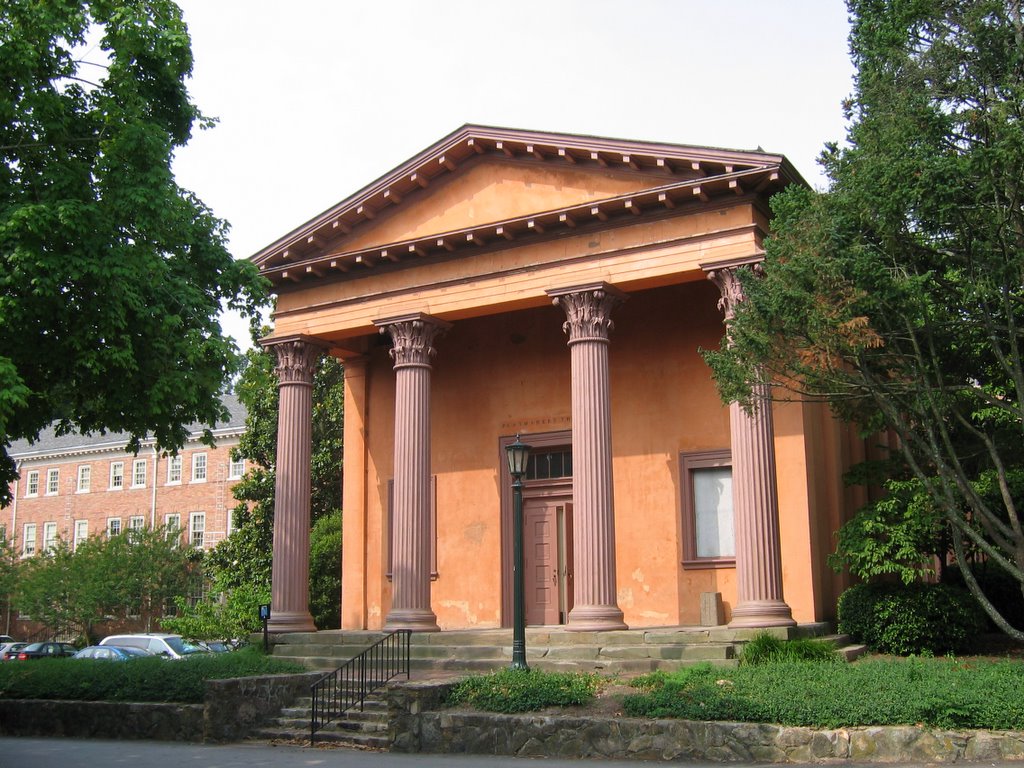
What is special is the monumental chapel next door which has the metrics of a mind blowing cathedral: seating for 1,670, seventy-seven stained glass windows containing 800-900 figures made from over 1 million pieces of glass, three organs, a fifty bell carillon, and a fine portal with sculpted figures of a curious collection of luminaries such as Savonarola, Martin Luther, Thomas Jefferson and Robert E. Lee (and who says Duke is just for Yankees?). I’ve been to countless churches and cathedrals in my time, but when we visited the Duke Chapel one of the three organs was playing and the combination of the music, the scale and the grandeur of the place made the visit uplifting and memorable. There is a sheet at the entrance with information for a self-guided tour (not great) and a much more useful brochure, “The Guide for Visitors” which I would definitely pick up.

After our visit to the Chapel, we made our way to the Sarah Duke Gardens, a short walk away. Occupying 55 acres the Gardens are recognised as one of the premier public gardens in the United States which attract more than 300,000 visitors annually. But don’t worry, the size of the place absorbs the numbers easily. On the day we visited, it felt like we were the only people there.

The gardens were designed by Ellen Shipman (1869-1950), a pioneer in American landscape design. Duke Gardens is considered Shipman’s greatest work. There are five miles of walks and pathways, areas devoted to flora of the southeastern United States, an area devoted to the plants of eastern Asian with lovely rock gardens, foot bridges, stone lanterns and a teahouse shelter. As I said before in my post about Kew Gardens in the United Kingdom, I’m not much of a gardener, but I loved my visit to the Sarah P. Duke Gardens and I respect the way they have devoted so much resources to the preservation of great American landscape design.

After our visit to the Garden, we wandered through the gigantic University hospital complex which, as I explained above, now tends to the medical needs of my parents. I suspect that if you are a patient, the “in your face” scale of the place is comforting but for me, I kept thinking about some of the Victorian era hospitals we still have in Britain and shake my head at this modern medical megalopolis. The place is so big that it has its own mini train (which looks like the little pods from Woody Allen’s movie “Sleeper”) to carry people around. Anyway, suffice it to say that if you take ill during your visit to Durham, you will receive some of the finest medical care to be found in the United States.

Following our tour of the campus, Alison suggested we get a sandwich at Fowlers on South Duke Street near the East Campus. Once again we found a parking place straight away. Fowlers is in a large converted warehouse with a café, a delicatessen with a very good selection of foreign foods, a large cheese selection, a butcher and a fishmonger. You can eat outside on the porch if you like. It was far too hot for that the day we were there. I had the homemade pastrami which was excellent even if I did have to send the first sandwich back because they used the wrong bread. I would love to give this place a better review because management obviously cares, in the right way, about food and so much of what is served is of superior quality. Still, on the day of our visit, I felt that staff was well intended but way too disorganised and it distracted from the experience. According to Alison, good meals near campus can also be had at Elmo’s Diner which serves inexpensive good southern food and great breakfasts as well as the Cosmic Cantina for burritos and pitchers of beer.

Following our lunch, we drove around the East Campus and past a Durham Shrine to fine food – the Magnolia Grill. Founded by chef owners Ben and Karen Barker, the Magnolia Grill serves sophisticated and beautifully prepared versions of traditional southern food and is one of my favourite places to eat in the South. Sadly, there was no time for a meal during this visit. Reservations can be hard to come by, but go if you can get a table.

After lunch we toured the East Campus, the highlight for me being the series of colourful benches built by students in front of their dorms which they happily burn and build again when Duke beats Carolina in basketball. Go figure. After that, we got back in the car and headed for Chapel Hill for some ice cream at Cold Stone on Franklin Street where, if you leave a tip, the happy workers, one of whom is my cousin, will sing you a funny little “tip song”.

Going back to Jeff Mason’s point that the best way to see America is by visiting its college towns, I highly recommend making Durham and Chapel Hill a stop on any tour of the American South. The attractions are interesting, the people are friendly, the food is great, you can park your car, and Carolina, for the record, definitely does not suck.

Good Food in Durham

The Magnolia Grill
1002 Ninth Street
919 286 3609
Reservations essential

Fowlers
112 South Duke Street
919 683 2555
Open 7 days a week for breakfast, lunch and dinner (closes at 6:00 on Sunday)

Elmo’s Diner
776 9th Street
919 416 3823

Cosmic Cantina
1920 ½ Perry Street (just off 9th Street)
919 286 1875

Friday, November 11, 2005

Jeff Mason's Southern Part of Heaven


Today marks a significant leap forward for NoCrowds as we post our first guest contribution. Jeff Mason, a friend and early strong supporter of this site, presents the idea that visiting American college towns offers a superior way to see America. Yes, we did promise recently to focus on Europe, but all rules can be broken for the right reasons. The right reasons here are 1) Jeff’s approach is perfectly NoCrowds focussing on ways to take back the travel experience and 2) he is one of the world’s experts on Chapel Hill. Anyone who has this much passion for a small southern town is unquestionably our kind of guy. For Europeans coming to the U.S., Jeff presents a first class concept about how to see the real America. Read on and I think you’ll agree.
North Carolina's Southern Part of Heaven

When traveling in America, one of the hidden opportunities to experience the best the country has to offer is to visit a “college town.” The environs generally offer a cosmopolitan town or village embracing expansive lawns surrounded by classroom buildings, bookstores, restaurants, and arts and sports venues.

The atmosphere is often charged with youthful exuberance and intellectual pursuits. Since many of the colleges located in these towns are also some of America’s more prominent liberal arts institutions, it also a good opportunity to encourage your kids to study hard so they can attend someday.

While crowded during the academic year, in summer and on weekends, these bucolic spots are deserted and offer a chance to take quiet strolls through the campus and enjoy the local fare in a more leisurely mode. These towns cater to students, so food for the stomach and mind can be had at a much lower cost and with less stress than in a large city. Plus, if you are like me, it is the chance to take advantage of things we neglected to do while we were in college ourselves.

While many such towns exist throughout the country – Charlottesville (University of Virginia), Princeton, Ann Arbor (University of Michigan), Hanover, NH (Dartmouth), Oxford (University of Mississippi), to name a few – one of the more popular is in Chapel Hill, North Carolina.

The town of Chapel Hill is home to the first state supported university in America – the University of North Carolina. It was founded by veterans of the Revolutionary War who dreamed of a new democracy in which all citizens had access (and duty) to an education. Chapel Hill’s major thoroughfare, Franklin Street, is named for Benjamin Franklin, who was an ardent supporter of public schools and drafted large parts of the University’s charter.
.
From very humble beginnings, the village and town have evolved into centers of scientific research and liberal arts. The town of Chapel Hill, part of “Research Triangle Park”, is known worldwide for it technology research. A former University president described Chapel Hill as “a town touched by a strange magic,” and that feeling is easily captured during a late morning or early evening walk from Franklin Street through the McCorkle Place quad in the oldest part of the campus

While newer than most of the other buildings on the quad, the Morehead Planetarium, located adjacent to Franklin Street, offers daily planetarium programs, science exhibits and chances to explore the night sky from its observatory. American astronauts trained here until 1975. On weekdays, the Planetarium also serves as the official “Welcome Center” for the University, where you can obtain maps, directions and schedule a campus tour.

The Coker Arboretum, located just behind the Planetarium, is a quiet 5-acre sanctuary of trees, flowers, birds and meadows. A botany classroom, many trees or shrubs are marked with an explanation about their unique nature. As with much of the campus, students use the arboretum for romantic walks, reading or lying in the sun.

If a stroll through the arboretum takes its toll, return to McCorkle Place and relax on the bench in front of “Davie Poplar,” which campus lore maintains started as the tree branch which the University’s founding fathers placed in the ground to mark where the campus would be built. (It is actually much older.) The nearby “Old Well” is where thousands of freshmen have sipped water, hoping the stories were true it would bring them good luck with their examinations. A few steps way is “Old East.” the oldest state university building in the country and a National Historic landmark. For many years, it was the only classroom building and dormitory on campus.

Today, the main campus consists of over 700 acres and almost 26,000 students, a highly respected faculty and one of the largest library systems in the country. The Wilson Library, at the end of the next quadrangle (Polk Place, named for a graduate and the 11th U.S. president, James K. Polk) houses the largest archive in the country about the American South, along with a large library of rare books and other special collections. On any given day, exhibits outside the main reading room can range from a death mask of Napoleon to Jack Kerouac’s manuscript scroll of his famous book, “On the Road.”

Being a liberal arts university, during the academic year the campus offers almost nightly performances by students in its Dramatic Arts programs in theatres located primarily along Cameron Avenue, or its popular professional theatre group, the Carolina PlayMakers Repertory Company. Memorial Hall is the venue for the Carolina Performing Arts Series, which brings professional performing artists to campus about 30 weekends a year. Similar to many colleges, these productions often explore current issues and new artists that cannot be produced at larger venues that demand higher ticket prices.

One block north on Columbia Street you will find the Ackland Art Museum, which displays part of its 15,000 piece collection in galleries devoted to major art forms and history.

Of course, no trip to Chapel Hill is complete without running into some famous athlete who graduated from the university. While many “Carolina” graduates are leaders of America’s largest financial institutions, prominent journalists and authors, actors and politicians, two of its more famous alumni are former NBA star Michael Jordan and world soccer star, Mia Hamm. It is not unusual for them and other alumni to return to the town to visit, particularly in the summer months.

Finally, no trip to Chapel Hill is complete without a stroll down Franklin Street and dining or relaxing at some of its more popular restaurants and pubs, which include the following:
· Top of the Hill . A microbrewery and restaurant that overlooks the major downtown intersection of Franklin and Columbia Streets.
· The Lantern. A small and popular restaurant specializing in Pan-Asian cuisine.
· 411 West. A popular Italian restaurant.
· Crook’s Corner. Famous for its classic “shrimp and grits” entrée.
· Elaine’s on Franklin. Regional cuisine.
· West End Wine Bar. A large selection of wines and beer.
· CrossRoads Restaurant. This restaurant, which is part of the university owned Carolina Inn, offers southern cuisine and is a short walk from Franklin Street. Each Friday in the summer and fall, the Carolina Inn provides concerts on its front lawn and porch, generally by local bluegrass groups.

This is just a small sample of the excellent restaurants near campus. But it is the vibrant pace of life in a garden like atmosphere that makes many people refer to Chapel Hill as “The Southern Part of Heaven.”

So, if you want to enjoy a quiet weekend or summer day in America, visit a college town. You get the cosmopolitan feel of a large city, without the crowds and noise, and a chance to mingle with some of the best and brightest of the next generation.

Location:
About 15 minutes west of the Raleigh-Durham International Airport, just off Interstate 40 West. Approximately 4.5 hours south of Washington, D.C., and 2.5 hours from both the North Carolina coast and mountains.

Hotels:
The Carolina Inn
800.962.8519
http://www.carolinainn.com/

Siena Hotel
800.223.7379
http://www.sienahotel.com/

Courtyard by Marriott
919.883.0700

Fearrington Inn
800.316.3829
http://www.fearringtonhouse.com/

Tuesday, August 30, 2005

Break the Trip with Ava


Oh, how evil is Interstate 95.

The north/south artery of the east coast of the United States, once a monument to American motoring, is now a filthy, fume clogged, congested menace of a road overfilled with rampaging cars and trucks. The only place to eat is at nasty fast food restaurants whose rancid fat knocks you back before you get out of the car. Tacky chain hotels dot the landscape. It’s a horror.

But chances are that if you are travelling on the east coast of the US, sooner or later, you too will find yourself on 95. If so, and if you are heading south, I have a suggestion for how you can get only one mile off that road, have a neat “No Crowds” experience for an hour or so, eat an inexpensive and authentic lunch and maybe even bag a bargain or two.

Five hours south of Washington and one mile off I95 at Exit 95 in Smithfield, North Carolina is the Ava Gardner Museum http://www.avagardner.org/ . That’s right, a museum dedicated to the life and times of the Hollywood goddess, one of Smithfield’s most famous native daughters. Even if you have never been interested in Ava Gardner, Hollywood, movies or movie stars, this is a wonderful gem of a museum.

First, Ava Gardner was as drop dead gorgeous as they come. What’s more, she had an interesting if tempestuous and ultimately sad life with lots of equally famous husbands. The Ava Gardner Museum takes all these ingredients and tells a really interesting story about one woman’s rise to fame during the golden age of Hollywood. I spent a very happy hour in the place recently and highly recommend it. The curatorship is first class. The objects are beautifully presented and well explained. There is an excellent film which introduces the story and sympathetically sucks you in. How the collection of memorabilia and the museum came about is a mind boggling tale in itself. The gift shop has a small but truly camp collection of things to buy which would make superb stocking stuffers for even the most jaded person on your Christmas list. And all of this only a 5 minute journey off that evil road.

If you are feeling hungry before or after your visit, you can get a fine sandwich around the corner from the museum at Marla’s. My children swear that the Italian subs at Marla’s are the finest sandwiches anywhere in the world. I’m not so sure, but they are good. Everything is made fresh to order and the place is packed with locals. Marla’s can be found at 135 South Third Street next to the Howell Theatre. Marla’s opening times are idiosyncratic so be careful. Open Monday and Friday 8-8, Tuesday through Thurday 8-2, Saturday 8-2:30 and closed on Sunday.

Before getting back on 95, if it is a weekday (absolutely forget doing this on the weekend, particularly in the summer) you can pay a visit to a vast outlet shopping emporium, Carolina Premium Outlets, http://www.premiumoutlets.com/carolina where, over the years, I have found very good buys on lots of branded merchandise such as Gap, Ralph Lauren, Samsonite, Banana Republic and Nike. It’s a big horrible concrete jungle of a place. There’s nothing nice or charming about it but if it is a good buy you want and the time is right, it can be worth a visit.

So that’s my suggestion for how to beat the I95 blues. Can anyone suggest other places along the stretch from Maine to Florida where you can find quick, easy and interesting alternatives to the mind numbing and disgusting chains? I’ve checked out several websites listing Gourmet food off I95 and nice places to stay and when they included chains like Ruby Tuesdays (yuk!) and EconoLodge I knew that No Crowds had a job to do. Together, we can take back the American Interstate experience, one exit at a time.

Beaufort Addendum


I asked my friend, Mase, a Beaufort native, to check my material on his former hometown, and he had this to add:

"The one thing that I thought about that might be interesting to your readers is that "The Dockhouse" is a great place to relax outside with drinks while mixing with boat owners from around the world whose yachts are docked footsteps away in the town marina, listening to live music most nights of the week, or watching people stroll up and down the boardwalk. One of the great pleasures of Beaufort is that it is small and compact, so you are certain to meet people from all over who are spending the night or several days in the marina."

Thanks, Mase.

Monday, August 08, 2005

Beaufort, North Carolina


In Search of Lost Time on the Carolina Coast

Picking up my son at Raleigh-Durham Airport, I stupidly left my copy of Marcel Proust’s “Remembrances of Things Past” on top of the automatic parking ticket machine which, at the time, seemed auspicious. My project for the summer could have been resurrected by Amazon but instead I put off reading Proust for yet another year. Still, my appetite for recapturing the past was more than satisfied during the week I spent in Beaufort, an historic seaport on the North Carolina coast which retains an authentic small town atmosphere despite the crush of modern tourism elsewhere on North Carolina's Outer Banks. Frankly, if I had the mass readership of a travel writer such as Rick Steves, I wouldn’t even be telling you about Beaufort, which I visit every summer. Beaufort is too unspoiled to share.

Established in 1709, the town was once the home of whalers, merchants, fishermen and even pirates, including the notorious Blackbeard. Over 100 historic homes remain which are beautifully preserved by the current residents. The streets are wide, shady and quiet. Gardens are lovingly maintained. Wild ponies can be seen grazing on Carrot Island and local children spend lazy afternoons jumping off the town dock. In fact, children are able to walk around Beaufort as children used to do, on foot or bikes or in boats, unsupervised and just happy to be out of school.

With children or without, it is fun to buy an ice cream from the General Store and walk along the bustling waterfront to soak up the nautical atmosphere. Some of the boats are pretty spectacular, huge yachts hailing from tax havens from around the world. There are ferries to isolated places to swim where, thanks to the Gulf Stream, the water temperature is a blissful 80 degrees Fahrenheit. Also on offer are harbour cruises, ecology cruises, parasailing, scuba diving, kayaking and a ride on a speed boat that looks like a shark, which the locals hate, but my 8 year old daughter finds thrilling. Deep sea fishing and bird watching are also popular.

Beaufort is also the perfect place to walk, jog and bicycle. The terrain is flat, the scenery is lovely and the other walkers, joggers and bicyclists are some of the friendliest people you will ever meet in your life. On my daily run from my parents’ house to the fish factory at the end of town, I would encounter rabbits, cranes, wild ponies and very little traffic. On the other hand, sitting on porches, sipping iced tea and doing absolutely nothing is also a perfectly respectable Beaufort pastime.

There is an active historic association http://historicbeaufort.com/bhaindex.htm which maintains a small but interesting collection of 18th and 19th century buildings you can visit as well as an historic graveyard, The Old Burying Ground, which looks like it is straight out of “Midnight in the Garden of Good and Evil”. My daughter was fascinated by the grave of the girl in the rum barrel who died at sea while returning from England but was brought back to Beaufort in the barrel to be buried. Today, her grave, sheltered by 100 year old live oak trees, is covered in cult-like fashion with toys, trinkets, flags and coins which visitors have left. There is also the grave of a British officer who died on a ship in Beaufort harbour and was buried standing up “in rebel’s ground”.

Families will enjoy a visit to the North Carolina Maritime Museum http://www.ah.dcr.state.nc.us/sections/maritime/default.htm containing a mind blowing collection of shells, lots of interesting facts and stories about Blackbeard the Pirate and a wealth of information about preserving the fragile coastal ecosystem. Across the street, there is an historic boat building operation where the hardy and practical ships of the past are being lovingly recreated. During the summer, the Maritime Museum holds one day “Build Your Own Boat Workshops” for a child working with an adult. By the end of the day, participants take home proper seaworthy boats that work well and look great, having learned a tremendous amount about the art of ship making.

For such a small town, Beaufort has a good selection of restaurants. Informal sandwiches and local seafood can be found at the Beaufort Grocery Company (which becomes more formal in the evening) and Finz’s Grill while delicious, upscale dining is available at Stillwater http://www.frontstreetgrillatstillwater.com/ with beautiful views over Beaufort Harbor, Blue Moon Café and and the recently opened Sharpies Grill. Your options for accommodations range from 2 inns, a number of good bed and breakfasts such as The Cedars http://www.cedarsinn.com/ and the Pecan Tree Inn http://www.pecantree.com/ and house rentals, which are a good deal if you are staying for at least a week. Check with Beaufort Realty http://www.beaufortrlty.com/ for rentals.

Interesting shopping can be found in the local stores and boutiques which focus primarily on things nautical and aquatic and the best news of all is that there is not a Gap or Banana Republic in sight. The Rocking Chair Bookstore has a well thought out selection of bestsellers and books of local interest. There are several well patronised coffee shops but no Starbucks.

On the drive down from Washington, D.C. to Beaufort each year, I pass an increasing number of SUVs filled to bursting with families on their way to the beach. I see these hot and irritated folks at the horrible and crowded fast food restaurants which is the only food available on Interstate 95. But I don’t find these people or the frenetic atmosphere they create in Beaufort and that is why Beaufort is the best place I know to relax, recreate, visit, eat and play. It is very southern in a “step back in time kind of way” and has been described, with some justification, as "Nantucket with a southern drawl". It has none of the glitz or hype of its better known northern counterpart. In fact, this is still a lovely small town where friendly residents and tourists peacefully co-exist for a few months. The pace is slow, there is not much to do at night, it is hot during the day, yet after a holiday in Beaufort, I feel that I have successfully recaptured those endless summer days of my childhood where doing anything and nothing was always possible.