Showing posts with label Literary Travel. Show all posts

Thursday, September 26, 2013

I Had a House in Rungsted ...


News Flash: Thomas Wolfe, Rudyard Kipling and Jane Austen make way for Karen Blixen. No Crowds has a new favorite literary destination.

We went to Copenhagen last weekend for a birthday party. On that score, I can report that anything you may have heard about dour Danes is absolute rubbish. They party hard there.

But my point is this. We were also able to sneak off for a morning and visit the Karen Blixen house and museum in nearby Rungsted,  And if you are ever in Copenhagen and you love literature, you should too.

Why? Because the house, gardens and grounds are just the way you thought they would be after reading Karen Blixen’s books, only way, way better. It’s easy to imagine Blixen, home from Africa, broke, devastated from the death of Denys Finch Hatton, riddled with mercury poisoning to treat the syphilis she got from her former husband yet determined to become the celebrated writer she in fact became. It’s easy to imagine her staring out over the sea with the soft mellow light of Scandinavia dreaming of the bright sun of the African bush. It’s all there: Africa, Denmark, an artist’s sense of order and arrangement. There are also some excellent exhibits of her life and work and paintings of people you know so well from her writing.  On the lovely Saturday morning that we were there,  we had the place almost to ourselves.

Rungsted is 25 kilometers north of Copenhagen and 10 kilometers south of Hamlet’s Elsinore. Opening hours and directions on how to get there by car or public transport can be found here.

Photo courtesy of the Karen Blixen Museum


Thursday, August 15, 2013

Look Homeward Lightning Bugs


This summer the lightning bugs returned to the farm after a long absence and we were so happy to welcome them home.  We returned too, to the summer places and attractions of our youth.

We returned to historic Tryon Palace in New Bern, North Carolina. We haven’t been there in 20 years when we took our children. We used to go there with our grandparents. But that’s not the reason you should go. This is.

If you’re keen on America’s colonial history, love historic restorations and hate crowds, you could skip Colonial Williamsburg (very crowded) and have a super experience in New Bern. There is a new splendid History Center with interactive exhibits that could convince any recalcitrant child that museums are the coolest thing on this planet.  The Governor's Palace and surrounding gardens and historic houses kept us fascinated and entertained for hours. We had a excellent lunch on the terrace of the History Center overlooking the mighty river Neuse. Oh, and before we forget: George Washington not only slept there, he danced there too.

We also went to Asheville, North Carolina. We haven’t been there in 50 years (not kidding) and were blown away by the culture, nature and ‘joie de vivre’ on offer in this southern mountain city.

If you go, don’t miss the drum circle that takes place downtown every Friday night. Hippies, hiphop grannies, kids, dogs - you name it, they’ll beat it. And try to get in a hike in the Great Smoky Mountain National Park  - think the ‘Last of the Mohicans’ with Daniel Day Lewis that was filmed there. We love the story of the park’s creation. In 1926, although Congress authorized its establishment , there was no federally owned land there. Philanthropists such as John D Rockefeller, and ordinary citizens of North Carolina and Tennessee - and I love this, the travel writer Horace Kephart and photographer George Masa, - campaigned tirelessly to create what is now a 500,000 acre achingly-beautiful preserve.

Also, don’t miss a visit to the homeplace and memorial of Thomas Wolfe, giant of American literature and author of Look Homeward Angel and You Can’t Go Home Again. The experience is so outstanding that it makes you want to run home and read Wolfe’s very, very long books all over again.

Finally, don’t do what we did and miss the Biltmore Estate, George Vanderbilt’s 250-room chateau built in 1895 that at 178,296 square feet, remains America’s largest privately owned house.  Bill Gates’s shack at 66,000 square feet pales in comparison. Alas, we didn’t have the time.

And so our summer of re-visitation came to an end. Last night as we walked up the driveway for the last time, our way was lit by a thousand little flickering lighthouses, lit by the flies we call bugs that are really beetles and I thought of Thomas Wolfe who ended one of the best passages in Look Homeward Angel with the line, “This is a moment."

Sunday, March 14, 2010

In Bed with Washington Irving


In 1829, Washington Irving arrived in Granada. So enraptured by the Alhambra, the city’s fabled and near deserted fairytale fortress, he moved in and wrote a book about the experience, the much admired Tales of the Alhambra. In 2010, an average of 6,000 daily visitors make their way through the legendary palaces and gardens. So how much of the romance is left? Can you get out of the scrum and recreate some of Irving’s experience ? It sounds impossible but you can. Here’s how

Start by avoiding July through September and Easter Week. Stay at the Parador de Granada San Francisco smack dab in the center of the Alhambra, and book your room at least 6 months ahead. Once a convent and resting place of Queen Isabella, this is now a swish, small hotel that absolutely makes your Alhambra experience. From the moment you drive up the closed off road, past the scores of tourists on foot wondering about the lucky folks in the car, you feel special. Outside is intensive tourism but inside the parador is your own private sanctuary. At night, when the tour groups are long gone, you can wander the battlement and bastions “treading haunted ground, and surrounded by romantic associations.” Like Irving you can believe that you "inhabit the enchanted palace of an Arabian tale", and "look down from its balconies upon chivalric Granada".

Another important thing to do prior to your visit, is to order your tickets to the Alhambra over the internet or by phone (902 441 221). Even if you are staying at the Parador de Granada, it is still a good idea to do this. Here’s why.

The fortress complex has some open areas, some areas only accessible by ticket and one area, the Palacio Nazares for which you need a time slot. If you order your tickets well in advance (you can order up to a year before your visit), you have a much better chance of getting a desirable time slot which for No Crowds travelers is either early in the morning or at night. The Parador will offer you a 2 ½ hour guided tour at EUR 49 per person, but we were perfectly happy with our EUR 13 tickets and EUR 4 audio guide which included the words of Tales of the Alhambra woven into the commentary.

At some stage during your stay you will want to leave your Arabian aerie and venture down into the city of Granada. To stay away from the crowds, we followed the excellent advice to be found in a 2008 article in the Guardian newspaper entitled “Granada’s top 10 Moorish secrets”. We especially appreciated the recommendation to visit the Carmen de la Victoria in the Moorish District, the Albaicin, which is now the guest residence for Granada University. The Islamic garden, with stunning views of the Alhambra, has been planted with flowers and bushes that would have existed in Nasrid times and we were quite alone during our marvelous visit. We also enjoyed a lively tapas evening on the Campo del Principe following the recommendation of Gayle Mackie, co-author of 100 Best Tapas Bars in Granada. Her favourite tapas bar, the atmospheric La Esquinta, also became ours.

After two magical nights, it was time to leave the Alhambra and the footsteps of Washington Irving with his love of the place still in our hearts and his haunting words still in our heads:

“Such is the Alhambra; a Moslem pile in the midst of a Christian land; an Oriental palace amidst the Gothic edifices of the West; an elegant memento of a brave, intelligent, and graceful people, who conquered, ruled, flourished and passed away.”


Friday, February 05, 2010

Jane in the Rain - It Mattered Not

"So where are you off to", my husband asked politely as I raced around the house throwing things into a backpack.

“I’m off to Box Hill with my Austen class. See you tonight.”

“Oh, is it an interesting house?”

“No, silly, it’s a hill – right outside of London. Great views. You know, it’s where they had that famous picnic in Emma.

Wait, your class is going to a hill? But it’s pouring.

Who cares? They don’t even know if Jane Austen ever saw Box Hill. If she can imagine it, well, so can I.

And imagine we did as we trudged through the rain, the fog and the mud. Thanks to our intrepid teacher, Alice Leader (you can read about Alice here and buy her books here ) we ‘saw’ Box Hill through the eyes of Jane Austen’s characters, even though, in actual fact, we saw next to nothing. We talked about how the servants and carriages would have made it up the hill, how the area would have been made ready for the fashionable business of dining “au plein air” and how Emma would have had her famous denouement with Mr Knightley. As our guide Mark so nicely put it, “The people change, but the place stays the same”.

While we Austenites were busy with our imaginings, we were passed by all kinds of walkers and mountain bikers, also undeterred by weather. Box Hill, is a country park of more than 800 acres, that is part of the National Trust which oversees more than 300 historic homes and gardens. It has much to offer anyone who loves nature and a fitting tribute to this other worldly place so close to London can be found in the opening line of Keats’ poem Endymion, which he finished while staying at the Burford Bridge Hotel at the foot of Box Hill:

A thing of beauty is a joy forever.

Thursday, April 23, 2009

The Writer's House


Rudyard Kipling. We grew up with his stories. We memorized his poems. We watched the movies based on his writing. Who can forget Mowgli, Baloo or Gunga Din? In his day, Kipling was as big as J.K. Rowling and the most famous writer in the English-speaking world. You know him well, but have you ever been to his house?

Well, you can and you should and here’s why. Bateman’s, Kiplings family home and refuge for more than 30 years, and now a National Trust property, has just reopened for the season and of all the literary sites you can visit in the UK, Bateman’s may be the best. First, because Kipling’s life is a gripping story full of contradictions and filled with professional triumphs and personal tragedies, and second, because the house exists today just as it was when Kipling lived there. His Rolls Royce is in the garage. His books and papers are in the study. His Nobel Prize sits proudly on the table.

One of the first things you see as you enter the house is the little window in the entry hall where his American wife, Carrie, who he once described as the ‘Ways and Means Committee’, would screen his visitors. The clues to this man’s life are everywhere, just as he left them. For this, we can thank the ‘Ways and Means Committee’, who bequeathed the estate to the National Trust as a memorial to her husband in 1939.

Wandering around the house it’s easy to see the world through Kipling’s eyes. His fascination with the Indian subcontinent, his need for privacy, the garden he designed and built from the proceeds of his Nobel Prize, his love of children and the tragic loss of his own. As far as drilling down to the details is concerned, the place is staffed with endearing cult-like volunteers with encyclopaedic knowledge of Kipling and nothing pleases them more than when you ask them a question. In addition to the house, there are extensive grounds and gardens with a working mill that was used by Kipling to generate electricity and a tea room that, on the day we were there, was packed with picturesque pensioners enjoying a spring outing.

To reach Bateman’s near Burwash in East Sussex from London, you can either take a train from Charing Cross Rail Station to Etchingham and then by bus or taxi to Burwash or you can drive. Either way takes about two hours. There is an excellent Journey Planner on the Bateman’s website with all the details. If you have a car, Sissinghurst Castle and Garden, another site with rich literary associations, is nearby as is Bodiam Castle, one of the best preserved moated castles in Britain.

The house is open from March 14 to November 1 every day except Thursday and Friday from 11:00 am to 5:00 pm. The gardens and tea room open throughout the year. Opening times can be found here.

Contact Details

Tel: 01435 882302
Fax: 01435 882811
Email: Batemans@nationaltrust.org.uk

Photo courtesy of the National Trust, Geoffrey Frosch

Tuesday, March 17, 2009

Ditch the Lonely Planet and Follow Samuel Pepys


I don’t use my London guidebooks anymore. I’ve found a better compass.

It was the story which ran in the London Sunday Times, Hot gossip as Pepys and Austen go blogging, which gave me the idea. By using http://www.pepysdiary.com/ ,which is an internet presentation of the diaries of Samuel Pepys, the renowned 17th century diarist who lived in London, I would, in the parlance of Twitter, follow Pepys.

Every day I receive an email describing what Pepys got up to on the same day in London 300 years ago. Sometimes it’s exciting stuff involving plague, fire and the execution of a king but sometimes it’s about shopping for gloves or philandering at a public house. Some days he’s at the Guildhall on business or Covent Garden for pleasure. Regardless of what Pepys was up to, he lived life large in 17th century London and following Pepys today is tons of fun.

For example, on March 12, 1665 Pepys did much business in the Royal Exchange, so on March 12, 2009, I went too.

Whereas Pepys would have conducted his affairs in a building which served as the centre of commerce for the City of London, I found a shopping mall filled with some of the world’s most expensive stores such as Bulgari, Tiffany and Hermes. The restaurants were mostly full but the stores were almost entirely empty. I had a pleasant wander around. They have fantastic loos and an unexpected statue of Abraham Lincoln in one of the entrances. I admired the diamonds and the watches, I swooned over the scarves but got in to trouble with the security guard for taking pictures. Like Pepys, who saw plenty of political, social and financial upheaval in his time, I couldn’t help thinking that in its present form this Bonfire of the Vanities monument to ueber-consumption couldn’t be long for this world. So thank you, Samuel Pepys for my instructive afternoon in the dying days of City excess and as Pepys wrote on the day three hundred years before, “and so home to supper and to bed.”

Portrait of Samuel Pepys by J. Hayls, 1666

Friday, October 10, 2008

The Treasure of the Flat Rock


More ideas from Laura Sanderson Healy on ways to enjoy North Carolina with No Crowds.


Do you believe in Shangri-La? I have found mine again -- the blink and you’ll miss it Village of Flat Rock, North Carolina. Set amid crystal lakes, steep mountains, and musical streams, Flat Rock became the preferred refuge of Charlestonians over 100 years ago when they sought the cooler hills when their city steamed up in the summer. Flat Rock is a joy today whether you like quiet nature hikes or art gallery and boutique browsing, and there is also pleasurable gobbling to be had all around.


The place must have incredible ley lines of psychic creativity, because situated alongside one of the huge “flat rocks” in the middle of town is the Flat Rock Playhouse, AKA The State Theater of North Carolina. This thriving establishment boasts a respectable repertory company which produces brilliant work year round.


Across the road is the massive property that holds Connemara, a National Historic Site better known as Carl Sandburg’s home. Do you remember his poem “The fog comes in on little cat feet?” The Swedish-American powerhouse, a compulsively prolific poet and biographer (one Pulitzer for his Complete Poems, one Pulitzer for his LINCOLN biography) came South with several boxcars of his library collections and spent 22 years based in Flat Rock. The tour of his home is 5 dollars and I learned that his wife was the photographer Edward Steichen’s sister. She made Connemara her own dairy goat empire, and the farm is maintained today for the petting zoo types. You can also visit the flat rock that Carl sat on in his chair with pen and paper, never stopping that otherworldly output.


If you just want to roam around the property and take one of several suggested hikes up to Glassy Mountain behind the farmhouse, you are welcome to do so, free of charge.


photo credit: Laura Sanderson Healy


Monday, October 06, 2008

PSSSST! You Can Go Home Again


Today's post is from Laura Healy, writer, southerner and friend.


“All things on earth point home in old October; sailors to sea, travellers to walls and fences, hunters to field and hollow and the long voice of the hounds, the lover to the love he has forsaken” Thomas Wolfe quotes (American short story writer and novelist, 1900-1938)


PSSSST! YOU CAN GO HOME AGAIN


This summer I lingered several days in Asheville, North Carolina, re-acquainting myself with this sublime town of dreamers and artists in the hilly western part of the state. Pubs and eclectic restaurants, music spots, galleries, antique shops and bookstores abound. It is still a quiet place, surrounded by the splendor of the Blue Ridge Mountains.


Number One on my list of attractions was the Thomas Wolfe Memorial, a museum set in Wolfe’s childhood home, a former boarding house his mother ran and which he immortalized in his autobiographical novels LOOK HOMEWARD, ANGEL and OF TIME AND THE RIVER.

Tourists swarm to the chateau-like Biltmore Estate south of town, but I enjoyed taking the $1 tour at the Thomas Wolfe Memorial, expertly led by a knowledgeable young man. The house nearly succumbed to an arsonist’s torch a few years ago but was restored and now boasts an elegant Visitors Center with screening room, shop, and exhibitions. As our small group visited each room and heard its stories, a summer school group of children sat on the front steps doing a writing workshop.

To see the angel sculpture that features in LOOK HOMEWARD, ANGEL, visit the very quiet Oaklawn Cemetery in Hendersonville, NC, just down the less traveled Highway 25 from Asheville, and stop for cool shopping at the Mast General Store on Hendersonville’s Main Street and have an ice cream across the street.


The Thomas Wolfe Memorial
52 North Market Street
Asheville NC 28801
(828) 253-8304
http://wolfememorial.com/


For great barbecue: TWELVE BONES, in the river arts district of town.


Photo credit: Laura Healy

Tuesday, October 09, 2007

Vita and the School Interview


I’ve always thought that visiting gardens was for nice grannies who were members of horticultural societies. The whole business of wandering around looking at plants seemed a quaint pastime, but not really my thing. I certainly would not consider driving 1 ½ hours out of London to visit a garden, but Eloise was interviewing at a school near Sissinghurst, and even I knew that Sissinghurst was one of premier gardens of England, created in the 1930s by Sir Harold Nicolson and Vita Sackville-West. Always fascinated by unusual aristocratic lifestyles and anything to do with the Bloomsbury group, I thought it would be really fun to visit the home of the woman who inspired Virginia Woof to write Orlando. Jeff was convinced we were in for another “namby pamby chic lit” experience but I told him that after Sissinghurst we would head for Gravetye Manor, a country house hotel with an impressive reputation and a Michelin one star restaurant. That improved his mood considerably.

Things got off to a promising start when the lady parking cars at Sissinghurst wanted to have an in-depth conversation about my Hermes scarf. I was wearing my best one in the hope of improving Eloise’s chances of getting into “the school of her choice” although Jeff is convinced that what I wear will have absolutely no impact on Eloise’s school admissions but I’m not so sure. As luck would have it, the car park attendant had the latest Hermes catalogue to hand and we were able to review her favourites and mine. By now, the cars were backing up behind us and Jeff was looking really worried that we would move on to shoes and handbags.

Once inside Sissinghurst Castle, which is a collection of remnants from a 15th century manor, we headed immediately for the central red-brick tower which dominates the garden, climbing straight to the top for the glorious views over the Kent countryside. On the way down the steep circular staircase, we stopped at Vita Sackville-West’s incredibly romantic study where she wrote many of her poems, novels and weekly gardening columns which I found hugely inspiring. Back outside, we wandered around the various garden areas which are arranged like a series of outdoor rooms, soaking in the atmosphere and revelling in the fine weather. Neither Jeff nor I can tell an exotic species from a garden weed but you do not need to know anything about gardening to appreciate the amazing aesthetic vision of Sissinghurst’s creators. The gardens are, in a word, sublime.

After the gardens, we headed for the library which looked exactly as you would hope, somewhat gloomy filled with old rugs, old furniture and lots and lots of books. Jeff was delighted to find that the information about the library had been translated into Catalan and began questioning the nice volunteer about the National Trust’s interest in supporting separatist movements which only goes to prove that this wonderful property has something for everyone.

Soon it was time to leave for the promised one star lunch. As was the case with Blenheim Palace, our last school interview outing, I left Sissinghurst with a long reading list which included revisiting Virginia Woolf’s Orlando (I was too young the first time), Sackville-West’s own writings and her son’s account of his parents’ relationship, Portrait of a Marriage, which was first published in 1973. That one garden could inspire such an outbreak of reading speaks volumes about the magical world-within-a-world that was created by two such supremely talented and unusual individuals. As we left Sissinghurst, I gave a thought to how Eloise was doing down the road. Who knows, thanks to her diligence and my scarves, we just might be back. I hope so.
Practical Information about visiting Sissinghurst:

Sissinghurst is run by the National Trust which oversees more than 300 historic homes and gardens. Even if you are only visiting the UK for a week or two, it could easily pay to become a member of this organisation. By my calculation, if you visit as few as four National Trust properties, a membership already saves you money and you are helping a very good cause. Memberships can be purchased on the National Trust website or at the first property you visit.

Although Sissinghurst was not busy on the day we visited in early October, it remains the most heavily visited garden in England and to protect the garden and the visitors experience, on busy days, the National Trust limits the number of tickets sold and those tickets are timed. Therefore, it pays to call ahead to find out what you are up against. On the website, the point is made that the garden is at its quietest in the late afternoon.

Sissinghurst can be reached from London by taking a train from Charing Cross to Staplehurst Station in Kent and at certain times, the National Trust runs a special link from the station to the property. Check the website for details.

Sissinghurst
Near Cranbrook, Kent TN172AB
Tel: 01580 710700

Friday, June 22, 2007

Harry Potter and the Garden of Secrets


It’s not often that NoCrowds get a chance to ride the Harry Potter tidal wave. Put “Harry Potter Tours” into Google and you will find over 10,000 entries, everything from Harry Potter’s South of England Tour to the Harry Potter Tour to London for the Release of Book Seven. What an industry! But not one of those tours mentioned the fact that you can visit a screaming mandrake plant, yes, the one featured in Harry Potter and the Chamber of Secrets, in a 17th century walled garden in the centre of London.

Founded in 1673 by the Worshipful Society of Apothecaries for the study of medicinal plants, the Chelsea Physic Garden is London’s oldest botanic garden and one of the best kept secrets in town. Historians, crime writers, gardeners, doctors, film buffs and newt catching kids will all love this four acre site between Royal Hospital Road and the River Thames, not far off the Kings Road

From the weird mandrake plant that actually resembles an ugly screaming baby to deadly nightshade (or “belladonna” because Venetian ladies would use it to dilate their pupils) to the Pacific yew tree used to make the cancer treatment “Taxol”, every plant has a tale to tell. There’s the story of the cotton plants sent from the Garden to the new colony of Georgia in America and the tea plants which were smuggled out of China by the Scottish botanist, Robert Fortune to start up India’s tea business.

On a recent visit with a “twenty something” visiting American, we chose to go on one of the Garden’s guided tours which is included in the price of a ticket. It was led by David, a gentleman straight out of central casting, who somehow managed to educate and entertain an eclectic group of visiting lady gardeners, new age herbalists and us. His descriptions of some of the effects of plant poisons were particularly vivid. When we finished our tour, my young friend remarked, “I loved it. My Grandmother would REALLY have loved it.

If you are travelling with young children, this garden is a wonderful haven in a built-up part of the city where children can run around, go pond dipping for bugs and newts and get something nice to eat at the café. In a Charles Adams moment, I really enjoyed the numerous posted warnings about the hazards posed by the poisonous plants, the bees and the ponds which none of the happy children nor their parents seemed to notice.

All in all, I can think of no better break from the upmarket, but not very interesting, shops of the Kings Road (it’s the same stuff you can get at the upmarket outlets at home) then an hour spent in the Chelsea Physics Garden. It is amazing how many things in our medicine cabinet have a link to this bucolic and historic place and you will be further amazed by the role plants play in our heritage and our lives. If you are looking for a place to eat after your visit, head for Foxtrot Oscar next door. Everyone who has ever eaten there, except me, seems to have been seated next to Prince William and they make a great burger.

Chelsea Physic Gardens
Swan Walk
London SW£ 4HS
Tel: 020 7352 5646
enquiries@chelseaphysicgarden.co.uk

Closest Tube station: Sloane Square

The Garden is open April – October
Wednesdays, 12pm-dusk or 9pm whichever is earlier
Thursdays and Fridays, 12-5pm
Sundays, Bank Holidays and Good Friday, 12-6pm
Admission Charges
£7.00 for adults and senior citizens£4.00 for students*, unemployed people* and children (5-15 years old)*

Friday, July 07, 2006

Not Tired of London


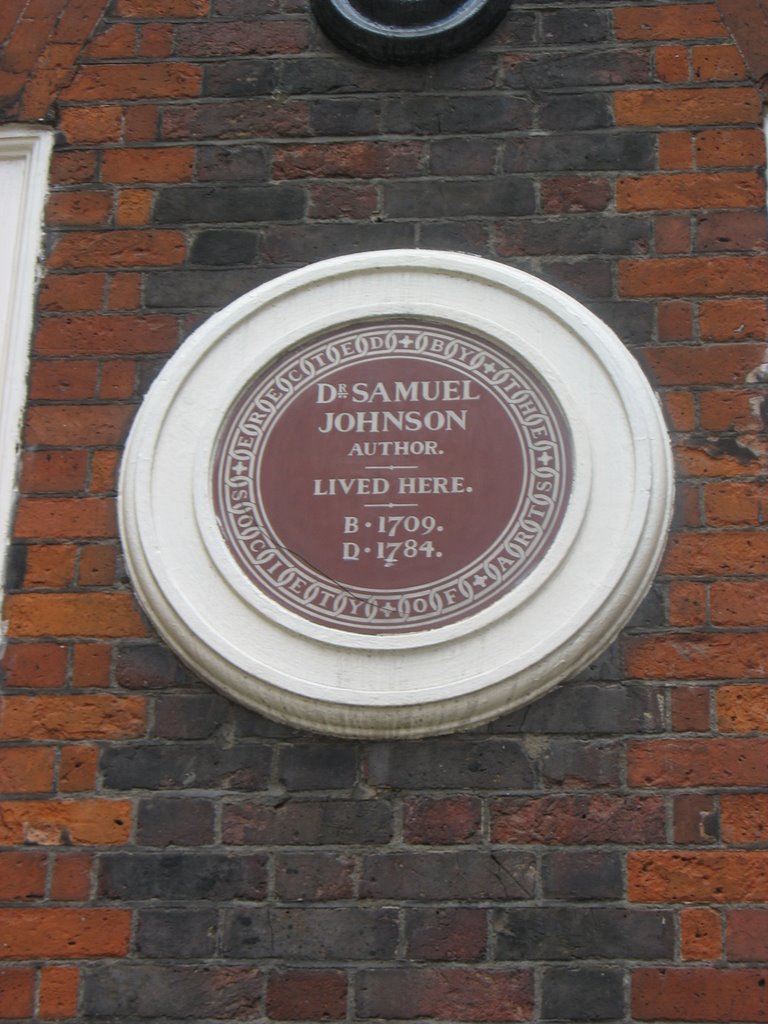
Sometimes, when the traffic, the parking, the grime, the ill tempers and the expense make me tired of London, I think of Samuel Johnson and his famous quote, “A man who is tired of London is tired of life”. Since Johnson was right about so many things, then he must be right about life and London and since, I assure myself, I am not tired of life, I should not be tired of London.

Last week, walking along Fleet Street where the traffic, noise and grime are singularly impressive, I saw a small sign pointing towards Samuel Johnson’s house. Curious and having time to spare, I ventured into the intimate passageways just north of Fleet Street that quickly take you back in time into the heart of historic London. Following the signs, I arrived at No. 17 Gough Square, and thought, “what the heck, I don’t know much about Johnson except the headlines and the house looks interesting.”

In fact, the building represents one of the few remaining residential houses of its age in the City of London. It was in this handsome house on the north side of an elegant small square that Dr Johnson lived from 1748 to 1759, to be near his publisher and it was in the attic of the house that he, along with six clerks, worked on his monumental Dictionary of the English Language.

Inside, the house has been impressively and simply restored using panelling and paint colours of the period. The furniture, prints and portraits provide plenty of human interest in the life of Johnson who rose from simple beginnings to become one of the towering masters of the English language. Only Shakespeare and the Bible are quoted more often. Included in the artefacts is a beautiful porcelain service belonging to Johnson’s friend, Joshua Reynolds, and an intriguing piece of Dickensian London can be found in the massive chain and bar over the front door, made by lady chain makers, to stop tiny children from being lowered through the small top window to open the door and rob the house. And we think we have a crime problem!

Upstairs, you can watch a video on Johnson’s life and times (note to the museum’s curator, as soon as funds are available, you need a new TV) and children have the opportunity to try on beautifully made Georgian costumes. I have seen plenty of costumes for children in museums and these were by far the nicest. There are also copies of the Dictionaries and other collections of books.

Back outside again, I stopped to admire the modern statue of Johnson’s cat, Hodge, who is sitting on a dictionary with oysters at his feet. We know about Hodge from the writings of Johnson’s biographer, Boswell, who, not being a cat lover, was shocked at the extent to which Johnson would indulge his pampered pet, even going so far as to go shopping himself for the cat’s favourite oysters.

On the way home, I reflected on how much I enjoyed this unexpected visit to Samuel Johnson’s House. The next time I am feeling a little weary from living in London, I will think not only about Samuel Johnson’s quote but also about his wonderful museum where you can happily spend an hour or so learning about the life and times of a remarkable man who never tired of London.

Dr. Johnson’s House
14 Gough Square
London EC4A 3DE
Tel: 0207 353 3745
Email: curator@drjohnsonshouse.org
Tube: Temple, Blackfiars, Chancery Lane, Holborn

Opening times: Monday to Saturday from 11am – 5:30, May to September and 11am – 5pm, October to April. Closed Bank Holidays

Admission
Adults £4.50
Children £1.50
Family £10.00

Monday, October 10, 2005

A Fun Day Out with Jane Austen


We planned to take out daughter to the Hans Christian Anderson exhibit at the British Library, but we were too late. It had closed the week before. Foiled in my original attempt to improve Eloise’s mind through literature (after all, she was named after literary heroine), I suggested that we drive out to Hampshire to visit Jane Austen’s house. Groans all around. “Who is that stupid Jane Austen and why do we have to visit her boring old house?” And from my husband came the lament that it was quite a long drive just to commune with some “namby pamby”woman’s writer. Still, I had just seen the latest feature film version of Pride and Prejudice starring Keira Knightley and there was no putting me off.

Following an inauspicious start but with the promise of a slap-up pub lunch in a pretty English village, we set out for Chawton, home of the Jane Austen House and Museum. We stopped for the promised lunch at The Chequers (tel: 01256 862605), in Well near Odiham. This is an attractive pub featuring a vine covered terrace, cosy rooms with good food, good beer, attentive staff and appreciative locals, most of whom had on riding clothes or were walking dogs.

After lunch and a ten minute drive, we arrived at Jane Austen’s pleasant 17th century house where she lived with her mother and sister from 1809 to 1817. Her years in the house were her most productive and it was there that Austen wrote Mansfield Park, Emma and Persuasion while revising Pride and Prejudice and Sense and Sensibility which she had written some years earlier.

Inside, the house is filled with everyday objects used by Jane and her family including furniture, dishes, jewellery and examples of needlework as well as pictures and correspondence relating to her writing. One of my favourite objects was a letter about Pride and Prejudice, written by a bed stricken Winston Churchill during the war, where he described “how he envied these people their quiet life”.

Even Eloise was struck by the small size and humble nature of Austen’s writing table which measured no more than 2 feet in diameter. “She wrote all those stories on that!” Eloise was also interested in the fact that Jane used the creaking door into the front dining room to alert her to intruders during her writing sessions whereby she would hide her work. This initiated a lively Q&A as to why women in the 18th and 19th century hid their writing and often used boy’s names to get published.

The bookstore within the house also has an extensive collection of Austen’s work including rare editions as well as biographies, literary criticism and works related to the period. Hard core fans will be delighted.

The beautifully tended gardens surrounding the house contain plants, shrubs and herbs that would have been used in gardens during Austen’s day. Also interesting is the little donkey cart which Jane used during her mysterious last illness when she was too weak to walk unattended, which can be found in the old Bakehouse.

Following our visit to the house, we had tea at Cassandra’s Cup Tea Rooms and Bed & Breakfast (Tel 01420-83144) across the road which had excellent cakes and where a double room with bath will set you back £55. We then walked the five minutes to the lovely St Nicholas Church, resting place of Austen’s mother and sister and had a peak up the road at the “Great House”, Chawton House, which had belonged to Austen’s brother and would have been most useful in teaching Austen how it felt to be a poor relation which she so eloquently described in her books.

On the drive home, I asked for my family’s critique of their day out with Jane Austen. As Jane Austen often does, she had worked her magic on husband and daughter. Gone were references to “stupid” and “namby pamby”. Eloise wanted to know more about this lady. That night, we took out the 10 year old, 4 hour long BBC production of Pride and Prejudice and although some was lost on her, Eloise understood the spirit and intelligence of Elizabeth, the haughty attraction of Darcy and the pure romance of the thing. “Will they get together in the end?” she kept asking.

Addendum – Getting to Chawton

To reach Jane Austen’s house without a car is detailed on the website, which from London would involve a train and bus ride and a walk. My suggestion for fans of Austen would be to first visit the interesting and historically significant nearby city of Winchester, particularly the Cathedral where she is buried and then make your way to Chawton. A good place to both eat and sleep in Winchester is the Wykeham Arms.