Showing posts with label London for Young Adults. Show all posts

Thursday, October 15, 2009

Take a Two Minute Trip to the Arctic


Who knew freezing your butt off could be so much fun?

When I heard that National Geographic had opened a store on London’s Regent Street, I thought:
It will be worthy
It will be well done
But exciting retail?
I doubt it.
Well, I was wrong.

Yesterday, on the way to look at kitchen counters at John Lewis (speaking of worthy but boring retail) I stumbled into the Nat Geo emporium and had a blast – literally.

Of all the things to do and see in this huge, glossy, dare I say it, sexy store, it’s hard to beat taking a spin in the testing chamber where you can try out your expedition gear in simulated extreme weather conditions while a thermo camera takes a pictures of your body’s temperatures. Even though I was in street clothes, the friendly member of staff was happy to let me have a go. Oh yes, it was super windy and cold but where else in London can you take a two minute trip to the Arctic?

In addition to the testing chamber, the store is filled with nifty products that would be great to have whether you are venturing down the block or around the globe. I found the shoes, boots, bags and backpacks particularly seductive. As you would expect from Nat Geo, there are inspiring pictures everywhere, a gallery, a space for presentations, a section for children, and a groovy looking café (the only busy place in the store) with world food and music.

It’s hard to imagine that this enormous store filled with relatively esoteric stuff will make lots of money but as an exciting retail destination and as an expression of the brand, it is a runaway success. In the guest book for the store’s current special exhibition on Finland, a young visitor, who obviously had a great time on his visit, put it this way: “I LOVE National Geographic” and that about sums it up.

The National Geographic store can be found at 83 – 87 Regent Street. There is another store in Singapore.

The photo of the testing chamber taken by Philip Meech & Tim Kavanagh is from the store’s website.

Wednesday, March 25, 2009

The Old Lady's in Danger - Again


Wild speculation. Cataclysmic losses. A gullible mob demanding vengeance. Wall Street 2008? Nope, London 1720. Here’s another one. “I cannot repay you.” Bernie Madoff to his investors. Nope, King Charles II addressing his bankers.

I learned all of this yesterday at the wonderful Bank of England Museum in the City of London. I avoided this place for the last decade, thinking that the story of the Bank “from its foundation in 1694 to its role today as the nation’s central bank” couldn’t be very exciting.

Well, I was wrong. First, there was the South Sea bubble mentioned above where everyone lost their shirt, company directors were arrested and the Chancellor of the Exchequer expelled from Parliament. Then there was the mob’s attack on the bank during the riots of 1780, where the bank was protected by a military guard that was only abolished in 1973. And then there’s that business about the raising of a Volunteer Corp from the Banks’ staff to defend the institution against a French invasion, not to mention being bombed during the Blitz and nationalised in 1946. Phew, it starts to put things into perspective. Over the centuries there have been plenty of crashes, financial meltdowns and public hysteria. We’re not the first and we won’t be the last.

In addition to presenting the history of the Bank, the museum provides several excellent interactive exhibits explaining inflation and other aspects of banking and monetary policy. The exhibits do a good job of communicating complex concepts in ways that are easy to understand and the museum is perfect for students and young adults, although I doubt they will jump for joy when you say, “Hey kids, today we’re going to the Museum of the Bank of England.” Take them anyway because this museum is a real winner. It’s topical, it’s not crowded and best of all during these hard times, admission, the brochure and the audio guide are all free.

Bank of England Museum
Entrance in Bartholomew Lane
London EC2R 8AH


Open Monday to Friday
10:00am - 5:00pm
Closed weekends, Public & Bank Holidays

Tel: 020 7601 5545
Email: museum@bankofengland.co.uk
www.bankofengland.co.uk/museum

Image: Political Ravishment, the old Lady's in danger. James Gillray, 1797

Monday, September 29, 2008

The Wellcome Collection


Idle hands are the work of the devil. Ask any parent.

If you find yourself in London this winter, either as a resident or a visitor, a great way to entertain your children without entry fees or crowds is to head for the Wellcome Collection on the Euston Road.

The Wellcome Collection is a museum about the human condition as seen through the prism of medicine, the body and art. Well, that’s how grown-ups see it. Children will see it as a very cool place to look at weird and wonderful stuff such as artificial limbs, fake eyeballs, diagnostic dolls, amputation saws and male anti-masturbation devices.

This treasure trove of artefacts once belonged to Henry Wellcome, a boy from America’s Wild West who ended his days as a great philanthropist and knight of the British Empire. The museum also brings medicine forward since the time of Henry Wellcome’s death in 1936, with galleries that focus on current issues such as genomes, new ways at looking at our bodies and modern maladies such as obesity.

There are frequent special exhibitions, and a free Young Explorers Pack which helps children engage in the experience. The Wellcome Library, including 2.5 million books, manuscripts, archives, films and pictures on the history of medicine, serves as a great reminder to our kids that there is more to human understanding than can be found by a quick search on Google.

From a NoCrowds perspective, this place is a real winner. Particularly on the weekends, when the Science and Natural History Museums in South Kensington are heaving and unbearably crowded, the Wellcome Collection, by contrast, offers a superb experience for families where you have the peace and space to enjoy it. It’s easy to get there, being just around the corner from the Euston Station, and there is a pleasant café if your brood becomes peckish as well as a gift shop for the ubiquitous, “If you behave, I’ll get you a nice treat at the gift shop.”

Wellcome Collection
183 Euston Raod
Tel: 0207 611 2222
Email: info@wellcomecollection.org
http://www.wellcomecolletion.org/

Galleries open Tuesday through Saturday from 10:00. Sunday at 11:00. Library closed on Sunday.

Photo courtesy of the Wellcome Collection webite.

Tuesday, February 05, 2008

London's Soho Rediscovered


Everything we love and hate about London can be found in Soho. Vibrant, edgy and authentic on the one hand, crowded, filthy and menacing on the other. We suspect it was always thus. When we were students in London decades ago, Soho was a really naughty place to go. Maybe we’re just “past it” now, but Soho’s Saturday night raves are not for us anymore. Some might find London’s most famous entertainment district exciting but we can’t help feeling that on a weekend evening it is uncomfortably crowded, filled with drunks and ear shatteringly loud. Because of this, we haven’t spent much time in Soho in recent years.

But recently we ran across a description of an eccentric Soho café, Maison Bertaux and an old fashioned and unusual coffee merchant, Angelucci, that focussed our attention on the fact that Soho still has places to go that are interesting and original. After whinging repeatedly in this forum that homogenized chain stores and restaurants have taken the fun out of many London neighbourhoods, we thought it was time to wander around Soho for a day and see how much fun we could find.

The first thing we noticed, thanks to London’s Blue Plaque system for commemorating famous residences, was how many free thinkers of the past, such as Casanova, Karl Marx, William Blake and Isaac Newton all chose to live inSoho. Today, the streets may be full of advertising and media office workers, tourists and free spirit wannabees but the old bohemian and tolerant atmosphere still exists and despite rising rents and creeping gentrification, Soho still feels naughty.

And what about the purveyors of vice? Still very much in business we can report but the thing which differentiates Soho from other red light districts is that there is a much nicer mix of sex and residents. There’s something about watching a woman touting for business standing next to the Soho Parish School which puts the whole sex industry into a different perspective. It is as if to say, “It exists. So what. And why do you care?”

Having wandered around Soho for a couple of hours, we finally made out way to Greek Street and Maison Bertraux which has been a centre for the French community for over 130 years and today is a café and patisserie that is the most perfect antidote to Starbucks. From the mismatched tables, the home made pastries, the French music and the very French proprietor, we were in heaven. There were all kinds of kooky people whiling away the afternoon and we sat for the longest time, revelling in the fact that such a place still exits.

Afterwards, we headed around the corner to Angelucci’s to buy some coffee. This shop has been run by the same Italian family since 1929 and has sold coffee to everyone from Charles de Gaulle to Dire Straits fans, as the shop was mentioned in the band’s first album. If the survival of Maison Bertraux is a miracle, we would liken the existence of Angelucci’s to the second coming. The shop is really a hole in the wall, the cash register is so old we couldn’t begin to date it. The grinders are out of a museum and the wonderful lady who served us has worked there for 26 years and her twin sister before that. Of course, we bought Angelucci’s special and secret blend, Mokital and of course we paid cash because they don’t take cards. If you want to try the Mokital before you buy, head next door to Bar Italia, the most famous place in London to have a late night espresso and the best place in town to watch an Italian football match. Had we not been late to pick up a child, we would have stopped at Bar Italia too.

Making our way towards home, we made a mad dash into Camisa, a small but perfect Italian grocer of the old school on Old Compton Street. As always, there was a line of loyal locals queuing up to buy the classic ingredients of the Italian kitchen. We have shopped here for years and like the locals, we know that this is where you go for the best quality ingredients at the best possible prices.

Heading home, with the pungent aroma of coffee filling the entire bus, we thought about what a great day it had been. In the future, any time we need a vacation from our middle class life, we’re heading back to Soho. Sometimes, as Dorothy found out in the Wizard of Oz, the stuff you are looking for is right in your own back yard.

Maison Bertaux
28 Greek Street
020 7437 6007
Open Monday – Saturday 9 to 8pm, Sunday 9 – 7 pm

Angelucci
23b Frith Street
020 7437 5889
Open Monday – Saturday 9 to 5pm except Thursday when the shop closes at 1pm

I Camisa & Son
61 Old Compton Street
020 7437 7610
Open Monday – Saturday 9 to 6pm

Bar Italia
22 Frith Street
Tel: 020 7437 4520
Open 24 hours

Tuesday, January 29, 2008

Wimbledon: The Back Story


Every year in late June, millions of tennis fans from around the world settle down to watch the Wimbledon championships on TV. Much of the commentary is devoted to the special traditions and atmosphere of the tournament. A few thousand fortunate individuals get to experience the event from inside the All England Tennis Club. For anyone who has the patience and endurance to wait in line all night, tickets can even be purchased on the day.

While anyone who manages to get into the championships raves about the experience, unless you are a former champion, a captain of industry or a member of the royal family, access to the club during the tournament is a hassle. But anyone who loves tennis can participate in the Wimbledon experience and still avoid the hassles and the crowds by visiting the Wimbledon Lawn Tennis Museum located in the leafy London suburb of the same name and take a “Behind the Scenes” tour of the grounds.

For years, NoCrowds couldn’t be bothered to do this. It wasn’t on our usual beat, we weren’t that interested in tennis and at £14.50 to see the museum and take the tour, it was pretty expensive. What got us motivated was the arrival from Shanghai of the complete set of Chinese “terracotta” tennis warriors, featuring the world’s top eight tennis players which would be on display at Wimbledon until March 2008. The press coverage had been intriguing and the whole idea sounded weird enough to be interesting.

As it turned out, while the terracotta tennis warriors were fun to see, we were taken completely by surprise at how much we enjoyed the museum and tour. In particular, we loved the innovative ways the museum went about presenting the personalities of the game. We were fascinated by the story of the French player, Suzanne Lenglen, (1899 – 1938), winner of 37 Grand Slam titles who shocked the staid British fans by wearing daring outfits and casually sipping brandy between sets. We found the “hologram” of John McEnroe talking about the great players of his era hugely entertaining, and we loved looking at the display of the Williams sisters outfits which continue to titillate British audiences. Towards the end of our visit, we had the good fortune to run into Manny, as charming a museum guard as you will ever meet and a bit of a tennis savant, who played clip after clip of the great moments in Wimbledon history for us. We got to watch the best matches of his favourite players (Agassi) and our favourites (McEnroe, Borg and Connors). Our hot tip for anyone thinking of visiting the Wimbledon Lawn Tennis Museum, ask if Manny is working that day and go and find him.

After about an hour in the museum, we joined a small guided tour of the grounds led by a Blue Badge guide who really knew her stuff. We were concerned when she mentioned that the tour would take 1 ½ hours, thinking we just weren’t that interested, but once again, we were surprised at how the story of the club and the game held our attention.. Highlights of the tour include the BBC television studio (the views of London from the top of the building are amazing), the Press Interview Room and lots of areas in the Millennium Building normally closed to the public. As the 1 ½ hours flew by, we thought about how much more fun it would be to watch Wimbledon this year with the whole back story of the tournament in our heads. We also thought about how convenient and pleasant it was to get closer to the Wimbledon experience without getting closer to the crowds.

Wimbledon Lawn Tennis Museum
Museum Building
The All England Lawn Tennis & Croquet Club
Church Road, Wimbledon
London
Tel: 0208 946 6131
Fax: 0208 947 8752
Email: museum@AELTC.com

Open daily 10:30 am – 5:00 pm (except during the tournament)
During the winter, there is one tour per day except at weekends when there are two. Visitors should reserve a space on the tour by internet or phone.

We were also surprised at how easy it was to get to Wimbledon. There are lots of ways to do it (to see them click here). We chose to take the District tube line to Southfields station and walk for 15 minutes.

The cost for an adult is £8.50 for the museum and £14.50 for the museum and tour.

Friday, January 11, 2008

London's Imperial War Museum


Yesterday began in a bad way with filthy weather, domestic disasters and a general sense that we were in a rut and everyone else wasn’t. At times like this, NoCrowds’ favourite trick is to bunk off and be a tourist for a day. Even if we only have a lunch hour to spare, going to see anything that takes us outside our own problems can often help save the day.

But we were feeling way too sorry for ourselves to be consoled by mere art and architecture, no matter how inspiring. And then it came to us that the perfect way to bask in our misery was to visit the one museum in London for which we have no affection – the Imperial War Museum in Lambeth.

When our sons were small, they loved going there. As you can imagine, the little action men loved the big guns, big planes and big armoured vehicles, oblivious to the fact that the museum’s brief was to cover all aspects of modern conflict with equal time for friend, foe, combatant and civilian.

What we took away from those visits so many years ago was that this was a very dangerous museum, dangerous in the sense that it was so even handed and so well done, that at some level, war seemed an inevitable part of the human condition. We didn’t like that idea then and we don’t like it now so charging over to Lambeth like a ‘just give peace a chance’ reincarnation of John Lennon seemed a cathartic and reasonable thing to do.

Now the first thing to know about the Imperial War Museum is that it is housed in a grand building, formerly the Bethlem Royal Hospital which, for centuries, was the major lunatic asylum for London, more commonly known as “Bedlam”. Well, how appropriate is that, we thought as we read the background material on the way to the site. The fact that enormous guns from the HMS Ramillies and HMS Resolution guard the entrance and that lots of men were milling around the guns enthusiastically taking pictures only seemed to wind this old peacenik up even more.

Once inside, we bypassed the Large Exhibits Hall containing the most important weapons and vehicles in the collection (and most of the boys and men) heading straight for the “My Boy Jack” exhibition (until February 24) which chronicles the relationship between Rudyard Kipling and his only son who died in the Battle of Loos in 1915. What makes the story so poignant is that Kipling’s son, who was practically blind, would never have been allowed to fight were it not for his world famous father who marshalled all his influence to gain his son a commission. The exhibit contains original documents and material used to make the television drama by the same name which starred Daniel Radcliffe of Harry Potter fame. Both the film and the exhibition are extremely moving and to be recommended.

From there we tackled the First and Second World War Galleries which are extensive and, we hate to say it, superbly done which include a walk through recreation of a WWI trench complete with “special sound, lighting and smell effects”. We had to battle our way through “The Children’s War”, which tells the story of WWII through the eyes of Britain’s children which was packed to the gills with modern day British school children who, surprisingly, seemed quite interested in these remote childhoods of air raids, evacuations and ration cards. At this point, we began to suspect that we were going to have to write something more than just “this is a place with big toys for big boys” review. Nevertheless, there was tons more to see before we passed judgement.

On the second floor, we spent a long time in the Art Galleries which contain a good collection of modern British paintings exploring the theme of war. In the same room as John Singer Sargent’s famous painting “Gassed” there is a new work by the artist, Steve McQueen, “Queen and Country” commemorating the British service men and women who have lost their lives in the Iraq conflict. Sadly, this exhibit is a work in progress and will continue until British forces leave Iraq.

On the same floor, there currently is a fascinating temporary exhibit (until March 30th) entitled “Weapons of Mass Communications” which uses posters to explore the relationship between advertising, publicity and government propaganda. Unlike the rest of the museum this exhibit was populated by hip media types, some with quite amazing hair, who seemed to be looking for new ideas.

On the fourth and fifth floor of the Imperial War Museum visitors will find two exhibitions on the Holocaust and Crimes against Humanity. As you can imagine, these exhibits are difficult to visit and even more difficult to adequately describe. In any case, we advise that you leave them for last. We found them informative and very, very sobering. Many of the visitors left comments in the guestbook that they had found this Holocaust Exhibition to be more powerful than either of the museums dedicated to the subject in Washington and Berlin. We also thought that the specially commissioned film on genocide and ethnic violence in Armenia, Nazi occupied Europe, Cambodia, East Timor, Rwanda and elsewhere should be compulsory viewing for anyone trying to gain a better understanding of conflict in the 21st century.

Following these two exhibitions, we decided it was time to call it a day. Once again, we went away convinced that this museum does too good a job of articulating what to us is so inexplicable. Despite all mankind has learned and despite all human achievement, in the words of Helmuth von Moltke “War is also part of God’s creation.”

The Imperial War Museum London
Lambeth Road
London SE1
Tel: 0207 416 5320
mail@iwm.org.uk

Open daily from 10 to 6
Free admission

Tuesday, November 13, 2007

Mummies, Dodos and a Dead Philosopher


How would you like a peek at the world’s oldest gynaecological papyrus? What about a long extinct dodo? Care to commune with a dead philosopher? All this and more is waiting for the intrepid visitor to the collections of University College London with a free afternoon and a sense of adventure.

University College London (UCL) was founded 180 years ago to provide higher education to anyone not served by Oxford and Cambridge, which in those days meant anyone who was not male, prosperous and a member of the Church of England. Over the years, the UCL has amassed more than half a million artefacts and specimens. Much of this material is available to the public and all the collections are free of charge. NoCrowds spent an afternoon at UCL recently and now ranks the collections as one of the top undervalued attractions for visitors to London.

The first stop on our self-guided tour was the Petrie Museum of Egyptian Archaeology. After navigating a building site, signing-in with security and dodging a student here and there, we made our way up a flight of stairs and through a study area to emerge into a gloomy room filled with crowded cabinets. It took a while for our modern sensibilities to click into this old fashioned way of displaying antiquities, not to mention the run-down state of the facilities, but half way around the first room we were hooked.

What makes the Petrie so interesting is the way the “stuff” of daily life in the Nile Valley sit alongside some of the greatest finds of Egyptian archaeology. Funny drawing on small chips of limestone, think of scratch paper, can be found near a fragment of Egypt’s oldest calendar. The museum includes both the world’s oldest dress and the world’s largest collection of Roman period mummy portraits. Despite the fact that only a portion of the 80,000 objects are on display and that the facilities are atmospheric but decidedly shabby, we were nevertheless able to imagine daily life in Egypt in a new and exciting way.

While the quality of the Petrie collection compares favourably with the Cairo and British Museums, unlike those immensely popular institutions, the Petrie was completely empty for the duration of our hour-long visit. Plans are underway to move the collection to purpose built galleries in a new University building which will do much to improve the Petrie’s profile and accessibility so if you want to see mummies without kiddies, get over to the Petrie sooner as opposed to later.

After the Petrie, we backtracked through the building site, around the corner and into the Grant Museum of Zoology. It’s the kind of place that if you hate asking people for directions, you’ll probably never find it. Go on and ask because you really don’t want to miss this Victorian time capsule. Crammed into a space not much bigger than your kitchen, the Grant is a crazy, Noah’s Ark collection of pickled, preserved and mounted creatures. Weird looking lungfish that can breathe air, a huge elephant’s heart, rare dodo bones and approximately 55,000 specimens all vie for your attention.

The last remaining zoological museum in London, over the years the place has been flooded, bombed and threatened with closure but on the day of our visit, a class of art students were intently working on drawing specimens and it added to the experience that the museum was still being used for research and teaching. In fact, we were the only tourists there which meant the volunteer guide was delighted to explain everything to us in colourful detail.

Saving the best for last, after the Grant Museum we headed for UCL’s main building where the weird and wonderfully preserved body of Jeremy Bentham sits in a cabinet prominently displayed in the main hall. The philosopher, Jeremy Bentham, one of UCL’s spiritual founders best known as the father of utilitarianism, had stipulated in his will that his body be preserved for posterity. In 1852, the glass fronted cabinet with Bentham’s “auto-icon” (his terminology) was donated to UCL.

Many stories surround what UCL describes as its “most famous possession”. One story goes that Bentham is regularly wheeled in to attend meetings of the College Council and that his attendance is always recorded as “present but not voting”. Another version of the story claims that Bentham does vote in cases where the Council vote is split, in which case, Bentham invariably votes for the motion. Another legend states that King’s College London stole the head and used it as a football. The truth of the matter is that Kings did steal the head but returned it after a ransom of £10 had been paid to the charity, Shelter. After the incident, the head was moved to the college’s vault. Are these stories true? We hope so. In any event, we now are of the opinion that no university worth attending should be without a dead spiritual founder in the front hall. In a word, awesome!

For London visitors with big appetites for the unusual and undiscovered, the collections of University College London deliver on so many levels. They’re fun, free, atmospheric, uncrowded and perfect for anyone of any age. Get there quick before the rest of the world figures it out.

Useful Addresses

Petrie Museum of Egyptian Archaeology
UCL Malet Place
London, WC1e 6BT
Tues-Fri 1-5pm & Sat 10-1pm
Tel: 020 7679 2884
Fax: 020 7679 2886
Email: petrie.museum@ucl.ac.uk
http://www.petrie.ucl.ac.uk/

Grant Museum of Zoology and Comparative Anatomy
Darwin Building, ground floor
UCL Gower Street
London WC1E 6BT
Mon-Fri 1-5pm
Tel: 020 7679 2647
Fax: 020 7679 7096
Zoology.museum@ucl.ac.uk
www.ucl.ac.uk/museums/zoology

Jeremy Bentham’s Auto-Icon
UCL South Cloisters
Mon-Fri 7:30-6pm
Photo of Jeremy Bentham's Auto-Icon courtesy of the UCL Bentham Project website.

Friday, October 20, 2006

The Happy Buddha off the King's Road


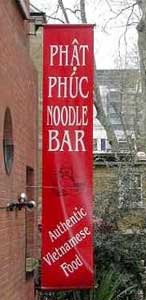
What’s fast, delicious, fun, cheap, perfect for children and will get you in all kinds of trouble if you say the name out loud. Phat phuc – which in Vietnamese stands for Happy Buddha.

Phat Phuc is an authentic noodle bar which can be found in an open air courtyard just off the Kings Road in Chelsea where seven days a week, the genial proprietor serves delicious rice noodle soups and a generous dose of philosophy from a decorative noodle cart brought over from Ho Chi Minh City. And you've got to love the fact that this is a cart with its own website!

You can sit outside either around the cart or at the few small tables nearby. If you like your food with conversation, sit at the noodle bar. Powerful heaters are fired up when things get cold but eating outside is all part of the novelty.

The menu is pretty much soup made with “pho” a clear broth with a choice of vegetables, beef or chicken, but the price is extremely reasonable ( about £6) , the bowls are large and the quality and freshness of the ingredients is excellent. Springs rolls are on offer for £2.20. As the lady sitting next to me yesterday remarked, “I live here. This is so much better than a sandwich.”

Phat Phuc is a real gem that drives a bulldozer through the conformity and pretentiousness of its surroundings. Students, ladies in Hermes scarves, shopkeepers and shoppers all communing over steaming bowls of healthy fare. Brings the kids but not lots of cash and enjoy the show.

Location - opposite Heals and next to the Chelsea Farmer's Market at 151 Sydney Street down the steps by the flower stall.

Tel: 07870 393863 or info@phatphucnoodlebar.com

Open daily from 12:00 to 5:00

Monday, July 03, 2006

19 Princelet - Where Georgian and Immigrant London Collide

Posted by Picasa


Take a guess what was the most popular search term in today’s electronic version of the New York Times – immigration. When I put “immigration” into Google, 521,000,000 responses came back. The entry and settlement of people in a country of which they are not native gets people excited for all kinds of reasons. But it was not an interest in immigration which made me rush to 19 Princelet Street in Spitalfields for one of the rare days in the year when London’s Museum of Immigration is open to the public. No, I went looking for more of the Spitalfields’ “picturesque” which had so captured my imagination at Denis Severs House, and where one can so easily imagine the past.

Once again, Spitalfields delivered the goods and of all the strange places I have visited in my quest for uncrowded and authentic experiences, 19 Princelet Street is the strangest. Haunted, heavy with romance, tragic, this unrestored house, built in 1719, and now in a dire state of disrepair, was once the proud home of French Huguenot master silk weavers. Over the centuries, successive waves of London’s East End immigrants have left their mark on the building which the Spitalfields Centre Charity is fighting to keep out of the hands of developers and retain as a permanent resource to tell the story of the Huguenots, Irish, Jews, Bangladeshi, Somalis and others who have sought refuge in the neighbourhood.

Through the writing of Rachel Lichtenstein and Iain Sinclair, the house also achieved fame as the setting for the mysterious story of its last resident, David Rodinsky, who lived above the synagogue and sometime in the 1960s disappeared. Rodinsky’s room remained locked and undisturbed for over 20 years with the chaotic contents, newspapers, a fossilised cup of tea, porridge on the stove, a head imprint in the pillow, covered in dust and frozen in time.

As my friend Laura and I arrived at 19 Princelet, we were asked to wait outside for a while, because the house is in such bad shape that only a small number of people can be in the building at any one time. Finally, it was our turn to enter the dust filled, gloomy hallway, sign the guestbook and head for the synagogue which had been brought from Poland in 1869 and reconstructed, out of sight, in the back garden.

The synagogue, abandoned in 1963 as Jewish residents began to move to other neighbourhoods, has left behind a treasure trove of amazing stories. Along the wooden walls of the second floor ladies gallery, printed in gold lettering, one finds the honour roll of former donors. From overhead, the light which manages to penetrate the gloom of the filthy glass roof would thrill a Hollywood set director. The excavated basement once served as the meeting place of the Friendly Society set up by Ashkenazi Jews to assist victims of the pogroms of the 18th century. In the garret above, once a place for silk weavers, lived the sad and mysterious David Rodinsky.
As we entered the synagogue, I grew increasingly interested in the conversation taking place between a group of young black and Asian women, many in head scarves, who were being shown around by one of the museum guides who was explaining the persecution suffered by the Huguenots and their need to find refuge outside of France. “But weren’t they all Christians, said one of the girls. “Yes, replied the guide who went on to outline the long conflict between French Roman Catholics and Protestants. “But they were all white?” The group of girls shock their heads in disbelief.

Before my visit, I was not convinced that London needed a Museum of Immigration but with that group of perplexed girls in mind, I now think it’s a good idea. Whether the huge amount of money can ever be raised to realise this ambition appears questionable. I hate to say this, but if I had to bet, I’d put my money on the developers. I hope I am wrong. With my sad prognosis looming, I urge you to jump at the chance to see this house. There are three days left this year when the building is open to the public:

Sunday 3 September 12 - 5pmfor European Day of Jewish Culture and Heritage

Saturday 16 September 12 - 5 pm
Sunday 17 September 12 - 5 pm
for London Open House weekend (prepare for crowds)

The website gives detailed information about how to arrange a group visit. The organisers ask for at least four weeks notice and a minimum donation of £100 pounds which seems fair to me when you consider that a family ticket for such tourist trash as Madame Tussauds can set you back £74. I can only put forward the idea that any effort and expense you make to see 19 Princelet will be rewarded with a completely unique and memorable experience. If you manage to read Rodinsky’s Room before your visit, the experience will be even more informed by the stories of the lost world of the Jewish East End. In any event, try to go.

19 Princelet Street
London E1 6QH
020 7247 5352
Email: information@19princeletstreet.org.uk