Showing posts with label Italy for Children. Show all posts

Saturday, October 24, 2009

Why is Lucca so Lucky?


Driving through the imposing medieval walls into the small Tuscan city of Lucca, we asked ourselves three questions:

Why does everyone look so happy?
Why is everyone on a bike?
Where is all the tourist hoopla?

Over the course of our three-day break, we found answers to all our questions.

First, everyone looks happy because they live and work in one of God’s green acres. According to Forbes magazine, Lucca is the second most idyllic place to live in Europe (after Patmos, Greece) and “has all the charm of Tuscany without the crowds … This is a quiet, though classy town, with lawyers and housewives peddling the narrow cobblestone streets past thousand year old churches and made-in-Italy fashion boutiques.” OK, that explains the contentment but …

Why does everone ride a bike? Because the busses don’t fit through the walled entrance and because most of the perfectly preserved historic centre has been pedestrianized. Locals and visitors alike find it more fun and easier to wiz around on bicycles. Bike rentals are everywhere and prices are reasonable (inquire at the tourist office). A highlight for visitors is to cycle the 4 km circuit around the broad, tree-lined ramparts.

But what about the tourist hulabaloo? As Lucca is a classy town and seems to appeal to a more discerning kind of tourist, the “tour bus, fake handbag and warped post card” options you find all over Florence and Pisa are in short supply. We did find lovely and fairly priced Italian linens in a shop called Butterfly on the Piazza S. Frediano and our daughter was able to find beautiful but affordable Italian paper and notebooks at the tobacconist on Via Santa Croce. Cultural offerings including churches, museums and ‘climbable’ bell towers were equally impressive and uncrowded.

Finally, we were delighted with our hotel and the restaurants. Thanks to the suggestion of Italian friends, we stayed at the mid-priced Hotel Ilaria, which was a great recommendation. This hotel benefits from an excellent location, charming staff, and lots of freebies including parking, WiFi, bicycles and drinks and snacks. Our rooms in the annexe, a former 14th century church, were large, nicely appointed and dead quiet. Rates include a generous buffet breakfast.

The best meal we had was at the Buca di Sant Antonio. This romantic restaurant has been a Mecca for the great and the good since 1782. The food and service were excellent. Also good was the Antica Locanda dell’Angelo where we feasted on budget busting truffles. We had a tasty €10-a-head lunch at Ristorante Gli Orti di via Elisa and the Café di Simo, with its belle époque interior, is a great place to see and be seen.

All in all, our three days in Lucca was hard to fault on any count. This town is indeed lucky, and we’ll be back.

Photo from Rex Maximillian's photo stream on Flickr.


Thursday, January 11, 2007

La Dolce Vita - Family Style

On the surface, Rome does not cater to young visitors. Green space hardly exists*, museums make no concessions for children, restaurants start serving dinner long after most children have gone to bed, and cars and motorbikes play a game of “chicken” with pedestrians that is guaranteed to raise the blood pressure of visiting parents. But this is the surface. Underneath what appears to be an “adults only” city, is a huge and thriving playground for the young and young at heart. We were there last week with two of our four children, aged 9 and 19, and they immediately “got” it. They had a blast and so did we.

In thinking about what made our Roman holiday so appealing to our younger members, I have come to the conclusion that Rome is, for them, one big HBO episode. It’s Western Civilisation for the MTV Generation complete with edgy editing: here Etruscans, there Baroque, look quick, now its Byzantine. Where we see antiquities, they see film sets. When our son, Mac, spent an inordinate amount of time digesting the information in an exhibition on Homer in the Coliseum, I asked him about his interest in the great poet. His reply, “Mom, I saw the movie with Brad Pit”. Ditto for the Coliseum and Russell Crowe.

Regardless of the source, Mac was connecting with audio/visual icons and enjoying it. The same can be said for Eloise who found it hilarious that a wolf would raise a pair of human babies. She also found the human relics in the churches to be quite fascinating as were the cats at Torre Argentina. In between walking around and looking at all the stuff, we had plenty of breaks for pasta-fuelled lunches and gelato (ice cream but taken to a higher level). To summarise, Rome magnificently met the needs of everyone in our party, and we would all go back in a heart beat.

In the hopes that you will bring your family to Rome and have as splendid a time as we did, here are our 10 Key Learnings for Family Fun in the Eternal City.

Stay in the Ancient Centre and Walk Everywhere

If you arrive in Rome via Fiumicino Airport and there are at least 4 of you, take a taxi (€40 fixed if it is a Roman based taxi/€60 fixed if Fiumicino based – it pays to ask for the Roman). Otherwise, the train is a good option.

After that, choose a hotel in the Ancient Centre so that you can walk to almost everything you would want to see. Public transportation is often crowded and sometimes chaotic. (The claim has been made that “neither Freud nor Jung could ever muster the courage to board a Roman bus.” In any event, avoid the #64 which is basically a Pick Pocket Convention.) By contrast, there is no better way to soak up the atmosphere of this remarkable city than by hitting the streets. With frequent stops for coffee, juice and gelato, we heard no complaints from our younger set.

As for hotels, I always freeload off my sister in her “palazzo” near the Pantheon. This neighbourhood is hard to beat as it is an easy walk to the Coliseum, Forum, Capitoline, Pantheon, Piazza Navona and Trevi Fountain. If you don’t have a benevolent Sorellina (baby sister) to bum off of, the Albergo Santa Chiara, around the corner comes highly recommended, is well reviewed by Frommers, Trip Advisor et alia and I am told that rates are “discussable” in the off-season.

Take and buy these books

City Secrets Rome – Tiny but full of delightful, idiosyncratic and useful information such as Danny Meyer’s (of Union Square Café fame) review of the trattoria, La Taverna da Giovanni, where he “learned the simple wonders of the Italian table.”

The Families who Made Rome is both a history and a guide with terrific stories and itineraries. It’s a big book but worth the space in your day pack.

Rome, Past and Present – You can purchase this guide book at any tourist or gift shop for roughly €11. The children will enjoy the fact that for each monument, there are overlays showing how it would have looked in antiquity versus what one is seeing today. Some editions come with a CD which cuts back and forth between now and then and helps the whole family make sense of the ruins.


Avoid the line at the Coliseum by buying your ticket at the entrance to the Palatine

Perhaps the smartest thing we did the whole week was to buy a joint ticket for the Coliseum and Palatine at the Palatine Entrance just outside the Forum and to the left of the Arch of Titus. We then sashayed into the Coliseum and past the monstrous line which snaked around the building. My movie mad children thought the Coliseum was awesome.

The Palatine was less of a hit as both the Farnese Gardens and House of Augustus were closed for renovations but we enjoyed the view and didn’t stay long.

See lots of churches – They’re quick, free and each one tells a story

We saw tons of churches during our Roman holiday without a single grumble. Why? Because Roman churches are the perfect pastime for folks with a video game attention spans. We could get in without a wait, did not have to justify an entrance fee by spending lots of time, and saw some pretty spectacular things, such as Caravaggio’s Saint Matthew cycle in the French Church, San Luigi dei Francesi, the frescos and faux dome of San’Ignacio (almost as good as the Sistine Chapel, with an American Indian in full headdress) and the 300 year old, perfectly preserved body of Saint Giuseppe Maria Tomasi ( the same noble Sicilian family as the author of The Leopard) in the Basilica of Andrea della Valle, the setting for the first scene in Tosca.

If you only do one museum with children, make it the Capitoline, the first museum of the modern world.

Back in 1471, in the hope of reviving the antique splendour of the city, Pope Sixtus IV donated a collection of bronze statues, including the famous statue of the She-Wolf suckling Romulus and Remus, which became the basis of what, is today, a superb collection of antiquities. The new galleries which opened last year are a wonderful addition and best of all, relative to the strength of the collection, this museum is way under-utilised.

Go to the Vatican and go as far into the Piazza as your crowd tolerance allows – even seeing St Peters from just the exterior is enough to grasp the scale and monumentality

The day we were there it was Epiphany and hence a total madhouse and we got no further than the life size crèche in front of St Peters, but we did get to see a great parade with emperors, gladiators, boy scouts and some characters straight out of the Life of Brian, and that was enough.

Eat in traditional Roman trattorias

There’s no real reason to blow the budget on formal dining. Roman trattorias are fun, informal and inexpensive. Here are some of our favourites:

Da Armando al Pantheon – try the stracetti con ruchetta

Matricianella – very popular so book ahead

Da Giggetto – traditional Roman/Jewish food

Osteria ar Galletto – also known as Da Giovanni’s – in a lovely corner of the Piazza Farnese (vicolo del Gallo, 1: Tel - 06.686.1714)

Renato & Luisa – our favourite, robust flavours and a warm atmosphere (Via dei Barbieri, 25: Tel – 06.68.69.660

Due Colonne –relaxed, a bit touristy, but very moderately priced and friendly service (via del Seminario, 122: Tel – 06.67.81.449


Visit www.mypantheon.com

No matter what the weather or time of year, there is no grander social space in Rome than the Pantheon. As recommended by City Secrets, “Come here first, before you go anywhere else … so the visitor can experience the ancient city as its builders did. After this you can imagine the Roman Forum and Imperial Fora not as a series of ruins but brimming with life.” It is at this point that your children will begin to see that http://www.myspace.com/ is really a cyberspace iteration of the social spaces first conceived and built in Ancient Rome.

See the Trevi Fountain at night, the later the better

The Trevi Fountain during the day is a sad state of affairs – wall to wall bodies punctuated by aggressive buskers and souvenir sellers. The crush of tourists in the small piazza completely spoils the experience but if you wait until after dinner when the tour groups have long departed, the difference is astounding. The later it gets, the better the experience and the illumination is pretty terrific as well.

On the way back, it's fun to have a gelato from Giolitti (via degli Uffici del Vicario), one of the best known gelateria’s in town. As they advise in City Secrets, “Just follow the ice cream cones”.

“This is Rome, You Can Do What You Want”

The best piece of advice we received during our visit came from our friend and native Roman, Stefano, who, when we admonished Eloise for something she was doing at the dinner table, responded with considerable charm, “Ah, but this is Rome where you really should let her do what she wants.”

In the end of the day, that is what makes Rome so magical for anyone, young or old. It’s the “attitude” and way of looking at life, and even if you are only visiting, you have bought yourself a wonderful, temporary ticket to La Dolce Vita, so go ahead and enjoy it for as long as it lasts.

* A friend, who considers himself Roman although he informs me that he is not officially considered one, as his family has not been Roman for at least seven generations, has taken issue with my statement about the lack of green space pointing out that:

"Rome does have some green space. Actually quite extensive: Villa Pamphilj, Pincio - Villa Borghese, Villa Ada, Villa Torlonia, The Janiculum Hill. They are all "central". Of course, if we talk about something like the London gardens things are different. However, there are smaller open spaces: Villa Aldobrandini (next to the Trajan Markets, on Via Nazionale) has a hanging charming garden with great views; the Giardini del Quirinale (how central can you get?), the "Circus Maximus" with the Caracalla Baths boulevard and the Villa Celimontana, the Aventine Hill with the lovely Giardino degli Aranci (aka Parco Savello) overlooking the city from South-East."

So there you have it - the real scoop (not the tourist take) on green spaces in Rome from an almost official Roman.


Wednesday, October 19, 2005

Ostia - Harbour City of Ancient Rome


I could write a book, and maybe I will, about dragging children through museums and monuments. More often than not it is a fat bribe that does the trick; the promise of something good to eat and the chance to pick out a nice gift in the shop. And so it was with real excitement that I read Nick Trend’s article in the Daily Telegraph about taking his family to Ostia Antica, the ancient port of Rome. Here I had found the description of a perfect NoCrowds adventure, a huge, totally underutilised archaeological site that had engaged and entertained a family for an entire day. Who could resist.

We ended up inviting Eloise’s godfather to join us for our excursion. In addition to being an avid historian, a fluent Italian speaker and pretty good translator of Latin graffiti, he also owns a car. The 20 mile drive from Rome was easy enough but for anyone without an Italian speaking, driving godfather, there are also good public transportation options such as the metro and even the possibility of travelling by boat. The official site of the Soprantindenza gives the most up-to-date opening times but is only available in Italian. Try http://www.ostia-antica.org/ if your Italian is not up to snuff.

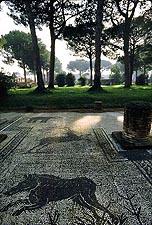
After the noise and incessant activity of Rome, Ostia seemed to us to be a green, romantic haven. In its hey-dey in the 2nd century, this would not have been the case as a thriving population of 100,000 inhabitants went about the business of supplying the city of Rome with goods imported from every corner of the ancient world. Within this city devoted to trade and commerce, with a main street that runs for over a mile, one can still find the remains of apartment buildings, hotels, brothels, bars, baths, communal latrines, workshops, storage buildings, a forum, temples and more.

During our visit, we had this 10,000 acre ancient harbour city virtually to ourselves with only occasional sightings of badly behaved Italian school children. Eloise was impressed by their irreverence. One of our Italian friends who read this posting feels strongly that these children must have been French. In any event, Ostia is a completely relaxed place where children can climb happily over the ruins and no one seems to mind. I’m sure the archaeologist do, but there were none evident during our visit. While extensive, Ostia is smaller than Pompeii and one comes away with a real sense of how a Roman town was laid out and operated. But it was the connection to Caroline Lawrence’s children’s mystery story, The Thieves of Ostia, which made the site come alive for Eloise. The book opens in the Necropolis as did our visit and as we continued to uncover the locations described so accurately by Lawrence in the story, Eloise began to buy in to the idea that not all tourism promoted by her parents is boring.

As a NoCrowds experience, Ostia rates 5 stars and demonstrates that within easy reach of Rome, one can still wander alone through the skeletal remains of an ancient city and have an intellectually absorbing, bucolic and and amusing time. This is what tourism should be all about. Go there.

Ostia Antica
Viale Romagnoli 717
Tel: 06 565 00 22

The ruins of Ostia Antica are open seven days a week, from 9 in the summer and 9:30 in the winter. Admission 5 Euro. Allow at least four hours for your visit.