Monday, June 26, 2006

Kew Gardens

Posted by Picasa

The best place I know to beat the heat in London, especially if you have children in tow, is the Royal Botanic Gardens in Kew. The 300 acre site offers a massive amount of royal and horticultural history, remarkable buildings including a historic palace, the largest collection of plants in the world, manicured gardens and lawns, a play area, and even a herd of sheep and wallabies which have been added to recreate the menageries of Kew’s past.

In many ways, Kew stands as a monument to the British monarchy's love of the great outdoors and it was the royals of the 18th century who took over, expanded and improved what we now think of as Kew Gardens. With the help of architects such as William Chambers and Capability Brown and botanists such as Joseph Banks who sailed with Captain Cook, Princess Augusta and later her son King George III transformed Kew into an exotic horticultural world unto itself.

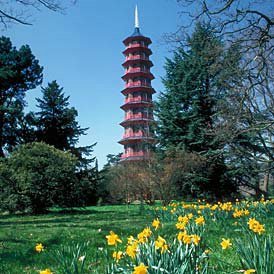
On a hot day recently, we pitched up at Kew with Eloise and were able to visit two monuments which have been closed to the public for years: the 163 foot high Pagoda and Kew Palace, the former home of King George III.

In 1761, William Chambers, inspired by visits to China, constructed the Pagoda as a surprise for Princess Augusta. How you can keep what some scholars consider the tallest secular brick building of its day a secret, I don’t know. My favourite factoid is that during World War II, holes were cut into each floor through which bomb designers would test their designs.

This summer, for the first time in recent memory, you can climb the 253 steps to the top of the structure. Eloise loved this part of our visit, particularly the extensive health and safety admonishments about what to do if you felt faint, felt chest pains, felt dizzy or generally unwell. The view from the top is nice although London is no New York or Paris from a panorama point of view. Still, the climb was a highlight of our visit.

Equally fun was our time in the newly reopened Kew Palace following a ten year restoration. Originally built by a London merchant, the house was used by the royal family between 1728 and 1818. Today, the intimate palace tells the moving story of King George III, his wife and their 15 children which began in domestic happiness and ended in madness (which we now know was illness) confinement and constitutional crisis. The decorations of the house have been restored to what they would have looked like in the early 1800s and include family memorabilia such as a doll house which the King’s daughters decorated themselves (found recently in a New York City antique store) and George III’s harpsichord.

Hauntingly, the top floor rooms have been left untouched for almost two centuries when the upstairs rooms served as a virtual prison for the King’s unmarried daughters. With Kew Palace, one gets to experience a beautifully restored, historic Royal Palace with a great story and without the crowds one finds at Kensington Palace or Hampton Court.

In addition to the Pagoda and Kew Palace, we also loved our visit to Queen Charlotte’s Cottage, a thatched rustic building which the Queen used for picnics and family retreats. The cottage was originally part of a menagerie which included such exotic animals as kangaroos and buffalo. As we walked around this perfect idyll of rural bliss, I also thought about Marie Antoinette playing shepherdess at the Petite Trianon and the craving of royals to pretend they are peasants. Eloise couldn’t be bothered with this but she did think it was an excellent idea to build a whole house just for picnics.

No visit to Kew would be complete without a “whip round” the glass houses which are justifiably famous and quite spectacular. In the Temperate House, you will find the Chilean Wine Palm which is over 16m high and is the world’s largest indoor plant. The Palm House recreates conditions similar to a tropical rainforest and in the Princess of Wales conservatory you can visit 10 different climatic zones. I’m not much of a botanist but I found the sheer scale of Kew’s collections exciting.

There are several restaurants within the Gardens. We had a snack at The Orangery CafĂ© and Restaurant found in a lovely Grade I building with a fine terrace for dining on a nice day. The Orangery also serves afternoon tea. In the Pavilion by the Pagoda, burned down by suffragettes in 1913 and rebuilt in the 1920s, there is a self-service cafeteria which also has a children’s menu.

As I write this post, our little micro heat wave has broken, Wimbledon has started and so, of course, it is pissing down rain. Equally predictable is the fact that when the tennis folks leave town, the sun will come back out and the temperatures will soar. When they do, I’ll head straight back to Kew.

Kew Gardens

Royal Botanic Gardens Kew
Richmond
Surrey
TW9 3AB
England

Information line: +44 (0)870 751 5179

Admission prices to the Royal Botanic Gardens Kew until 31 October 2006
Adult: £11.75
Concessions: £8.75
Children under 17: Free (but must be accompanied by an adult).

Please note: Admission to Queen Charlotte's Cottage is included in this price.
Admission prices to Kew Palace
Adult: £5.00
Concessions: £4.00
Children (5 - 16 accompanied by an adult): £3.00
Children under 5: Free

(NB: admission ticket to the Kew Gardens must be purchased for access to Kew Palace - for gardens admission prices see above)

Transportation

Take the District Line (Richmond Train) to Kew Gardens station or in summer take a Thames River Boat from Westminster Pier. The journey takes approximately 1 ½ hours and costs £10.50 for adults, £5.25 for children one way with family tickets also available.

Monday, June 19, 2006

The Best Things to do in London in the Heat

Posted by Picasa


Occasionally, it gets really hot in London. When it does, there is little relief for the summer visitor. Most of the transportation, accommodation and entertainment options are not air conditioned and certainly not to a level a North American visitor would expect. If you find yourself in London on one of our few fine days with temperatures soaring, I have several suggestions for places you can visit which will get you out of the concrete and away from the crowds.

My first suggestion is to do what Londoners do and beat the heat by visiting a National Trust country house, but in this case, instead of renting a car or hiring a driver, take the Underground to Osterley Park, set smack in the middle of west London. From the Underground Station on the Piccadilly Line, the Park is a half mile walk through suburban sprawl but worth the effort when one enters the park, wandering past grazing horses and cattle to arrive at Osterley House, a magnificent example of an 18th century country villa surrounded by 350 acres of parkland and gardens.

The original house at Osterley was built in Tudor times by Queen Elizabeth’s financial advisor, Sir Thomas Gresham. The crumbling Tudor mansion was acquired by the Child’s banking family in 1713 and as the family’s wealth grew, the most fashionable architect of his day, Robert Adams, was commissioned to turn the place into “the palace of palaces”. Even if you have little interest in country house interiors, you can’t help but be excited by the exuberance and elegance of these rooms. And while everyone else is sweltering back in the city centre, you can wander through this grand house essentially by yourself.

The parklands and gardens which surround the house are massive and lovely and perfect for walking. If you don’t mind hauling a picnic along with you, the grounds offer beautiful places to eat “au plein air” with lots of shade. Leftover bread is perfect for feeding the ducks. Alternatively, there is a National Trust Tea Room in the 16th century stables with outdoor tables. Although you are in the centre of a huge estate, if you have a pair of earphones left over from your airplane goody bag, bring them along because the noise from the thundering M4 Motorway, the Great West Road and the nearby Heathrow Airport belies the otherwise bucolic experience. With that said, without the audio, you would swear you were in the middle of the countryside which is not bad considering you are only a 30 minute subway ride from Piccadilly Circus.

N.B. While the grounds are open daily, access to the house is from March 4 to October 29 and the days vary according to the time of year. From March 4 – March 26, the house is open Saturday and Sunday from 1-4:30 and from March 29 – Oct 29, from Wednesday to Sunday.

Osterley Park & House
Jersey road
Isleworth, Middlesex TW74RB
Tel: 020 8232 5050
01494 755566 (Infoline)
Fax: 020 8232 5080
Osterley@nationaltrust.org.uk
Tube Station: Osterley on the Piccadilly Line


Photo of Osterley State Bedchamber courtesy of National Trust website

Tuesday, June 13, 2006

Sicily - Great in Any Weather

Posted by Picasa
Another school holiday loomed. One of our favourite things to do when all else fails is to freeload off my sister in her fab “La Dolce Vita” apartment in the ancient centre of Rome. “Could you put up with us for a few days”, I asked? “How about you meet us in Sicily for a long weekend” she countered and so the deal was struck.

Given that we only had an elongated weekend; Alexa was recommending the small village of Scopello, an easy 40 minute drive west from Palermo Airport and a short distance from the Zingarao Nature Reserve. The Zingaro , covering 4,000 acres with four miles of what many consider the most spectacular coastline in Sicily also represents one of the most intact ecological environments in the Mediterranean basin.

We were to stay at the Pensione Tranchina in Scopello, recommended by Karen Brown and others, owned and run by a Sicilian/Panamanian couple known for their warm welcome and knowledge of the local area.

A few days before our departure, a devastated Alexa called to say that the weather report for Sicily for the June weekend was uncharacteristically horrendous with rain, wind and low temperatures. One can only be philosophical about these things plus the acid test of a travel destination is whether it can charm visitors in less than charming weather. As it turned out, our weather was indeed lousy but Sicily was magical.

For us, the allure of the island centred on the combination of good beaches, exciting landscapes and coastline, great food and top tier antiquities. From our base in Scopello in the west, which is closer to North Africa than the Italian mainland, we could easily reach the empty beaches in the Zingaro Nature Reserve along well marked hiking trails. Equally accessible were the awe inspiring ancient Hellenic ruins of Selinute and Segesta and the medieval mountain town of Erice.

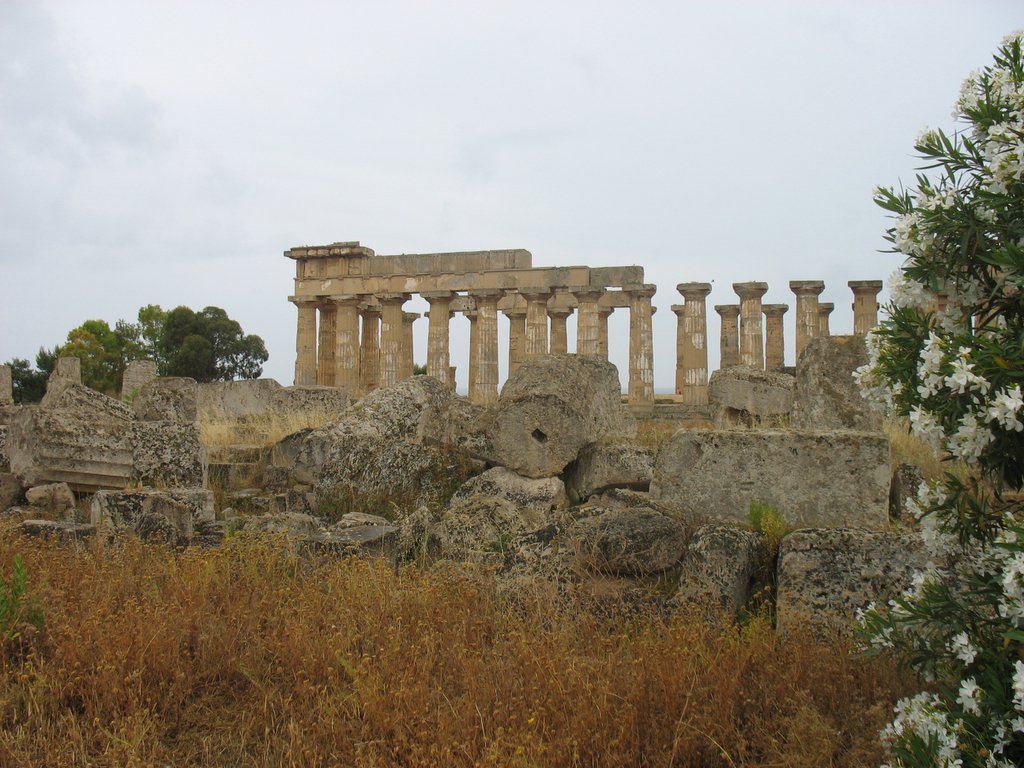
Selinute, the site of the Greek city of Selinus, lies in spectacular isolation on the coast. One has to use a lot of imagination to reconstruct the Greek colony from the collapsed temples and heaps of ancient rubble levelled over the centuries by earthquakes. Nevertheless, even our eight year old daughter was caught up in the romance of the enormous site, recounting for us the exciting tales of ancient gods and goddesses. After a heavy morning of antiquities, we had a good lunch at the Hotel Alceste in the beach resort of Marinella di Selinute, which is a five minute drive from the ruins of Selinus.

On another rainy day, we spent the morning at Segesta, the rival city of Selinus. Again, the ruins are set in dramatic isolation, this time in the middle of the countryside. More intact than Selinus with a superb Doric temple, the beautifully sited theatre proved the highlight for the children, who put on a performance of Shakespeare followed by popular songs for an appreciative audience of tourists.

Also to be recommended is the medieval mountain town of Erice towering 800 meters above sea level. On a good day, it is said that you can see both Mount Etna and Tunisia from the summit. Needless to say, we saw neither, but what we did do was have a jolly lunch at Ulisse ( the Cave of Polyphemus where the Cyclops ate 6 of Ulysses men can be found in Erice) near the main square where my brother-in-law drank the olive oil, much to the consternation of the proprietor. We visited an interesting modern art gallery, bought beautifully made non-touristy ceramics in a small shop, again off the main square and the olive oil drinking brother-in-law claims to have gotten the best old fashioned shave with a hot towel on the way back to the car. Not bad for a grey day.

Despite the uncooperative weather, I found Sicily to be a perfect No Crowds destination. The Sicilians were wonderful hosts, proud of their island and happy to share its rich heritage with an increasing number of visitors. Palermo Airport was modern, quick to get in and out of and surprisingly efficient.

Scopello proved to be an unspoiled medieval hamlet located on an incredibly idyllic stretch of coast, featured in the George Clooney film Ocean’s Twelve. In a perfect case of life imitating art, when the heist movie, Ocean’s Twelve, was filming in Scopello, several members of known Mafia families were arrested for trying to infiltrate the set, a charge which the producer of the film vigorously denies. For the record, we saw absolutely no evidence of anything sinister anywhere in Sicily, but then I’m no Julia Roberts.

Pensione Tranchina was a spotlessly clean and friendly place that offered excellent value, particularly the delicious four course dinners at €19 per person. We also had good meals in Scopello at Torre Benistra which has a beautiful outdoor terrace and Il Baglio in the courtyard.

The area around Scopello, particularly the romantic remains of the old tuna fishery, is delightful and popular with snorkelers and divers. The Zingaro Reserve is a brilliant example of conservation of which the Sicilians should be proud.

Of course our stay was too short and we visited only a fraction of what the island has to offer. But thanks to Alexa’s excellent planning, we were able to enjoy the best of Sicily on a busy holiday weekend with no crowds. We’ll be back and who knows, maybe next time in good weather.

Pensione Tranchina
Via A. Diaz n. 7
91014 Scopello
Tel: 0924541099
Fax: 0924541232
pensionetranchina@interfree.it

Torre Benistra
Via Natale di Roma
Scopello
Tel: 0924 541 128

Ulisse
Via Chiaramonte 45
Erice
Tel: 0923 869 333

Hotel Alceste
Via Alceste 21
Marinella di Selinute
Tel: 0924 46 184

Wednesday, June 07, 2006

A Day in the City of London

The doubleganger and I decided we were due a return visit to our old haunts in the City of London where both of us had worked for many years. Kate was keen to check out the recently refurbished St Paul’s Cathedral and I wanted to make a long over-due visit to the Geffrye Museum of Historical English Interiors. On a day typical of the wettest May London has seen since the 18th century, we met in a downpour on the slippery steps of St Paul’s.

In a recent post covering my favourite freebies in London, I used the opportunity to whinge about both St Paul’s and Westminster Abbey charging hefty entrance fees to visitors. I still think it is a sad state of affairs but the transformation of St Paul’s is so magnificent that I can only encourage everyone to open your wallet, give them the £9 and go.

After spending four years under scaffolding at a cost of £10.8 million, the interior of the St Paul’s has undergone a stunning restoration as part of its 300th anniversary that has left it gleaming and magnificent. During the “mother of all spring cleanings”, over 1,000 cubic feet of dust were removed and 15,500 square meters of stone cleaned. Although I have visited St Paul’s countless times, I found the cleaned-up mosaics, paintings and stonework much more exciting and engaging. To keep children interested and for anyone who would like spectacular views over London (without paying the £13 for the London Eye), be sure to climb to the Golden Gallery in the Dome which rises 285 feet (85.4 meters) above the Cathedral floor.

On the day we were there, staff was setting up an exhibition of photographs taken of Anne Frank’s family by her father before the family was to go into hiding from the Nazis. This exhibition will remain in the Cathedral until June 12 and is included in the admission charge.

From St Paul’s, we decided to walk to Spitalfields for lunch. On the way, Kate introduced me to one of those places in the City which you can walk by hundreds of times and have no idea of the importance. In this case it was a bust of William Shakespeare in a charming small garden off of Love Lane dedicated to John Heminge and Henry Condell, actors and friends of Shakespeare, who collected his plays and arranged for the publication of the first folios in 1623. The memorial presents the case that without the selfless diligence of these two men, the world might never have heard of William Shakespeare.

On top of that, behind the garden is the remains of the Christopher Wren church of St Mary Aldermanbury which was built in the 1670’s, destroyed in the Blitz in 1940 and moved to Westminster College in Fulton, Missouri in the 1960’s where Winston Churchill gave his Iron Curtain speech. I was completely amazed to find important milestones in the lives of Shakespeare and Churchill in one hidden corner of London. But then, that is London.

After a stroll through Spitalfields, we ended up at St John Bread & Wine on Commercial Street opposite the market. This is the “little brother” of St John in Smithfield Market, a shrine to lovers of animal entrails of every description. I had been dying to try this place and Kate was game. The menu is limited and somewhat challenging ( stuff you don’t usually eat and/or stuff you’ve never heard of or don’t want to hear of) but what we had was superb. I had the devilled kidneys on toast and Kate had the best looking bowl of cockles I’ve ever seen. With tip, lunch came to £15 a head.

After lunch and en route to the Geffrye Museum, we had a Carpe Diem moment which I am happy to report, we seized. Walking down Folgate Street to show Kate the outside of Dennis Severs House, I let her know that this was one of my favourite places to visit in London but difficult to see because of the limited opening times. Just then we noticed that the door at Number 18 was open. We had been lucky to stumble on an out-of-hours opening and even luckier to be included in the group making their way around what David Hockney has described as “one of the world’s five greatest experiences”. Like everyone, Kate was blown away and if you find yourself in London on a Monday or the first or third Sunday of the month I can give you no better advice than to drop everything and visit this house. Opening times are explained in more detail on the website. It’s a good idea to call ahead.

After we finished communing with the French Huguenot silk weavers of Spitalfields, we finally made our way to the Geffrye Museum of Domestic Interiors on Kingsland Road in Shoreditch. Turning into the front garden surrounding the beautiful 18th century former almshouses of the Ironmongery Company, one gets a good dose of that “step back in time” feeling which makes London one of the best of all possible cities to be a visitor.

We began our visit in the older buildings working our way around to the new wing, eager to see the special exhibition Domestic Archaeology, an audio-visual investigation of the living room. As we approached the exhibition, the fire alarm sounded.

Now every society has moments in its history which brand the national psyche forever and after living in London for over a decade, I am convinced that the big event as far as this town is concerned remains the Great Fire of 1666 after which 87 churches, 13,200 houses and 436 acres of the city lay in ashes. To this day, Londoners take their fires seriously. Former New Yorkers are less excited and given that we were rapidly chased out of the building, we decided to stroll through the award winning gardens. This gave great displeasure to the stressed-out guard who insisted that we congregate with the rest of the visitors as the fire brigade, straight out of Fahrenheit 451, rushed into the building. At that point, we decided to call it a day and left the Geffrye Museum to its fate. You’ll be happy to know this oasis of calm in the bustling East End of London is still standing.

St Paul’s Cathedral
Ludgate Hill
Tel: 020 7246 8357
Tube: St Paul’s

Open Monday through Saturday from 8:30 to 16:00

St John Bread and Wine, Spitalfields
94-96 Commercial Street
London E1 6LZ
Tel: 020 7251 0848

Dennis Severs House
18 Folgate Street
Spitalfields London E1 6BX
(closest tube station is Liverpool Street)
Tel: 00 7247 4013Fax: 020 7377 5548
info@DennisSeversHouse.co.uk
The house is open every Monday evening (except holidays). Times vary according to the season. £12 Reservations required ALSO the 1st and 3rd Sunday of each month between 2- 5 PM £8 no reservations AND lunchtime between 12 – 2 PM on the Monday following the first and third Sunday. £5 no reservations .

Geffye Museum
136 Kingsland Road
London E28EA
Tel: 020 7739 9893
Tube: Old Street
Open Tuesday - Saturday 10am - 5pm
Sundays & Bank Holiday Mondays 12 - 5pm
Closed Mondays (unless Bank Holiday), Good Friday, Christmas Eve, Christmas Day, Boxing Day, New Year's Day

Tuesday, May 30, 2006

Marks & Spencer


When your husband tells you to go out and buy a new bathing suit, you can be quite sure that the acquisition is long overdue. With this imperative in mind, I decided to it was time to return to that “mother of all British institutions” – Marks and Spencer.

I hadn’t been in a store for ages. Neither had the British public were one to believe the headlines. “Is M&S in Terminal Decline?” has been asked so many times that one didn’t even want to be seen going into the morgue of mass marketing. It was embarrassing to be seen there. The stores looked lousy. The merchandise was boring beyond belief. Even the iconic underwear ( and by association the swimwear) was judged “not worth buying any more”.

But along came an ad campaign with a very beautiful middle-aged Twiggy to change all that. How did a model famous in the 1960s get customers back into Marks and Spencer? It’s a weird dynamic but a powerful one. Twiggy looks so great in the kind of clothes that most middle-aged women need to wear, that you are seduced into getting back into the store and having a look. I needed a swimsuit, I was past the bikinis on offer at Topshop and Zara and anyway, I wanted to look like Twiggy, heroine of my youth.

I chose to visit the M&S on Kensington High Street and not the main store on Oxford Street. First, I hate Oxford Street. It is the kind of street that makes you want to quit consumption all together. It is just too big, too crowded, too voracious and too crude for an enjoyable shopping experience. The same can be said for the Oxford Street Marks & Spencer. The M&S on Ken High Street has just enough stuff to keep me happy but not so much stuff that I am turned off.

The store in Kensington has been spruced up and looks better. Improved lighting insures that the merchandise looks more appealing. I’m still confused about where to find stuff but less so and the ladies underwear, I am happy to report, is back in fine form.

I found my ideal swimsuit quickly. Instead of setting me back £100 which is what an equivalent product would have cost me at Harrods, my lovely white one piece was a reasonable £35. It was made in Portugal from a sturdy fabric that should hold everything in the right place. I loved it and was in the mood to shell out for some beach accessories as well. But alas, the accessories were created with an over tanned Ivana Trump in mind and I gave them a pass. The fact that I tried on my new fab suit in a disorganised dressing room and had to wait a long time to pay for it, demonstrated that some things at Marks haven’t changed.

So would I recommend a return visit to this icon of British retailing. Yes, I certainly would for underwear (including socks and tights), jumpers/sweaters and food. In the underwear department, you can buy anything from good quality inexpensive utilitarian to great looking sexy stuff at modest prices. The food buyers have finally woken up to the fact that the middle classes have an aversion to additives and food miles and the jumpers/sweaters still beat anything on the high street for value and durability. Their washable wool can withstand the onslaught of even a housekeeper from the Philippines (and for those of you who have ever had someone from the Philippines do your laundry you know how miraculous this is). These sweaters make great affordable gifts.

For the rest of the merchandise, I’m still not convinced. The children’ department continues to look like an outpost of Disneyland. M&S take note – Eloise does not want Winnie the Pooh on her knickers. The shoes still can’t compete with the cutting edge cheapo shoe stores such as Office and for my money, the heralded Per Una and Autograph lines can’t hold a candle to what’s on offer at H&M, Zara and Topshop.

But with all that said, it’s nice to see a British institution getting back to the business of being a British institution. It seemed unnatural not to shop there. Too much has changed in this socially managed “paradise” of an island in the last eleven years and I, for one, look forward to the return of orderly queues, a rousing defense of free speech and buying my knickers at M&S.

Photo of Twiggy in M&S outfit from ad campaign taken from company's website

Tuesday, May 23, 2006

The Coach and Horses


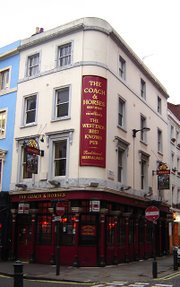
Try as I do to sample all the real London institutions, I must confess to having missed out on the Norman Balon experience at the Coach and Horses, a Soho institution on Greek Street.

For over 60 years, Norman has famously held the title of London’s rudest landlord. Last night, at age 79, he handed over the reins of the Coach and Horses to a new owner. The Coach and Horses has long been a hangout for journalists and Soho personalities. It featured in Jeffrey Bernard’s Lowlife column for the Spectator and was the basis for a play staring Peter O’Toole, “Jeffrey Bernard is Unwell”. Most famously, the pub served as the site of fortnightly Private Eye lunches.

Norman Balon’s memoirs which are currently out of print are entitled “You’re Barred, You Bastards” and some of his more printable sayings which were included in a wonderful article about him in today’s Daily Telegraph include:

Here’s your money. F**** off.

You’re barred. You’re too boring to be in my pub.

I don’t care if you are a man or a woman, you can go now.

Out!Out!Out!

You’re so ugly you’re upsetting the customers.

Can’t you see, you idiot, that I’m on the telephone – to an MP trying to find the Private Eye Lunch.

And don’t come back.

How this venerable institution holds up without Norman Balon remains to be seen but I am very sorry to have missed his time.

Coach and Horses
29 Greek Street
W1
Tel: 020 7437 5920

Photo courtesy of Wikipedia

Friday, May 19, 2006

Favourite London Freebies


London may be the third most expensive city in the world but it can not be faulted for its rich offering of free entertainment. In fact, digging into this topic I am amazed at the almost limitless things to do in this town that are hugely entertaining and easy on the purse.

Let’s start with the museums: the British Museum, the National Gallery, the National Portrait Gallery, the Tate Britain and Modern, the Museum of London, the Victoria and Albert, the Natural History Museum, the Wallace Collection, Sir John Soanes Museum, Kenwood House, and many, many more. I’m not much for Math, but I counted 63 museums in London that don’t charge for entry and I suspect there are more out there. Most of these places also offer free or nominal cost films, tours, concerts, lectures and workshops which make for a whole lot of free activities.

In addition to its free museums, London has some of the loveliest parks you will find in any city in the world filled with no-cost or inexpensive things to see and do. Most of the larger parks, such as Hyde Park, Kensington Gardens, Holland Park, Regents Park, Battersea and Richmond Park have well equipped playgrounds, lakes with boats you can rent, cafes and even historic building and art galleries. Many of the parks offer guided walks, such as the Peter Pan Walk in Kensington Gardens.

For example, yesterday, I had a fine walk through Kensington Gardens en route to the Serpentine Gallery for modern and contemporary art which until May 21 has an admission free exhibition of works by Ellsworth Kelly. The combination of the park in full spring bloom, the elegant small gallery and sparse and thought provoking artwork put a very fine spin on what had started out as a grey and grumpy day. After the Gallery, I walked home via the refurbished Albert Memorial, an amazing example of “high Victorian gothic extravaganza”. All in all, an engrossing couple of hours that cost me nothing.

As well as the great museums, libraries and parks, London has fabulous markets where you can savour the exuberant street life and many fine examples of antiques, clothing, collectibles, food, jewellery and much more. And there is the added benefit that almost everything on offer costs far less than what you find in the boring old chain stores.

London is estimated to have over 100 markets ranging from the famous and crowded Covent Garden (with loads of free entertainers hoping to be discovered) and Camden Market as well as Borough the foodies paradise and Billingsgate for fish, Bermondsey and Portobello for antiques, Columbia Road for plants and flowers, Petticoat Lane for clothes, Brick Lane for “treasures and trash” and Leadenhall for a taste of Victorian times. Napoleon thought he was insulting the English when he described them as a nation of shopkeepers unfit for fighting but I would argue that it is precisely in the markets where you come to appreciate the dynamism and diversity of this society.

London churches are also wonderful places to visit. Sadly, both St Paul’s Cathedral and Westminster Abbey now feel the need to charge tourists £9 and £10 respectively, but London has many fine examples of churches dating from Norman times through to the modern era which do not charge and offer an interesting, uncrowded experience. Some of my favourite London churches include Southwark Cathedral, St Bartholomew-the-Great (you saw it in Four Weddings and a Funeral), the Brompton Oratory, All Saints Margaret Street and Temple Church which is currently under siege by Da Vinci Code groupies. Both St Giles in the Fields and St James in the West End offer free concerts and Westminster Abbey has free weekly recitals by top organists at 5:45 every Sunday. For something out of the ordinary, visitors are welcome to visit the Shri Swaminarayan Mandir Temple in Neasdon, north London, the only traditional Hindu mandir outside India which Reader’s Digest once called the “Eighth Wonder of the World.”

And finally, there are historic buildings and what can only be described as “one offs” that do not charge for access such as the Houses of Parliament and the Guildhall, where the Guilds who controlled London in earlier centuries met. For a more Dickinsian view of London, visitors over the age of 14 can visit the Old Bailey Criminal Court to view court sessions. Science enthusiasts can hang out at the Dana Centre and music fans can sample the nightly concerts in the Foyer of the National Theatre.

Actually, I now realise that I have only begun to scratch the surface of free things to do in London. One of the most useful resources I have found to keep tab on freebies is the website http://www.londonfreelist.com/ which is well organised and comprehensive. In fact, I’m now on a mission to find and report on the best value entertainment that London has to offer and to continue to do damage to London’s reputation of being unaffordable.