Showing posts with label Paris for Culture. Show all posts

Friday, February 15, 2013

We'll Always Have Paris

I may flirt with St Petersburg or cast a wayward eye at Belize but I always go back to Paris.

Yes, Paris has seen better days. The mood is decidedly down and the only obviously growing business is begging. The streets are filled with striking [fill in the blank] and anyone with money is moving out. But today is St Valentines Day and I am here with my husband - in the city of light and l'amour - and as cities go, it is still a wonder.
.
First, there's the Look - Every time we arrive - conveniently by Eurostar or less conveniently by car, in rain or sun or snow - the elegance and sheer beauty of the place makes us feel glad to be alive. Yes, every time. How many cities can you say that about?

Food and Dining - We may complain that our old haunts aren't as good as they were or as we remember. We may talk endlessly about how restaurants are cutting corners and standards are falling and then we pop in to an old favourite like Aux Charpentiers (10, rue Mabillon Tel:01 43 26 30 05) near St Sulpice, a place that my mother-in-law frequented with relish 50 years ago and we still had a great lunch of stuff that sounds revolting and tastes divine. Tongue, calves feet and blood sausages and we are reminded that every French person considers every meal important and we sigh with envy.

Shopping - I learned something new this trip. If you get caught in a demonstration, go shopping. I got caught on the wrong side of Boulevard St Germain during the teacher's strike and came home with the most fabulous set of sheets from Oliver Desforges that I had been eyeing for over a year. And here was my story: "I wouldn't have bought them but I was worried about the crowd getting out-of-control so I just ducked into a shop to be safe. You do want me to be safe, right?" And that was, dear Reader, the easiest justification for buying something I wanted but didn't need I have ever come up with. So if you are in Paris and the streets are full of demonstrators, you know what to do.

Back to the future for culture - If you think you have done all the museums in Paris, my advice is start all over again. After 20 years of visiting, we' ve kind of achieved that status so this time we went back to the museums we last visited in 2005. We spent a blissful day at Jacquemart Andre and Nissim de Camando which were as fine as we remembered and even managed to visit a new one, the Musee Cernuschi, the City of Paris's Museum of Asian Art.

Eternal and invincible - The photo above is a picture of my husband standing in front of the building on Place St Sulpice where he lived as a little boy. The ground floor may now be an Yves St Laurent boutique but the view of the Place is essentially the same.  Children still play by the fountain and run up the hill to the Luxembourg. No matter what happens in the short term, we'll always have Paris.


Friday, June 18, 2010

The Flame of French Resistance


March 2010, Paris

David Cameron: “Fancy a day out, Sarko? Call me Dave, by the way. Look, I need to beef up my European credentials. You need a break from pension reform so lets celebrate the 70th anniversary of Charles de Gaulle’s radio broadcast on June 18th together here in London. Bring Carla.”

Nicolas Sarkozy: “ Dave. I can do better than that. I can cover a Eurostar with pictures of de Gaulle, fill it with 800 former servicemen AND bring Carla. The myth, oops, I mean the flame of French resistance must not be extinguished.  See you in June.”


While in Paris last week, No Crowds also took the chance to  ‘refresh’ the flame of French resistence by visiting the Memorial to Marshal Leclerc, dedicated to the Commander of the Free French Forces and the liberator of Paris, and the adjacent Museum of Jean Moulin, devoted to the leader of the French Resistance. Both of these museums can be found in the illusive Jardin Atlantique, located on top of the Montparnasse train station.


Now, you would think a roof garden on top of a train station would be easy to find. Not so. To begin with, there are two entrances with free-standing glass elevators that, in better days, would whisk visitors up to the garden in the sky but judging by the amount of rubbish in the empty and sinister relics, they haven’t worked in ages. Two other possibilities exist: a staircase in the far left corner of the Montparnasse train station and an entrance from Boulevard Pasteur.

Because it is hard to find, this 8.5 acre roof top garden in the middle of a densely populated part of the 15th Arrondisement is an uncrowded and rather magical place. Surrounded on all sides by modern high rise buildings, including the uniquely ugly Tour Montparnasse, the garden is filled with trees and plants from the Atlantic area of France. The space is a surprising urban oasis that is perfect for children who love the many hiding places and views down onto the train tracks and station through the ventilation shafts.


OK, the name is a mouthful, but this museum, which is actually two exhibitions in one building which tells the story of France’s experience in World War II through the eyes of two very different Frenchmen. Marshal Leclerc was the Commander who led the 2nd Armored division that liberated Paris from the Germans (‘aided’ by the Americans as they put it) while Jean Moulin was a French government official tortured and executed by the Germans who is considered the father of the Resistance. Both museums have large collections of photographs, documents and film from the period. Unlike most museums in France, many documents and explanations have been translated into several languages, including English. The museum is well-curated, empty and the permanent collection is free. During our visit, a French school group joined us briefly. Otherwise we had the building entirely to ourselves. Closed Mondays.

Now, at first I thought it was a weakness that this memorial/museum presents a view of the resistance and liberation not universally shared by all historians. But increasingly during my visit, I came to appreciate what Charles de Gaulle and his compatriots were able to pull off with little more than rousing oratory and good political instincts and after a visit to The Memorial of Marshal Leclerc Hautelocque and of the Liberation of Paris and the Museum Jean Moulin I know exactly why Dave and Sarko are so keen to share in the warm glow of de Gaulle’s inspiring London broadcast to the people of France.

Wednesday, March 03, 2010

Paris Feedback - In Shorthand


We have always dreamed that No Crowds would develop into a place for like minded travelers to share discoveries. Today, we moved closer to that goal with the addition of a report on a visit to Paris by Trish, a savvy traveler if ever there was one. We've been telling her for a long time that she doesn't need to write a lot (she's busy - just like you), just pass on a list of highlights and she's done exactly that. So enjoy these wonderful suggestions (we can't wait to try the Laiterie St Clotilde) and be sure to send us your own discoveries.

I had a great time in Paris. - thank you for all your tips and here's some feedback in shorthand.

Restaurants:

· Cocottes (Cafe Constant new outpost, a few doors up) – fab – very groovy, packed, casual sitting on bar stools at the bar or at high tables. Most of the food comes served in the signature cocotte – a small cast iron pot. Most plates are around 10-20 euros – I had 2 courses and 2 glasses of wine for 45 euros

· Le Petit Lutetia (Lutetia is the old word for Paris according to the waiter) – old fashioned, good food, sat with older formal Parisian couples who live in the chic 7th Ar. I was actually staying about 200 yards directly up the street in Rue Vaneau! Again around 45-50 euros per person with 2 courses and wine.

· Restaurant Laiterie Sainte Clotilde The best new find!! I always discover the good places by walking past, seeing a full and buzzing place and just trying it. Again up the road from me at 64 rue de Bellechasse in the 7th, I found Restaurant Laiterie Sainte Clotilde. So named for the magnificent catholic church a block away where I went to moving Ash Wednesday High Mass. Restaurant has been open year and a half. The young female chef is half English and was looking over cookbooks at the bar after dinner discussing recipe ideas with the owner for a menu that changes every few days. Again about 40 euros for 2 courses and a few glasses of wine – this was by far the best food I had in Paris. Not traditional – imagine a French River Cafe – the chocolate cake was a recipe from the owner’s great aunt!

· Terminus Nord. My Parisien friend took me to dinner one night to a restaurant right opposite Gare Du Nord called Terminus Nord. Full of locals – it is the typical large brasserie with traditional food, the ubiquitous seafood platters etc. Food not that amazing but a great convenient fix before or after your train journey and not too expensive.

. Lunch at Maillol Museum was a treat in a quirky basement restaurant. From a very contemporary menu I had an excellent lentil salad served in a glass jar.

The Museum in the 7th is a real gem – housing the fabulous Maillol collection in the mansion that belonged to his mistress and muse Dina Vierny who died only recently. Plus fab temporary shows – I saw an amazing exhibit called “C’est la Vie:Caravaggio to Hirst”

http://www.museemaillol.com/index2.html

· The Museum pass was a great tip – if you haven’t got it in advance of arriving in Paris – go to a quiet, less popular museum from the list. I had gone to the Rodin Museum to buy the pass and faced a queue at 10am. Later I was going for a run along the Seine when I spotted the obscure Musee de l’Assistance Publique on quai de la Tournelle where there are no queues! Sadly I wasn’t interested in seeing the history of Parisian hospitals, but the helpful staff, pleased to see a visitor, sold me a museum pass! I then sailed past the queues at the bigger attractions – v. long queue at the new Orangerie. (isn’t that an amazing re-furb!)

· A must see - Monumenta - every year in the ‘off season’ at the Grand Palais, a leading international contemporary artist is invited by the Ministry of Culture and Communication to create an exceptional new work for the 13,500 m² Nave of the Grand Palais. This year it was the French artist Christian Boltanski. I waited 40 mins to record my heartbeat for his project that will see 50,000 human heart beats recorded and placed in a digital library in Japan for a little piece of history. I have a DVD copy which I am going to upload on my kids I-pods for when they are missing me!

http://www.monumenta.com/2010/english/votre-visite/Votre-visite.html

· The best Van Gogh painting NOT in the Royal Academy show is actually in the Rodin Museum – I was admiring the portrait of Le Pere Tanguy there and noticed in the fabulous show at the Royal Academy a week later, that it is referred to in the Japanese room with an only a postcard image.

· I walked past a lovely hotel also near me and picked up a rate card – may be worth recommending – The Hotel de Varenne on rue de Bourgogne. www.hoteldevarenne.com

Room with bath 177 euros, breakfast in lovely courtyard, 10 euros

That’s all the news that’s fit to print!


Tuesday, April 21, 2009

How to Avoid the Crowds at the Rodin Museum? Skip the Museum


Here’s the brief. It’s a glorious spring day in Paris. Too beautiful to be indoors. You’ve shopped, you’ve eaten, you’ve wandered … Its time to feed the mind but your appetite for culture is tempered by the all too perfect weather. Maybe you have a child in tow who needs a romp. And you want to avoid the crowds. So where should you go?

No Crowds favourite Paris destination for moments like this is the garden of the Rodin Museum on rue de Varenne in the 7th Arrondisement. In 1908, the writer Rainer Maria Rilke had this to say about the garden in a letter to Rodin. “You should, dear great friend, see this beautiful building and the room I live in … Its three bay windows fantastically overlook an abandoned garden, where from time to time one sees little rabbits jumping over the trellises, like something out of an old tapestry…” Rodin became so smitten with the place that he ended up renting rooms on the ground floor, coming nearly every day to meet with models and clients. By inhabiting the Hotel Biron until his death and with the donation of his works, his archives, and his collection, the establishment of a Rodin museum was secured.

In 2009, you could hardly call the garden of the Rodin Museum abandoned but it’s certainly not crowded. A visit to the atmospheric garden allows you to stroll around, eat an ice cream, contemplate some of the greatest masterpieces in the history of art and avoid the throngs who instinctively head indoors to see the collection. All for price of a euro which is what it costs for garden only access. And guess what? On a glorious day, its perfectly OK to skip the hot and crowded, although lovely, Hotel Biron because as a master of monumental sculpture, Rodin’s greatest works such as the Thinker, the Gates of Hell and the Burghers of Calais are all outside anyway. Use the money you saved on the entry ticket to rent an audio guide for a fantastic half hour or so of narrative and anecdotes on the life and work of this passionate artist all enjoyed au plein air.

Unfortunately, the museum does not have a separate line or entrance just for the gardens and the wait to purchase your ticket can take 15 to 20 minutes, although last Sunday, we waited for only five. Holders of the Paris Museum Pass, which we highly recommend, get in free and go straight to the head of the line, as you do at roughly 60 other museums in Paris.

Sometimes, carving out a piece of a great experience is the best way to enjoy it. On a perfect day in Paris, perhaps the best way to enjoy Rodin is to skip his museum and go straight for the garden.

Rodin Museum
79 rue de Varenne
75007 Paris
Tel 33 (0)1 44 18 61 10
http://www.musee-rodin.fr/

Opening times from Tuesday to Sunday
11 October to 31 March, from 9:30 am to 4:45 (park closes at 5:00 but ticket desk closes at 4:15)
1 April to 30 September from 9:30 am to 5:45 pm,(park closes at 6:45 but ticket desk closes at 5:15)


Photo from Mike Gadd's photostream on Flickr


Friday, February 06, 2009

How to Beat the Line at the Arab Institute


Last week, we headed over to the Institut du Monde Arabe in Paris to see the exhibition “Bonaparte and Egypt, Fire and Light” about Napoleon’s sensationally disastrous campaign in Egypt which nevertheless became a propaganda victory back home.

The Institut, sitting directly across the Seine from the Ile de la Cite, is a trip in itself. The architects worked hard to bring eastern and western ideas to this surprising building. Our favourite fact about the place is that there are 240 moucharabiehs (think of small metal diaphragms) on the exterior of the south side which open and close individually according to the light. Founded by the French government and 22 Arab nations with the mission of fostering mutual understanding, the Institute has held some blockbuster shows over the years and we have waited in some blockbuster lines to get in to these shows. The reviews for Bonaparte et L’Egypte were good enough to lead us to expect long lines again so we headed over first thing in the morning in the hope of beating the rush.

We entered from the south side (away from the Seine) about 9:50 a.m., passed through security and asked the guard which way to the Bonaparte exhibition. We were told the exhibition had not opened yet and were directed to a waiting area for groups. Just before 10:00, we followed the signs upstairs to the exhibition area. Waiting outside in the cold (at the west exhibition entrance) was a long line of museum goers. The grumpy guard told us to wait in front of the ticket booth until 10:00 at which point we bought our tickets and were the first into the exhibition, which, by the way, would have been worth the long wait in the cold.

Moral of story: Enter before 10:00 am on the south side as if you are joining a group. Head upstairs to the exhibition a few minutes before it opens, look innocent as if you had no idea you entered “through the back door” et voila – you’re at the head of the line. Yes, we know queue jumping is bad, very bad, and there is the option of buying tickets online but you need to speak French and be organised enough to plan several days in advance.

Bonaparte et l’Egype is at the Institut du Monde Arabe until March 29.

A lovely place to eat lunch in the neighbourhood is at the bistrot Le Buisson Ardent on rue Jussieu directly across from the hideous University of Paris campus. With a Michelin guide “Bib gourmand” rating (representing exceptional food and drink at moderate prices), this small, friendly restaurant that once was a coaching inn, has a great prix fixe lunch featuring updated bistro classics such as blaquette de veau and gigot. We prefer the traditional front of house to the more modern rooms as the back.

Institut du Monde Arab
1 rue des Fosses Saint Bernard
Place Mahammed V
Paris 5th
Tel: 01 40 51 38 38
Fax: 01 43 54 76 45
http://www.imarabe.org/
Museum open 10 to 6 Tuesday through Sunday

Le Buisson Ardent
25, rue Jussieu
Paris 5th
Tel: 01 43 54 93 02
Monday through Friday for lunch and dinner
Saturday dinner only

Wednesday, February 04, 2009

Hunting in Paris


Paris is full of weird and wonderful museums. There’s a museum of the Paris Police Force (Musee de la Prefecture de Police), a Museum of Freemasonry (Musee de la Franc-Maconnerie), a Museum of Eroticism (Musee de l’Erotisme) and a Museum of Counterfeiting (Musee de la Contrefacon) but our current favourite for unusual subject matter is the recently reopened Museum of Hunting and Nature (Musee de la Chasse & de la Nature) on the rue des Archives in the Marais.

The Museum of Hunting is housed in the beautifully refurbished Hotel de Guenegaud. Built between 1651 and 1655 by the celebrated French architect, Francois Mansart, for the King’s secretary, the hotel is both a rare example of grand Parisian living in the middle of the 17th century and the perfect showplace for the collection. Even if you have no interest in hunting or nature, the building alone is worth a visit.

The collection, however, is a fascinating pastiche of everything to do with man’s relationship with wild creatures and nature: guns, paintings, a stuffed wild boar, stag horn cutlery, a Jeff Koons’ terrier and a phantasmagorical owl ceiling made out of heads and feathers are all part of the story.

We really like the way the museum does not engage in the current political debate on the subject. Hunting is neither promoted nor vilified. Even in the examples where animals meet a brutal end, the relationship between hunter and hunted seems more noble and humane than man’s current practice of industrial animal farming. Along the same line, the collection of guns and hunting accessories are so handsome and so beautifully displayed that one’s sentiments about the evils of all weaponry is also challenged.

This is a wonderful museum on every level: great location, fabulous building and fascinating collection. On the day we were there, we had the place completely to ourselves.

Museum of Hunting and Nature
62, rue des Archives
75003 Paris
Tel: 01.53.01.92.40
muse@chassenature.org

Image courtesy of the museum website

Tuesday, March 06, 2007

The Museum of Romantic Life


“What shall we do this morning?”

It was a grey day in a wintry Paris. I was there with my husband on a quick business trip and we had a half-day opening in our schedule. No children in tow. What to do?

“I know, let’s go to the Museum of Romantic Life which had been highly recommended to me as an unknown but worthwhile small museum in a section of Pigalle which had once been known as New Athens because of the large number of 19th century artists, writers and composers who lived there.

Jeff was sceptical, thinking that he would be dragged through yet another “namby pamby Chic-lit” experience when a whip round the Army Museum at the Invalides was more his style, but he was game to explore a different neighbourhood and therefore agreeable.

Readers of NoCrowds know that I am a sucker for just about any experience that resembles a time warp and on that score, Romantic Life delivers. The minute you walk down the cobblestone and ivy covered alleyway, you are transported out of Paris and back to the 19th century countryside. The Italianate mansion, set in a rose and lilac garden that must be gorgeous in summer, was once the home and studio of the fashionable court painter, Ary Scheffer (1795-1858), who counted amongst his friends the leaders of the Romantic Movement such as Delacroix, Gericault, George Sand, Chopin, Liszt and Rossini who were all regular guests at his soirees. I couldn’t wait to get inside and begin my romantic experience.

The ground floor of the house is devoted to the George Sand Collection which contains the furniture, paintings, jewellery and memorabilia from Sand’s country chateau, Nohant. Highlights include side-by-side evocative plaster casts of the hands of George Sand and Chopin (they were together for eight years) and a drawing of Nohant by Delacroix who was a frequent guest there as well as drawings and paintings by Sand of her surroundings, family and friends. You won’t find much insight in the collection as to why Sand abandoned her aristocratic husband, started smoking cigars and wearing men’s clothes and embarking on affairs with famous artists but the rooms are atmospheric and when we were there, quite deserted. Thanks to Sand’s aristocratic great grandfather who was the winner of the battle of Fontenoy and the Grand Elector of Saxony and future King of Poland, there are some engaging military portraits and busts which interested Jeff. On the next floor of the house, one finds the works of Ary Scheffer whose style has been described as “frigidly classical” and includes themes from Faust, religious paintings and some interesting portraits of Scheffer’s fashionable friends.

Jeff and I liked this small museum which was a welcome change from the many art behemoths in Paris which demand so much stamina. The mood is very “Recherche du Temps Perdu” and I think if we had gone in the summer when the flowers are in full bloom and you can take tea in the garden (the tearoom is open from May to September), we would have been even more enthusiastic. This is a museum that you can see in under an hour and if you still have an appetite for art and artists studios, the Gustave Moreau Museum is a short walk away and well worth visiting.

After our romantic interlude in New Athens, Jeff and I headed for rue Saint Marc in the 2nd District near the Paris Stock Exchange for an even more romantic lunch at the wonderful “Aux Lyonnais”. This bistro, which has been in operation since 1890, is my idea of restaurant heaven. The décor is the classic belle époque with yellowing walls, tile floors and large etched glass mirrors. The atmosphere is relaxed while the service is attentive and professional but not stuffy. Best of all, the food is fabulous, being restaurant legend Alan Ducasse’s take on traditional Lyonnais fare. There is a €28 prix fixe lunch menu which is great value for this calibre experience. With wine, water and coffee, we ended up spending €45 a head for one of the best lunches I have had in Paris.

Useful Addresses

The Museum of Romantic Life
16, rue Chaptal
75009 Paris
Tel: 01 55 31 95 67
Fax: 01 48 74 28 42
http://www.paris.fr.musees/
Open Tuesday through Sunday from 10 am to 6 pm

Gustave Moreau Museum
14, rue de La Rochefoucauld
75009 Paris
Tel: 01 48 74 38 50
http://www.musee-moreau.fr/
Open every day except Tuesday from 10 am to 12:45 pm and from 2:00 pm to 5:15 pm

Aux Lyonnais
32 rue Saint Marc
75002 Paris
Tel: 01 42 96 65 04
Fax: 01 42 97 42 95

Monday, November 06, 2006

Paris - If you Need a Reason, Go for the New Museums


When I was a student in Paris, I loved to spend lost afternoons in the Musee des Arts Decoratifs in the Marsan Wing of the Louvre Palace on the rue du Rivoli looking at dusty cabinets full of ceramics and fraying tapestries. It was a quiet oasis in a bustling part of Paris which had masses of beautiful objects but little popular appeal. Those days are long gone.

Following a 10 year, €35 million refurbishment, the recently reopened decorative arts museum is a stunner, and if ever there was a case to be made that France has “owned the luxury goods space” for the last 500 years, the case is made brilliantly in the Musee des Arts Decoratifs. Each one of the 6,000 objects on display literally screams at you, “Look at me! I am beautiful”. This may be the stuff of everyday life, furniture, fabric, porcelain, wallpaper and toys, but it is definitely not life as we know it. From the “over-the-top” bed of the courtesan who was the inspiration for Emile Zola’s scandalous novel “Nana” (just imagine what went on there) to the re-creation of Jeanne Lanvin’s 1920s apartment, this is all fabulous stuff fabulously displayed.

The excellent English language audio guide tells the story of 500 years of French savoir faire and style with just the right combination of detail and narrative. There is now a restaurant in the museum that serves lunch and dinner daily and a huge and very good gift shop. If you are of the persuasion that “knick knacks” could never be as interesting as paintings, this museum will change your mind. Interest has soared since the museum reopened on September 15 and if you do not want to wait in line, be sure to either purchase a museum card or pre-book a ticket on the website or through FNAC .

But such is the richness of Paris’s cultural offering that the Musee des Arts Decoratifs is only one of three superstar museums to open or reopen its doors to the public this year. Jeff, Eloise and I made half-assed attempts to get in to see both the new Musee du quai Branly, Jacque Chirac’s €200 million monument to ethnic and primitive art on the Left Bank and the recently reopened L’Orangerie where, after long delays, a completely new space has been built for Monet’s mesmerising water lilies, but in both cases, with no museum passes and no pre-booked tickets, we took one look at the lines and went elsewhere. We also did not go during the late nights which both museums offer. The bottom line is that these places are too popular for spontaneity.

Just standing outside the enormous and radical Musee du quai Branly sitting outrageously in the 7th District, one of the grandest of grand Paris neighborhoods, is enough to signal that something completely different and exciting is going on here. Everyone says, as they have with the Tate Modern in London, that the building, not the collection, is the experience. In a way, who cares? I just want to get in and see the thing. Ditto for the Water Lilies.

It may seem counter-intuitive to the NoCrowds ethos to recommend going to precisely the museums everyone else is trying to see and yes, sooner or later, the crowds will lessen as the opening of some other celebrity monument steals their thunder, but I can’t help believing that if the Branly and the rebuilt L’Orangerie are half as fun and exciting as the Musee des Arts Decoratifs, then it is worth fighting to get in to see them while the paint is still fresh and they still have their mojo.

Musee des Arts Decoratifs
Tuesday – Friday, 11 am – 6 pm; Saturday and Sunday 10am – 6 pm
107, rue de Rivoli
Metro to Palais-Royal, Pyramides or Tuileries
Admission - €8 - €6.50 for students and seniors
Phone – 01 44 55 57 50
http://www.lesartsdecoratifs.fr/

Musee du quai Branly
Tuesday – Sunday, 10 am – 6:30 pm
Late opening on Thursday until 9:30 pm
37, quai Branly
Metro: lena, Alma-Maceau
Admission - €10
Tel: 01 56 61 70 00
Fax: 01 56 61 70 01
http://www.quaibranly.fr/


Musee de L’Orangerie
Open everyday except Tuesday, 12:30 – 7:00 pm and 9:00pm on Friday
Jardin des Tuileries
Metro: Concorde
Admission: €6.50 - €4.50 for students and seniors
Tel: 01 44 77 80 07
http://www.musee-orangerie.fr/
Information-orangerie@culture.gouv.fr

Photo of "Nana's Bed" by Philippe Chanoel from the Musee Les Arts Decoratifs' website

Monday, February 06, 2006

NO ONE Eats in Montmartre


Thirty-two years ago, my father was on business in Paris staying in an extremely smart hotel. I was a student in a less salubrious part of town. Very kindly, Dad suggested that I choose a part of Paris I wanted to eat in, and he would find a slap-up spot for a fine dinner. I chose Montmartre. After all, I was there to study Art History and so it made perfect sense to me.

“But Monsieur, NO ONE eats in Montmartre” was the response of the rattled Concierge. Not fazed one bit, my father insisted (what a great Dad) that a table be booked. Thirty-two years later, I returned to Montmartre.

Yes, I realise that Montmartre is one of the main acts in Paris’s tacky tourism show, but I have also read that one need only wander two streets back from the Sacre Coeur or Place de Tertre to find a delightful village well worth the detour. Plus, I’m a sucker for the movie Amelie. Of course I am too worldly to think that Montmartre could be anything like the film and the fact that I spent a year living near Salzburg, had nothing to do with the Sound of Music.

So off I went to see if any of Montmartre’s anti-bourgeois past could still be found. I arrived by Metro at the Abbessese Station, a fine example of the classic Belle Epoque style of Paris stations. Inside, be sure to use the stairs and not the lift to see an astonishing display of graffiti which the numerous Japanese tourists found quite exciting. Outside, I should have seen the Bateau-Lavoir, the atelier of Picasso, Juan Gris, Modigliani and other artistic giants, but I missed it somehow. Never mind, the real thing burned down several years ago. What stands today is a reconstruction.

From the Metro, I walked up the hill to the Sacre Coeur , dodging the joggers who use the steps as their personal gym. They’re not as sadistic as the serious guys who run you over in the Luxembourg, but it pays to stay out of their way. There is a funny funicular for the less fit, and I’m sure that any child would relish the chance to ride a ski lift in the middle of Paris. I had a quick peek in Sacre Coeur and it’s really not too exciting. I did read an interesting fact about the place. For the past 110 years, men and women have been holding a 24/7 prayer “relay” to purge the sin of humanity. I’d give them an “A” for effort but a “D-“ for impact.

Going from one tourist trap to another, I wandered over to the Place du Tertre ( the place where my father convinced the concierge to book us a table). My God, it is awful, rather like Marrakesh after a bus load of unsuspecting tourists has been dumped into the Souk. The “artists” are giving a super hard sell to the tourists and the tourists wander around searching for something that hasn’t been there for the last 100 years.

From this tourist horror, I flew over to the small and very charming Musee de Montmartre which can be found at 12 rue Cortot, in a pretty 17th century house. Some of the famous residents who lived and worked in the house include Renoir, Dufy and Utrillo. I liked this small museum tremendously. The staff where remarkably solicitous, the collection exuded the village/bohemian atmosphere that made Montmartre famous and the view of Paris ( and its last remaining vineyard) out the top windows is particularly lovely.

My next stop on my search for bohemian Montmartre was the Montmartre Cemetery and here I found the most vivid example of the romantic, anti-establishment quartier of my imagination. The cemetery is a peaceful green haven, below street level frequented by lots of feral looking cats, schoolgirls smoking cigarettes, families tending grave and a smattering of tourist on the prowl for the many resting luminaries. If the permanent residents of this place were to rise up, what a party it would be. Here is who I found: Edgar Degas, Gustave Moreau, Berlioz, Alexandre Dumas, Stendhal, Offenbach, Nijinsky, Francois Truffaut ( the French New Wave filmmaker), and my favourite, Louise Weber, the creator of the French cancan.

From the Montmartre Cemetery, I walked over to have a quick look at Pigalle and the Moulin Rouge. It all looked very sad and tired. If I were you, I’d give it a pass. At that point, I hopped on the Metro and headed home, the same Metro station that I introduced to my father thirty-two years ago when we were unable to secure a taxi back to his hotel after our fine dinner. Seeing as it was his first ride on a Paris subway, he took great interest in how the whole thing worked. Being an engineer by training, he appreciated the scale and efficiency. Well Dad, the Metro is still efficient, I’m still searching for my anti-establishment past and the Concierge is still right – NO ONE eats in Montmartre.

Montmartre Museum
12 rue Cortot
75018 Paris
Tel: 0146066111
Open everyday from 11 – 6 except Monday
Fee: Eur 5.50
Metro: Abesses or Anvers
Bus line 64, 80

Montmartre Cemetery
37 Avenue Samson
Tel: 0153423630
Open Monday through Friday 8 – 6
Saturday 8:30 – 6, Sunday 9 – 6 ( 5:30 in winter)
Metro: Blanche or Place Clichy

Wednesday, February 01, 2006

No Romantic Life with Gustave Moreau


Hoisted on my own petard … again. After hearing from my friend, Fanny, that one of the best NoCrowds museum in all of Paris had to be the Museum of Romantic Life in the 9th arrondissement, off I went to see it. But alas, there was to be no romantic life for me that day. Like the Museum of the Hunt, the Museum of Romantic Life is closed for renovations until February 28th. And try finding that little tidbit on the website.

This life as a travel blogger can be difficult. Here I am, far away from my own quartier. Oh, where to next? On the locked gates of my original destination, there was a thoughtful note from the under-occupied staff of Romantic Life suggesting that I visit the Musee Gustave Moreau which was a short walk away. Such is the richness of Paris’s cultural landscape that having been disappointed twice in as many days by closures; I was able to find fabulous alternatives for both just around the corner.

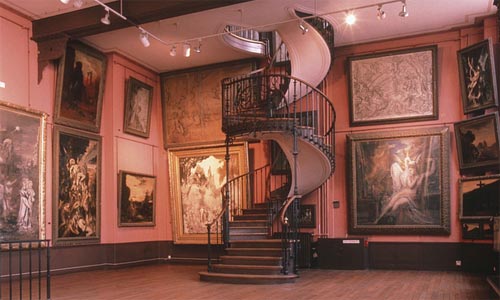
And, as advertised, The Gustave Moreau museum proved to be highly worthwhile, thanks in large part to the excellent public relations skills of the French symbolist, Gustave Moreau. Obviously concerned about his position in the history of art, Moreau designed and paid for the museum to be built so that his works could be collected and displayed as he desired and the setting is fabulous. I’m not a big fan of symbolism, but the more I looked at the paintings, drawing, water colours and sculptures, the better I liked the work. You see, Moreau knew what he was doing.

From the perspective of experiencing how a successful artist lived and worked in Paris towards the turn-of-the-2oth century, the Museum is first class. After touring the dramatic studio, visitors are directed to the intimate apartments of the artist which have been perfectly preserved and offer rich insight into the sources of inspiration for his work. According to the museum, nothing has changed in a century and the “windows still open onto the garden Moreau could see every day.”

This is a small museum and can easily be viewed in under an hour. Of course, fans of Moreau could spend much longer. As a national museum, it is included on the Museum Pass. Please be aware that it closes on Tuesday and for lunch.

Gustave Moreau Museum
14, rue de La Rochefoucauld
Paris 75009

Phone 01 48 74 38 50
http://www.musee-moreau.fr/
Metro: Trinite
Open every day from 10:00 to 12:45 pm and from 2:00 PM to 5:15
Closed on Tuesday

Wednesday, January 25, 2006

The Marais - Where Past is Prologue


Paris, January 19, 2006. I woke up late. There was a serious leak in my building which, after careful investigation from our gardien, Mr Luzio, happily did not originate from our apartment. My son had sent me a document overnight which needed attention. And so what did I do in response to all these domestic interruptions? I dropped everything to head straight for the Marais and get lost for a day.

The Marais is so much fun because it is simultaneously the hippest and the most historic part of town and a great place to observe the collision of trendiness and tradition . The hip bit involves “of-the-moment” people, attitudes, boutiques and restaurants. Because I am decidedly not hip, I shouldn’t make recommendations in that domain but trust me (and your guidebook), if its “trendy” you’re looking for, head for the rue des Francs-Bourgeois and enjoy the show. If it is Sunday and you have a shopping itch to scratch, this is one of the few areas of Paris where stores can legally stay open.

If its history you’re after, head first for the Musee Carnavalet where you can spend a hugely entertaining time exploring Paris from its origins to the present. The museum is spread over two beautiful and very historic mansions. When I arrived, there was a smattering of tourists and tons of French school children communing noisily with their glorious past.

From pre-historic remains to the tiny shoes of Marie Antoinette, the keys to the Bastille, the chess pieces Louis XVI played with while waiting for his execution, the bedroom of Marcel Proust, its all in there and more. I’m sure any child would be fascinated with the gruesome models of guillotines and pictures of Marie Antoinette with her head on a stake and I’m certainly going to bring Eloise along on her next trip to Paris. Whether you are a history buff or not, this engaging museum is uncrowded, fun and free. What could be better?

From the Musee Carnavalet, I dashed off to the Musee Cognacq-Jay, a short walk away, which has an exquisite collection of 18th century paintings and objets d’art in the Hotel Donon amassed by the founder of the Samaritaine Department Store ,Ernest Cognacq, and his wife Marie-Louise Jay. This is a perfect NoCrowds museum: intimate, relatively unknown and a sublime treat for anyone interested in the 18th century. There is no charge to enter.

The next stop on my Marais tour should have been the Musee de la Chasse et de la Nature ( Museum of Hunting and of Nature), based on the hilarious descriptions of its content – hundreds and hundreds of stuffed animals from elephants to bush pigs, guns of every variety and gory tapestries plus painting by Breughel, Rubens and Corot and Chardin. But dear Reader, the Musee de la Chasse was closed.

These things happen to me a lot because I do not follow my own good advice to always call and check if things are open. And if you think having a quick look at the website would help you out, it certainly did not in this case where later I found buried deep in the site, under “Practical Information”, the following: “The museum is closed from January 2005 and will open in 2006.” Practical indeed. OK, we’ll try that one later.

Sometimes, when travelling, what you enjoy is not what you would have chosen. At loose ends on the rue des Archives, I remembered that the Musee de l’Art et d’Histoire du Judaisme ( Museum of the Art and History of Judaism) was around the corner, so off I went. Housed in the imposing and impressive Hotel de Saint-Aignan, I was caught off-guard by the serious security process one goes through to gain entry. Plus my Museum Pass did not cover the entrance charge of EUR 6.10. Was this a good idea, I asked myself? Well, as it turns out, it certainly was.

What I found was fascinating. To quote from the museum’s website, “At the end of the visit, the visitor will have completed a voyage through different historic periods, will have discovered the diversity of Jewish communities and acquired several essential notions concerning the foundations of Jewish culture.” There is a very good English language audio guide included in the price of your visit. The documents from the Dreyfus Affair alone were “worth the detour”. If you have any interest in Judaism, you can learn an awful lot from a visit to this museum.

At 4:00, any sane person would have stopped and had a great falafel at the most famous of all falafel joints in the Marais, L’As du Falafel on the rue des Rosiers, and had I been with Jeff, perhaps earlier we would have had lunch at out old favourite on the Place des Vosges, Coconnas, but left to my own devices, I knew I had time to squeeze in just one more museum and so it was off to the Musee Picasso.

Since this post is way too long already, I shall be brief. If you love Picasso, go. Everyone raves about this place. Perhaps it was just the end of a long day ( and an object lesson for me to nibble not gobble at the Marais’s cultural attractions) but the enormous collection of paintings, drawings, statues and ceramics spanning all the periods of Picasso’s career just didn’t get me very excited. The Hotel Sale is spectacularly beautiful but I kept remembering all the marvellous paintings that were not in the collection. The museum was quite full and for some reason everyone wanted to have their pictures taken in front of every piece. Dodging and ducking the constant parade of photographers wasn’t much fun.

I had planned to finish my day by sitting for a while in the Place des Vosges, the oldest and loveliest square in Paris but realising that even I had reached my limit, I reluctantly headed home happy to have spent an entire day in world class museums where I never waited, rarely had to pay and was hardly ever disappointed.

Museums

Musee Carnavalet
23-29 rue de Sévigné 75003 (metro Rambuteau or Saint-Paul) Tel. 01 44 59 58 58 Open 10.00-17.40 except on Mondays – free entrance except for temporary expos

Musee Cognacq Jay
8 rue Elzévir 75003 (métro Saint-Paul) Tél. 01 40 27 07 21 Open 10.00-17.45 except on Mondays
Free Entrance

Musee de la Chasse et de la Nature
60 rue des Archives 75003 (metro Rambuteau) Tel. 01 42 72 86 43
Currently closed for renovation

Musee d’Art et d’histoire du Judaisme
71, rue du Temple (metro Rambuteau or Hotel de Ville)
Tel: 01 53 01 86 60
Open 11:00-6:00 Monday – Friday and Sunday 10:00 to 6:00
Charge: Eur 6.10/3.80

Musee Picasso
5 rue Thorigny 75003 (metro Saint-Sébastien Froissart, Saint-Paul) Tel. 01 42 71 25 21 Open 9.30-18.00, 9.30-17.30 in winter, except on Tuesdays
Charge Eur 7.70/5.70 – no charge for Museum Pass holders

Food and Restaurants

L’As du Falafel
Rue des Rosiers

Coconnas
2 bis, Place des VosgesTel: 01 42 78 58 1
Photo of "Portrait de la Residente de Rieux" (detail) by Maurice Quentin de la Tour courtesy of the Cognacq-Jay website

Monday, January 23, 2006

Screw the Louvre ?


Over Christmas at the fabulous Home Ranch in Colorado, I met a cross-country skiing cowboy from L.A. who got very excited about the NoCrowds idea. As I explained that searching out undervalued treasures was always better than following the diktats of “tick the box” tourism, he became even more excited. “Screw the Louvre” he exclaimed as we skied through the trees. “People will understand it. Put it on your business cards”.

Catchy, I thought but not really what we’re trying to accomplish. Yes, the Louvre is an icon of the overcrowded and compromised travel experience. But at the same time, the Louvre has 35,000 premier works of art on permanent display, is the largest museum in the world and has been in the business since 1793. Surely there must be a way to visit the “mother of all museums” that is pleasant and rewarding?

Based on the wonderful experience I had visiting London museums on their late nights, when I arrived in Paris last week, I immediately took off for the Louvre which is open until 9:45 on both Wednesdays and Fridays. Armed with my Paris Museum Pass (described in Paris Bits & Pieces), I arrived at the Louvre about 5:00, found no lines anywhere and entered through the Pyramide. Had there been a line, my Museum Pass would have allowed me to enter without waiting at the Porte Richelieu on the rue du Rivoli or the Porte des Lions or Galerie du Carrousel. (N.B. Porte Richelieu closes daily at 6:00).

Having easily navigated my entrance, I headed for the least crowded section, the Richelieu Wing and spent several hours exploring the Decorative Arts collection including Napoleon III’s opulent apartments and the museum’s collection of Northern European paintings. I was virtually alone. No tour groups in sight but the Rembrandts, Van Dycks, Davids and Poussins were fabulous. The illuminated views into the courtyard were inspiring. I loved it.

Emboldened by my success thus far, I ventured downstairs to see what was going on in the most crowded sections of the Louvre, the Galerie d’Apollon and the first floor rooms in the Denon wing. There were plenty of groups of what seemed to be well-heeled professional Parisians taking Art History courses milling about. The galleries were full but comfortably so. The atmosphere was fine.

The acid test of my late night hypothesis was that I was able to stand in front of the poor bullet-proofed Mona Lisa with a very small group of appreciative individuals. The fact that the Louvre has recently restricted the taking of photographs and videos in the most popular sections of the museum really helps one’s enjoyment of the experience.

At about 9:00, I’d had enough of my museum marathon and headed home. As was the case with so many museums in London, going to the Louvre at night made all the difference. Instead of the hordes that tramp through during the day, the people I shared the Louvre with last week were taking their time and seemed genuinely interested. The collections are everything they’re cracked up to be and you certainly get your money’s worth. Yes, the museum is totally confusing and even overwhelming but after giving the Louvre a pass for decades, I’m glad I went. Go at night and I think you will be too.

Metro
Palais-Royal-Musée du Louvre station.
BusThe following bus lines stop in front of the Pyramid: 21, 24, 27, 39, 48, 68, 69, 72, 81, 95, and the Paris Open Tour bus.

Museum Opening Hours
Monday, 9 a.m. to 6 p.m. Wednesday, 9 a.m. to 9:45 p.m.Thursday, 9 a.m. to 6 p.m. Friday, 9 a.m. to 9:45 p.m.Saturday, 9 a.m. to 6 p.m.Sunday, 9 a.m. to 6 p.m.
The museum is closed on Tuesdays and some public holidays.
Ticket Prices
Eur 8.50 for full-day access, Eur 6 for access after 6:00 on Wednesdays and Fridays

Photo courtesy of the Louve website "Musee du Louvre" A. Dequier-M. Bard

Monday, November 28, 2005

Paris Bits & Pieces


Some observations for visitors to Paris

All lovers of art and haters of lines should invest in a Paris Museum Pass which provides free, unlimited priority access to over 70 museums including the Louvre, Musee d’Orsay, the Musee Rodin, the Musee national Picasso and the Chateau of Versailles. It is hugely and perversely satisfying to saunter past the long lines, flash your card and slip inside. One, three and five day passes are available. There are lots of places to buy a Museum Pass: at any museum or monument involved in the program, at major Metro stations and at any FNAC store in the city. Cards can also be purchased in advance over the internet from a huge range of providers, just enter Paris Museum Pass into your search engine.

1 day pass for EUR 18
3 day pass for EUR 36
5 day pass for EUR 54

Unfortunately, these passes will not get you into any special or temporary exhibitions. To cut the line for special exhibitions, buy your tickets in advance at any FNAC store located throughout Paris. If you understand rudimentary French, you can buy your tickets over the internet which can be collected at any FNAC saving even more time.

With that said, I want to warn NoCrowds readers from the useless indignity of purchasing tickets in advance for block buster exhibitions at the Grand Palais. I saw 2 shows there recently and in each case, the experience was lousy although the exhibitions should have been fabulous. Even with your timed ticket, you wait outside in a line of irritated fellow ticket holders. The number of people inside the exhibition space is ridiculous. It is almost impossible to see the canvases. The rooms are hot and claustrophobic. I won’t be going back regardless of what is on offer.

Speaking of crowds and museums, for years, I have struggled to find a good place to eat lunch near the Musee d’Orsay. One senses that most places too close to the museum can be sloppy and expensive and not much worried about serving up a good meal. After seeing a terrific temporary exhibition of Russian art at the Musee d’Orsay recently, my husband and I discovered a good value, good food, good experience restaurant on rue de Bellechasse which is confusingly named “Le”. It is a small space but had an appealing atmosphere. I had the lunch formula for EUR 15 which was well prepared and satisfying. Service was good. The place was filled with Parisians who obviously enjoy a well priced, well prepared lunch in a neighbourhood not known for it. “Le” is now my post Musee d’Orsay hangout.

Le
20, rue de Bellechasse
75007 Paris
Reservations: 01 47 05 11 11

Speaking of restaurants, my friend Glenn, an American in Paris who offers lovely apartments to rent at Paris Apartments Rentals has recently posted his top ten restaurants for visitors to Paris. Check it out and add your own.

Tuesday, November 22, 2005

Musee Nissim de Camando


Nothing in the guidebook’s description prepared me for the utter sadness of the Musee Nissim de Camando. A short walk from the Musee Jacquemart-Andre on the border of the Parc Monceau, the elegant mansion built to resemble the Petit Trianon at Versailles is known for its beautiful and extensive collection of 18th-century French decorative arts and furnishings. Yet it is the story of the fabulously rich and doomed family de Camando, once described as the “Rothschilds of the East” which makes this museum one of my favourites in all of Paris.

I think it was Voltaire who recommended that one always “begin with the conclusions” and so it is in the Musee Nissim de Camando. Passing through the doors of the entrance to this magnificent house one finds a plaque on the wall which states simply and brutally, “Mme. Leon Reinach, born Beatrice de Camondo, her children, Fanny and Bertrand, the last descendents of the founder, and M. Leon Reinach, deported by the Germans in 1943-44, died at Auschwitz.”

So who was this family? What was the story behind the house and its collection? How was such fabulous wealth amassed? Why did such fabulous wealth not save them?

The story begins with Moise de Camondo, a member of family of Sephardic Jews who built a banking empire in Constantinople which in 1870 opened a branch in Paris. Over the years, Moise became an important collector of 18th century French art and antiques. After marrying a beautiful and rich young woman who bore him two children, she runs off with the horse trainer and leaves Moise to continue filling his house with treasures and dining with the likes of Marcel Proust. During the First World War, Moise’s only son, Nissim, dies in combat. (There is a touching letter of condolence from Proust in Moise’s changing room.) In 1935, Moise dies and leaves his mansion and the collection to the Musee des Arts Decoratifs in memory of his son. His daughter Beatrice, having married the artist Leon Reinach, devotes herself to horses and riding and perishes in Auschwitz.

In addition to this haunting story, the museum scores accolades on two other accounts. First, the collection of 18th century French decorative arts is amazing. The pieces are displayed precisely as Moise de Camondo placed them with such care during his lifetime. If you want to avoid the crowds at Versaille but still capture the sense of life as a French aristocrat before the revolution, go to the Musee Nissim de Camando.

In addition to capturing the interiors of the 18th century French aristocracy, the house also succeeds in demonstrating the life of wealthy high society at the turn of the 20th century. One can easily imagine lunching with Proust in the elegant dining room overlooking the Parc Monceau. The kitchen downstairs gives a fascinating insight into the infrastructure required to produce those lunches.

But finally, it is the de Camondo’s glittering rise and terrible fall which defines ones visit to this museum. Like the family in the “Garden of the Finzi-Contini”, the de Camandos had every reason to believe that they were secure in this fabulous world they had created. In the end, neither their immense wealth, their exquisite taste nor their powerful friends could save them.

Musee Nissim de Camondo
63, rue de Monceau
75008 Paris
Tel: 01 53 89 06 05
http://www.ucad.fr/fr/04museecamondo/index.html ( in French)
Metro: Villiers, Monceau

Open : Wednesday – Sunday (closed Mondays and Tuesdays)
10:00 -5:30 pm

Tarif: EUR 6

Thursday, November 17, 2005

Musee Jacquemart-Andre


According to my sons, both movie moguls in-waiting, it’s the story that matters. You can take a good tale and make a bad movie but never a good movie from a lousy tale. With this in mind, it is hardly surprising that visitors rave about the Musee Jacquemart-Andre in Paris because, at its core, it’s a cracking love story.

Back in the late 19th century, the son of a hyper-rich, Bonapartist, Protestant banking dynasty, Edouard Andre, devoted to collecting all aspects of the fine arts, commissions a portrait from a young, Catholic, royalist painter, Nelie Jacquemart. Nine years after the picture was painted, Andre marries the artist and forms one of the greatest art collaborations in French history. The couple spend the rest of their days amassing a superlative collection, including works by Rembrandt, Van Dyck, Botticelli, Fragonard and David and die childless. The mansion and its contents are then bequeathed to the Institut de France and the legacy is secured.

To visit the mansion today, the excellent audio guide unfolds the Jacquemart-Andre story in room after sumptuous room, here a Tiepolo ceiling, there a Donatello statue, walls that could be opened up using hydraulic jacks to provide for parties for over 1,000, a Venetian smoking room for him, a studio converted into an Italian sculpture gallery for her. Their taste was so impeccable, their manners so good and their wealth so immense, that they refused to bid against the French state on important pieces even though their budget vastly exceeded that of the museums

The Institut de France has done a marvellous job presenting the house and contents. The garden is lovely and the original dining room has been converted into a restaurant and tea room with a spectacular Tiepolo ceiling. There are beautiful 18th century Belgian tapestries hanging on the wall and Louis XV consoles around the room. Lunch and afternoon tea are available and you shouldn’t miss this chance to dine under a Tiepolo ceiling.

As mentioned, the audio guide is interesting and there is a treasure hunt for children which my nieces recently took and judged to be big fun. These young ladies ( 8 and 11 years old) went so far as to say that “perhaps museums weren’t so boring after all”. I generally don’t like gift shops, but the one at Jacquemart-Andre is fine.

So there you have it, a Paris love story where an unlikely but blissfully compatible couple devote their life and vast fortune to the pursuit of beauty. Vincent Minnelli had a whiff of this story’s potential when he shot some of the scenes from Gigi in the Jacquemart-Andre mansion. Hollywood, listen up, hire my sons and make this movie.

Musee Jacquemart-Andre
158, boulevard Haussmann
75008 Paris

Tel: 01.45.62.11.59
Fax: 01.45.62.16.36
http://www.musee-jacquemart-andre.com/

Open every day from 10 to 6
The café is open from 11.45 to 5:30

Metro – Either Miromesnil or St Philippe du Roule
A five minute walk from the Champls-Elysees and the major department stores

Full rate Eur 8.50
Concessions available