Showing posts with label Belize. Show all posts

Wednesday, January 29, 2014

Back to Belize

In 2011, I wrote a post entitled “Can you handle 18 – From 13 to 88?" about a family reunion in Belize that was a huge success, so huge, we went back. Again, we numbered 18 and if you do the math, this time the age range was 15 to 90.

Once again we went straight back to the oldest jungle lodge resort in the country, Chaa Creek. Why, you might wonder would we not want to try somewhere new? The answer can be boiled down to one word – people – because that is the secret sauce of Chaa Creek that you can’t get anywhere else. Just like the Costa family and their staff in the previous post made the Hotel La Perla in Corvara the nicest hotel in the world, Mick and Lucy Fleming and their daughter and staff make Chaa Creek the nicest resort. Nothing is impossible or too much trouble. Nothing is refused or denied. Whatever can be done to make your holiday wonderful, the Flemings and their team will do it.

For this family reunion, the weather was a challenge. It rained a lot which meant some of the sites, roads and activities were either closed or the access was incredibly difficult. But such was the ‘can do’ and adventurous spirit of Chaa Creek that if we were game, they were game. We forded rivers (and got stuck) drove through impassable roads (and got stuck) and came back every night with wild stories to tell. There is nothing that brings a far-flung family together like an adventure and we had many. Aunt Mary braved the zipline through the forest canopy. We went deep into the Mayan caves. My mother (in her 80s) once again demonstrated her horseback-riding prowess. My father, in his 90s, was a great walker.

And through it all, the people of Chaa Creek pampered us, rescued us, fed us, mixed wickedly good drinks and made sure that our family had a wonderful, wonderful time. And in the end, that's what it's all about.


Tuesday, January 22, 2013

Change


In this post, No Crowds reporter Penny asks if a person can change in just one day and describes how one Belizean family delivers a lesson in facing change with grace.

I asked Joe Martinez, poet, rancher and ecohotelier, how he felt about the dam.  The lake in which we were now floating, had been a Macal tributary rated whitewater grade 6 only a few years ago.  He had grown up here, listening to the rush of water over rock at night, fishing on its banks as a kid.  Now the reservoir was a still blue plate separating forested limestone canyons…different.  

“Everything changes,” he observed, a bit wistfully, but resolute. 

I guess there would be many ways to think about change here.  We had scrambled down to the pontoon boat over a crumbling incline on which the terraces of the Maya were still visible.  Mounds dot the property: they think some were shrines; some were remnants of a village.  So, yes, everything changes and sometimes perhaps changing to a purpose is better than cleaving to old patterns and letting one’s home slowly change itself and collapse. Read all about it in Jared Diamond’s book of that name. 

Our guide Lazaro, Joe’s brother, had also seen recent change.  His dreadlocks, now braided together into a meter or so of detached bushy hair, had been cut a few weeks before so that “people would take him more seriously in the business”.  That is, in the Central American offices to which he journeys to sort his clients’ paperwork before taking them deep into the jungles of Belize, Guatemala, Nicaragua– birdwatching, rafting, hiking, riding, discovering.

We were spending the day with Lazaro,  Joe, three young blue heeler mixes that looked remarkably like the wild dogs of Africa and an indeterminate Lab mix, waterfall hopping from a pontoon boat where the Upper and West Macal spread into what is now called Vaca Lake.  Lazaro’s nephew (another Joseph) had promised a serene day seeing, hearing, and being in the water and this is what we got.      And lest you wonder whether our tour fit the no-crowds theme, we saw only five other human beings while we were there: Uncle Joe, in his 80s, ensconced on his porch; poet Joe’s wife Miriam; their daughter (and later their son), and a Swiss guest, a “professional birdwatcher,” who accompanied us down the trail to the water, but left with her binoculars as we set off.  I hope she didn’t get lost – there wasn’t going to be anyone around to ask for directions. 

Waterfall number one pooled at the bottom --  good place to wash your hair in the downpour – but it was a little cold.  Feeling a bit like Goldilocks, but unwilling to follow Lazaro in, we satisfied ourselves with a climb up the slope of the fall and looked about us.  The sap of this tree, he tells us, can be used as glue.    Tea made with the leaves of another is good for stomach upset.  Use the bark of another for dye. The seeds of that plant are good for anemics.   And there are thousands of trees, bushes, vines…he seems to know the names of them all, and each has a use. 

As we float downstream, he points out a pair of white eagles on tree limbs across the water, the kingfisher on a passing branch, the vultures circling one of the canyon ridges, the nose of a small crocodile which had made its way down the river as it had become more serene in its harness.   When we cut the motor, there is no sound at all.  No traffic noise or passing planes; no human voices, nor are there the sounds of any of their surrogates – radios,  machines.  Joe shares some of his poetry, including the one about a foreign flower that won him his German wife.  It is a good place for poetry, although somehow most human effort seems a bit beside the point in the face of the vast green, the hidden lives among the hundreds of trees – palms, mahogany, poisonwood, acacia, Caribbean pine.

The swimming hole sits atop waterfall number two. One would have to be careful not to relax too much and find oneself going over the 10 metre drop to the bottom.  This is where we eat lunch and listen to birdcalls and the soothing constant splash of water.

At waterfall number three, you can watch a leaf fossilise before your eyes.  Organic compounds from the jungle vegetation dissolve the limestone at the top, and as the water brings it down, it crystallises again over fallen leaves, turning them to sandstone.    The overhangs build up, and the course of the falls changes over time.  When Joe and Lazaro were children, the falls were over there – a meter or so to the south.  We pile in, but we are not, quite, still enough to turn to stone ourselves. 

Back at Martz Farm, there are tree-house rooms built of wood up over a jungle creek and a lodge with more accessible bathrooms and plenty of room for communal admiration of the scenery below.   As we say our goodbyes, a hen heads for the hutch with her brood.   Joe lopes away to bring in the mules he breeds from a mare he drove to Wisconsin to buy.  His young son sits comfortably on the saddle before him.  The wood stove is stoked for dinner.

Can a person change in just one day?  Maybe not.  But a memory can change the way you look at other days.  And this last day was a perfect one that I return to remotely, just before sleep (or more recently and less romantically  in a queue at the Post Office), to assure myself again that somewhere things are just that perfect, at least for one day. 

Our visit also furnished a lesson in change with grace.  The world is going to come to the Martinez’corner of Belize no matter what.  But they would like to choose how it comes, and to treat those who come as guests. Quite deliberately they play the role of hosts and custodians.  I think they are hoping that although we may bring some welcome changes, we’ll be willing to enter their world as it is, and not change it too much.  I share that hope. 

End note:  We were staying at Chaa Creek Lodge, which Kate has described here in her 2010/2011 postings.  Also a magical place: comfortable, welcoming and tasteful.

If  you would like to stay at Martz Farm, go to www.martzfarm.com, subject of much paise on TripAdvisor. 

Lazaro’s bespoke adventure tours can be reached through hideawaycampdv@yahoo.com and they are also on Facebook. 

There can be some delay in response because the farm is remote and they do not have internet access there.  They do check in St Ignacio at least every other day though. 


Saturday, January 19, 2013

What about the waste?


A No Crowds traveller discovered lots of trash washing up on the beautiful beaches of Belize and wanted to know how it got there. In this post, Penny outlines the problem of cruise ship waste and proposes measures each of us can take to solve it. Please share this post with any one who loves to travel and cares about the environment. Thanks.

That’s a melodious blackbird, tuneful behind me in the mango tree.  I leave my front door and squeak down the sand to the waterline.  On the horizon, waves break on the barrier reef.  The frigates are circling a palapas on the dock, and will be disappointed that the disembarking entourage is composed of scuba enthusiasts rather than fishermen. Closer, a blue heron nudges the minnows in the sea grass.

This is paradise.  It’s an island where (if you do not want to travel by water, and depending on how fast you can ride a bike) your fastest mode of transportation is likely to be a golf cart, bobbing along the sandy single lane in back of the houses that line the shore.

Dislodged sea grass comes in every morning.  And bottle caps, pieces of plastic forks, carefully cut portions of opaque milk bottles, shreds of cellophane, a lonely ravaged flip flop.   The seagrass will melt back into the Caribbean, or it can be raked and spread on fields.  But what to do with the other items, the bottlecaps and brittle food containers?    They say it will take somewhere between 450 and 600 years for them to dissolve, though dissolve they shall, changing the chemical composition of the seas.

And to here, to paradise, the items find their way,  refuse from those floating first world metropolises, the cruise ships.

The UN and others have tried to stop the dumping.  There is a Marine Pollution protocol in place, the so-called “MARPOL”, under which the Caribbean in deemed a “Special Area” because of its fragile reefs and enclosed nature.  However, enforcement of MARPOL is through the countries under which the liner is flagged, and the flag countries tend to be far away and disinterested in enforcing UN protocols. Even flag states that sign the protocol do not have to sign up to all if its annexes, such as Annex V, the one that forbids discharge of plastics.

Efforts by poor Caribbean states force cruise lines to internalise the cost of their waste production have not met with success.  A single ship will arrive with more trash than the people of a developing country could afford to generate in months.  But when Grenada suggested a US$1.50 a head tax to defray the cost of waste disposal, Carnival Cruise Line simply stopped going there, depriving it of tourist and trinket revenue altogether.

As we get older, many of us may decide that if we want to see more of the world, it will have to be from the hassle-free deck of a cruise ship.  No packing and carting of luggage.  You know where your next meal will come from (although perhaps not where it goes).  We’re maybe not as interested in local nightlife as we once were.  Could happen – they say people don’t believe how much they will change in a decade ahead, even when they know how much they changed in the decade behind.


But if any of us no-crowdsers decide to take to the seas in this way, let’s ask what is happening to those orange juice bottles, that cellophane, the six pack ring tops, the brittle see-through food trays, not to mention all of our organic “products”.  I think it’s time that the patrons of the cruise ships insist that they are people who pick up after themselves.  That they will not toss their trash overboard where it chafes the coral and ends in the stomachs of sea turtles.  Time for those who pay that piper to start calling the tune.

If ever you book a cruise, if you have friends who travel this way, let’s all start asking, “What about the waste?  What are you doing with our trash?”  And let’s make sure we get honest answers.

Photo: Ambergris Caye, Belize
December 2112

Thursday, February 03, 2011

Can You Handle 18 – From 13 to 88?

No, it’s not a math class, it’s a family reunion.

Now I don’t know about you but just the term ‘family reunion’ sets off my gagging reflex. It’s not my family. I’m crazy about them, spread out as they are across Australia, Europe and the US. It’s the idea of an organised  get together –I’m thinking Disney or a cruiseship – that seems so ‘yuk’. Did you know that 34% of adult Americans (that’s 72 million people) have travelled to a reunion in the last 3 years. and that there is even a magazine that covers the industry?

But my family’s genome is decidedly contrarian and crowdphobic so our challenge was to find a location, undiscovered by Reunion Magazine that would be a good fit for 18 people ranging in age from 13 to 88 with a diverse set of tastes and interests.

Reader, we chose Belize. (Can you tell that I’m taking a Bronte class?) And here’s why.

It’s a tiny country in Central America (about the size of the state of Massachusetts, formerly known as British Honduras) where the official language is English. It has a small but diverse population and punches way above its weight in terms of what it has to offer: climate, world class Mayan antiquities, a magnificent Barrier Reef, over 1,000 islands, excellent fishing, diving and snorkeling, rivers for canoeing, and jungle and wildlife reserves for exploring.

So where did we go and why?

To the oldest jungle lodge resort in the country, Chaa Creek. What started as a farm owned by a young ‘counter-culture’ English couple in the 70s is now a ‘grown-up’ resort, still owned by the same interesting couple.  Chaa Creek describes itself as ‘wildly civilized’ and that actually sums it up nicely as the place is, at the same time, both supremely relaxed and highly sophisticated. Accommodations are tasteful and comfortable. The staff is capable and charming and there are a vast amount of things to see and do.

For our gang of 18, there was truly something for everyone. Just take our New Year’s Day activities as an example. Following a hard night at the Blue Angel Bar in San Ignacio for the younger crowd, a large group rose early and took off for Guatemala and the ancient ruins of Tikal. Another group, including my parents in their 80s, headed down the Macal River in canoes, finishing the day drinking beers on San Ignacio’s main street, while our 13 year old daughters spent the day getting beauty treatment at the Spa.

During our stay, we also rode mountain bikes, went horseback riding, lounged by the pool, visited several magnificent and deserted Mayan antiquities and went deep underground in caves to explore the Mayan underworld.  Chaa Creek even organized a special lunch for my sister’s birthday that looked like something out of an Isak Dinesen story, involving horses, champagne, dining  ‘au plein air’ and an ancient Mayan site.

And so, for you crowdphobic travelers who think that trying to get your family together is at best an exercise in herding cats and at worse, a commercial nightmare, head for Chaa Creek Lodge in Belize. There are 18 of us who are sure you’ll have a wonderful time.

Photo Credit: Leland Hedges - the view from his bedroom at Chaa Creek


Thursday, February 12, 2009

Back to Belize


It was social media that got us thinking about Belize, the small country in the north eastern corner of Central America we last visited in 2006. After seeing us on Twitter, Kevin from Turneffe Flats, a fishing, diving and eco-marine destination on Belize’s Turneffe Islands got in touch.

Looking at the information and website for Turneffe Flats, we vowed straight away to get back to Belize. This small English speaking country (about the size of the state of Massachusetts) completely beguiled us the last time. We explored jungles, rain forests, and caves full of ancient Mayan artefacts and human sacrifices. We were bums on a beach, we saw amazing flora and fauna (including the world’s only jaguar reserve), and visited the spectacular ruins of a lost civilisation. And with the lowest population density in Central America, Belize was anything but crowded. In fact, for our money, Belize is one of the best destinations in the world to find all the elements that make for a perfect holiday: relaxation, adventure culture and education.

And the next time we go back, we’ll give serious consideration to a visit to Turneffe Atoll and Turneffe Flats. We love the idea of an informal but “grown-up” (as in electricity, air conditioning and good food and booze) isolated lodge on a virtually uninhabited island. Even though we neither fish nor dive, which are Turneffe Flat’s specialties, we can definitely get in to all the other things on offer: snorkelling, kayaking, all kinds of tours to visit the animal and marine life, opportunities to learn about the Maya and even a Belizean cooking class. And we appreciate the fact that Turneffe Flats, through 1% for the Planet, gives 1% of its revenues to support organizations promoting conservation and sustainability of habitats such as Turneffe.

A word of caution. Turneffe Flats is an expensive option for the independent traveller, roughly $2,000 per person per week for the Adventure Program described above and more if you fish or dive. But everything is included, the Trip Advisor reviews testify to the quality of the operation and anyway, do we really want a lot of cheap accommodations being built all over one of the world’s most biologically important and fragile ecosystems?

OK, we’ve convinced ourselves. In 2009, somehow, we’ve got to get back to Belize.

Turneffe Flats
Email: vacation@tflats.com
Telephone – 501 220 4046
Toll free from the US – 888 512 8812

Thursday, March 23, 2006

Caye Caulker – Better than Magaritaville


As our boat pulled up to the dock at Caye Caulker, a tiny island lying 21 miles off the coast of Belize City, a skinny, toothless smiling man straight out of central casting picked me out from the dozen or so people disembarking. “ I can tell from the look in your eyes that you are Katherine Hedges and that you want to go to the Iguana Reef Inn. I am Frederick and I will take you there.” Frederick then hoisted our backpacks into the basket of his bicycle and off we went. “Here you can eat – very economical, there you can wash your clothes. This lady will do your hair. Where are you from? My favourite book is I Buried My Heart at Wounded Knee. I have read it many, many times but I lost it. Have a nice time on Caye Caulker. See you around.”

Indeed, Frederick was the perfect introduction to this care free island. With the decline of the fishing industry over the years, islanders have come to depend more and more on tourism, but the place still feels relaxed and un-commercial. Most accommodations consist of guest houses, there are no cars but a comfortable amount of aging golf carts, no golf courses, but easy access to spectacular snorkelling, fishing and diving and plenty of laid-back restaurants serving super fresh seafood. On Caye Caulker, dressing for dinner means putting on a shirt.

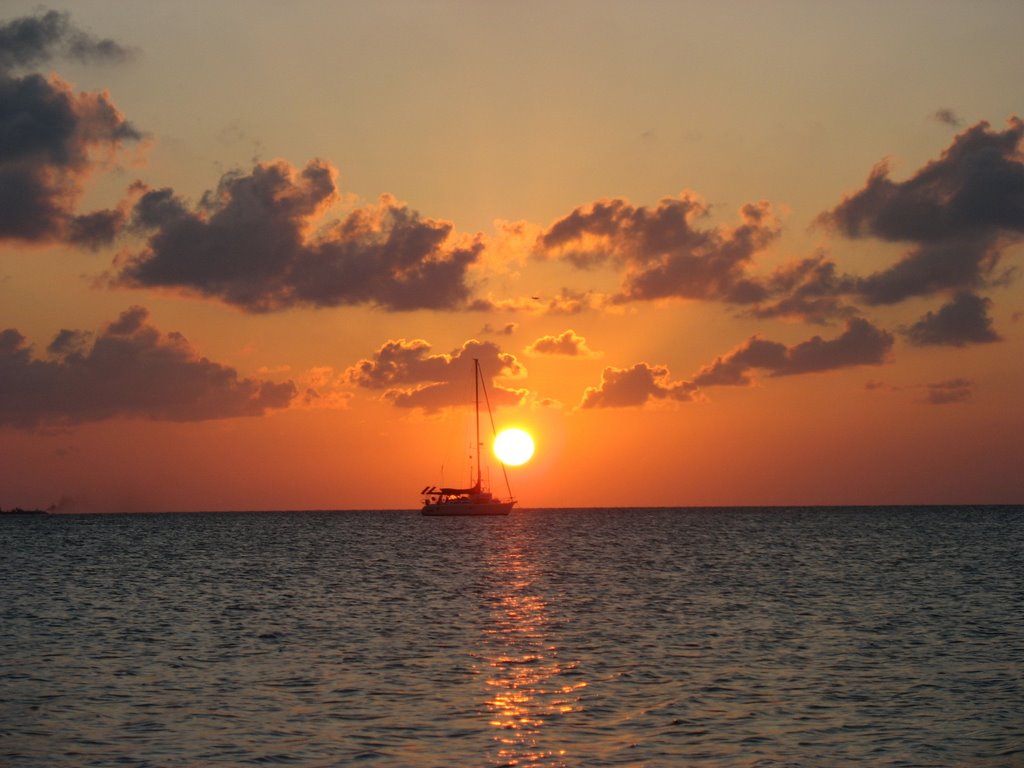
Knowing that Jeff’s tolerance for rediscovering his non-existent hippie past was limited, I booked us into the only truly grown-up hotel on the island, the Iguana Reef Inn which has beautifully decorated rooms, air conditioning (important), a delightful sandy beach on the water, good swimming and a first class bar. While the Iguana Reef does not have a restaurant, they serve an ocean-side breakfast with homemade yoghurt, fresh tropical fruit, cinnamon rolls and pots and pots of steaming and very good coffee. Probably the best place on the island to watch sunsets is from the beach at Iguana Reef where the photo above was taken.

There are plenty of very informal places to eat on Caye Caulker. Our favourite was The Sand Box by the front dock where tables are set in the sand, both inside and out. The portions are generous and service friendly, although Jeff did rather shock our waiter when he asked him where he could buy one of those great Haile Selassie shirts he was wearing. Really cheap, really deeply fried and really good take-away food can be found at Pirates. We almost ate at Rasta Pasta based on its cool name, location and reputation, but they had had a big party there the night before, en-route to resupply them the drinks distributor was hijacked and so there was nothing to drink. We went elsewhere.

There are lots of great things to do on the island: snorkeling, diving, wind surfing, fishing, boating, you name it. We did none of that. We did manage to rent bikes and ride around, we walked on the beach, but mostly we dozed on the beach, read books and drank beer. Occasionally, Jeff would wander off to check his email at the internet bar. We took leisurely lunches. It was perfect. Go quick before tourism or a hurricane or both wash this laid-back idyll away.

Iguana Reef Inn
PO Box 31
Caye Caulker, Belize
Tel: 501-226-0213
Fax: 501-226-0087
Email: iguanareef@btl.net
http://www.iguanareefinn.com/

The Sand Box
on the beach, near Front Dock
Tel: 501-226-0097

Rasta Pasta Rainforest Café
Front Street
Tel: 501 226 0358 or 501 206 0356

Wednesday, March 22, 2006

So Where Did They Go?


Jeff claims that I like to worry about stupid stuff because it distracts me from worrying about serious stuff. Maybe, he’s right. As evidence, take my life-long angst about Virginia Dare, the first European child born in the New World who vanished, along with 116 colonists without a trace. Ever since my parents took me to see, “The Lost Colony”, now playing in its 69th season on Roanoke Island in North Carolina, I have been worried about those folks.

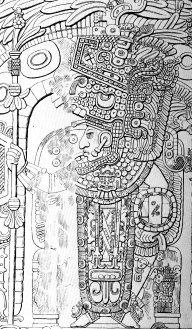
But after visiting Belize and Guatemala, I can take worrying to a whole new level. Now I have the disappearance of an entire civilisation to keep me busy. And not just any civilisation. Almost 2,000 years ago, the Maya, spread across what is now Mexico, Guatemala, Belize, Honduras and El Salvador, without benefit of metal tools or beasts of burdens, built massive cities filled with palaces and temples, developed sophisticated systems of astronomy, mathematics and calendrics, and outperformed the heck out of a slumbering Europe mired in the Middle Ages.

Robert Sharer of the University of Pennsylvania called the collapse of the Maya one of the most profound cultural failures in human history. While most scholars agree that the collapse was probably due to some combination of the effects of prolonged warfare, overpopulation and sustained drought, these same scholars are also in agreement that the demise of the Maya remains a cracking mystery yet to be resolved. Even Mel Gibson is about to release a major motion picture about it.

For a NoCrowds traveller, visiting Mayan sites presents the perfect opportunity to see intriguing ruins in sublime privacy. Compared to the scores of people you usually find traipsing around Roman or Egyptian antiquities, you can pretty much climb on, in, and around the Mayan monuments all by yourself. Rent a car, buy a guidebook and get lost for a day in the jungle. Or you can join a small group with a guide and have the story told to you. Either way, you can’t help but share in the excitement of discovery.

With four days to fill and with hundreds of Mayan sites distributed across five countries, we made our choices based on budget, time and accessibility. In Belize, we visited three sites: Actun Tunichil Muknal, Xunantunich and Cahal Pech. For the grand finale, we drove across the border into Guatemala, spending the night at the ancient ruins of Tikal.

We spent our first day “Exploring the Place of Fright”, as National Geographic’s Adventure Magazine described it in 2001. Actun Tunichil Muknal is a 5 kilometer cave first discovered in 1989 and filled with objects left by the ancient Maya including over one hundred and fifty ceramic vessels and implements, a variety of animal remains and the skeletons of 14 individuals believed to have been sacrificed. To visit the cave, you must ( and believe me you need to) join a group. We used PACZ Tours (the same outfit used by National Geographic) out of San Ignacio who did an expert job of guiding us through the eerie netherworld while expertly highlighting the geological and archaeological treasures along the way. When we began to worry that we would drown, fall off a ledge or never see daylight again, our guide, Jamal, carefully encouraged us forward.

To reach Tunichil Miknal, we first hiked for 2 miles through the jungle. We then approached the cave, strapped on our helmets with flashlights and swam into the deep water pool at the entrance. After the heat of the jungle, the water was shocking. Following an hour of climbing over boulders and wading neck deep through the flooded cavern, we arrived at the main chamber filled with the pots, implements, vessels for bloodletting and the most remarkable of all, the human skeletons.

I don’t think this cave will stay open to regular tourists much longer. The impact of so many humans is taking its toll. The objects are too important and the visitors are too exposed to injury. If you are in Belize, I would encourage you to make every effort to see Tunichil Muknal while you still can. Throw caution to the wind, be sure to wear closed shoes (we didn’t) and have the time of your life “exploring the place of fright”.

For a less demanding but very interesting experience, we also recommend Xunantunich (pronounced shoe-nan-too-nich ) and Cahal Pech, two sites which you can see in one day from San Ignacio. One of the best ways to see these sites is with a rental car. You are in control of your itinerary and timing and the driving was easier and more enjoyable than I expected. We rented from Crystal Auto Rental at Belize’s International Airport. The company provided excellent rates and service and is the only firm in Belize that allows its cars to be driven into Guatemala.

If you want to join a tour to any of the sites, including Tikal, Caracol and Tunichil Muknal , the best place to get oriented is Eva’s on Burns Avenue which is San Ignacio’s unofficial tourist bureau and the social equivalent of Rick’s Place in Casablanca. Sooner or later, everyone ends up there and whatever you want to do, Bob Jones can sort you out.

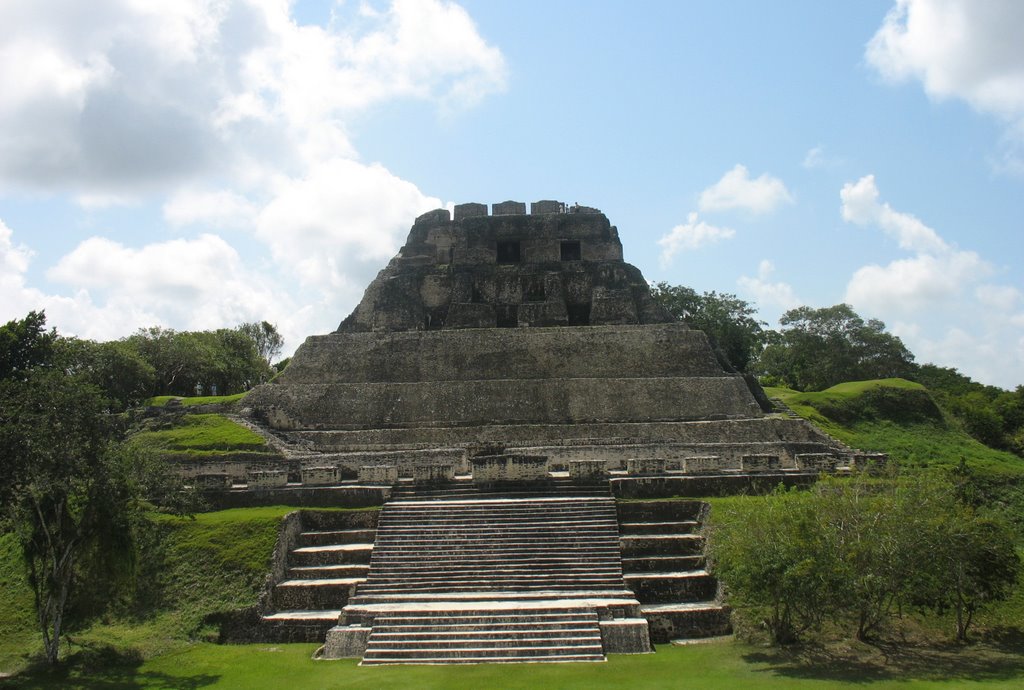
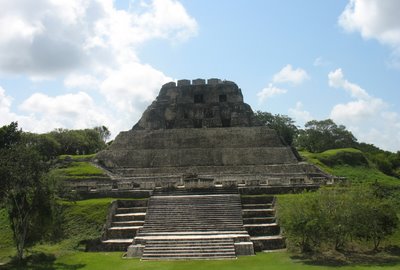
From our base at Ek Tun, it was a short drive to the ancient city of Xunantunich, situated near the Guatemala border in the oldest archaeological park in Belize. You reach the archaeological park via a free, hand cranked ferry which takes you across the Mopan river. There is an excellent visitor’s center. When we visited the site, there was absolutely no one there which was spellbinding.

This was also the case at Cahal Pech, down the Benque road from Xunantunich and only one mile from downtown San Ignacio. During the Classic period, Cahal Pech was the palace of an elite Mayan family. The site was continuously occupied from 900BC to at least 800AD. Hundreds of figurines have been found there, many of which can be seen in the visitor’s centre.

Saving the best for last, on our fourth day, we left Ek Tun early and headed for the Guatemala border. There is a complicated set of procedures and payments to exit Belize with a car and enter Guatemala. Once we crossed the border, we had about a two hour relatively easy drive to the Tikal National Park, a 370 square kilometre protected area which forms part of the Maya Biosphere Reserve, the largest tropical reserve in Central America.

When arriving at Tikal, it is the scale of this mighty megalopolis rising above the forest canopy that is so impressive. Covering an area of roughly six square miles, central Tikal contains over 3,000 separate constructions including temples, palaces, shrines, ceremonial platforms, small to medium residences, ballcourts, terraces, causeways and plazas. In addition, there are over 200 stelae ( carved stone monuments) and altars.

In response to the daunting size of these mighty ruins, we hired a guide for the afternoon who did a wonderful job bringing the ancient city to life as well as explaining the interesting plants and wildlife. Our guide, who found us at the entrance with a very charming marketing pitch, charged US$40 for roughly four hours of touring and we felt he added real value to our experience.

Having heard so much about Tikal, I expected large crowds, but they weren’t there. We saw plenty of tour buses when we arrived but the site is so large that we viewed most of the ruins with only a handful of people. By 3:00, the buses were long gone and the ruins were left to a rugged group of backpackers, bird watchers and others who elected to overnight in the three rather crummy hotels in the park.

We stayed at the Tikal Inn which is a small hotel with a nice pool that serves lousy but cheap food. Rooms range from $40 to $80 a night. I insisted on this option, although others tried to warn us against it because I thought it was the best way to beat the crowds in the early evening and late afternoon but you really don’t need to stay in the park to have a NoCrowds experience. If I had it to do over again, I’d stay in the nearby picturesque city of Flores which sits on a small island in Lake Peten Itza.

After our night in the Tikal Inn, we left the next morning to go back to Belize. Somehow we missed a turn and were half way to Guatemala City before we sensed something was wrong. A quick u-turn and we were back on our way to the border which was much easier to cross in the other direction. After an uneventful drive to Belize City, we returned the car, headed for the docks and caught the next boat for Caye Caulker.

Reading List - With the 2 books below and buying the guide books at the sites, we were well equipped:
The Rough Guide to Belize (includes Tikal and the Bay Islands) by Peter Eltringham
The Maya (7th Edition) by Michael Coe

Details:

PACZ Tours
pacztours@btl.net
Tel: 501-804-2267 or 501-824-2477

Crystal Auto Rental
reservations@crystal-belize.com
Tel: 501-223-1600 or 800-777-777
Fax: 501-223-1900
http://www.crystal-belize.com/

Eva’s Restaurant and Bar
22 Burns Avenue
Tel: 804 2267

Hotel Tikal Inn
Tikal NationalPark
hoteltikalinn@itelgua.com
Tel: 502 7926-1917 or 502 7926-1950 or 502 7926-1953
Fax: 502 7926-0065

Tuesday, March 14, 2006

House Guest in Paradise


For our stay in the Cayo District, after doing tons of research on the many options for accommodation, we chose Ek Tun on the Macal River, 12 miles upstream from the visitor-friendly town of San Ignacio. We chose Ek Tun because it seemed the most authentic and unusual of the higher end jungle retreats. Not really a “resort”, nor a bed and breakfast, Ek Tun defies categorisation. With only two traditional stick and thatch cabins, and spectacularly situated on 200 acres backing onto a large jungle reserve, Ek Tun feels like your own private paradise. But being gringos from London, of course, we needed a local interpreter to this Garden of Eden. That’s where Phyllis, the owner and host, comes into the picture.

Now Phyllis is as authentic and unusual as the retreat she has carved out of the jungle. A passionate gardener, formerly from Colorado, she is a woman of strong opinions who runs an idiosyncratic operation with expert local knowledge, superb cooking skills, and a big heart. Everything at Ek Tun is informed by the personality of this “larger than life” individual.

As far as the practicalities are concerned, be aware of the following. First, the cottages do not have electricity. Forget the hairdryer. Instead, oil lamps are lit at dusk and the effect is archly romantic. The bats and geckos eat the bugs so they don’t eat you. On top of that, the beds are comfortable, and the hot showers were the best we found in Belize.

And what Phyllis is able to whip up in a simple kitchen, where all the ingredients must be hauled in from San Ignacio, puts us “big supermarket, sub-zero freezer and fancy oven” cooks to shame. Meals are generous, thoughtful, beautifully executed and delicious. Even my French educated husband who measures most experiences by the quality of the cooking was charmed.

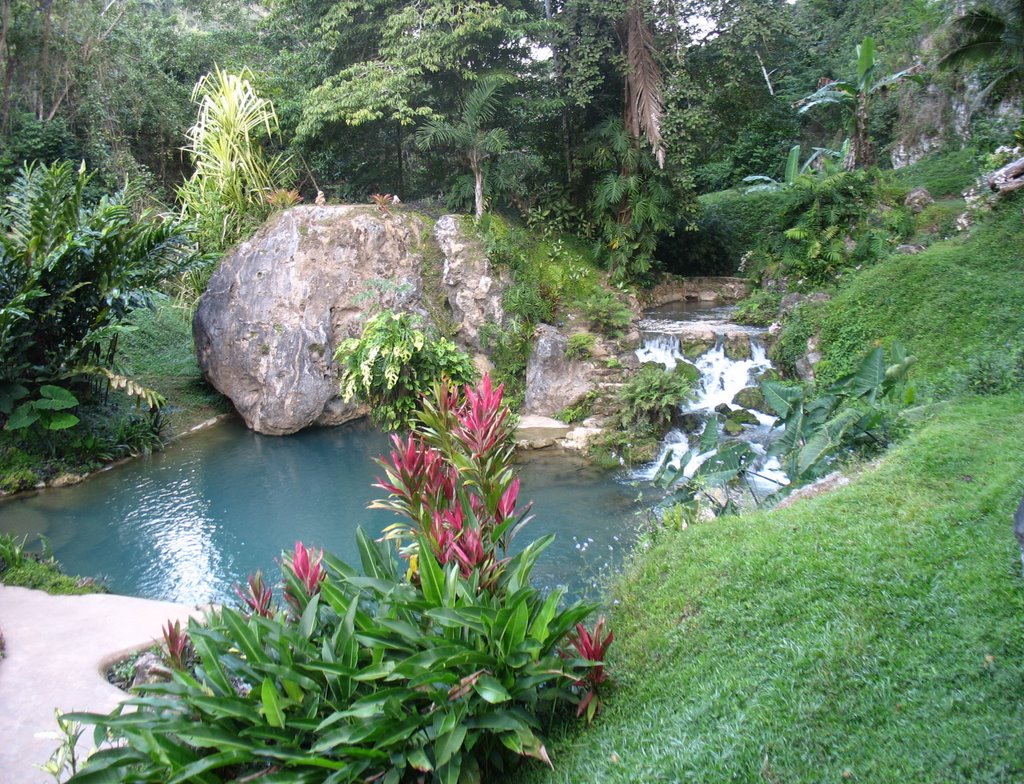
Finally, when Phyllis says Ek Tun is remote and private, she’s not kidding. After a tortuous ride on a bumpy dirt road, the last leg of our journey was by small boat. - sort of a “Dr Livingston, I presume” experience. On our first day at Ek Tun, while Phyllis and the other couple in residence busied themselves with kayaks, we went hiking, swimming in the beautiful natural mineral pool ( pictured above) and ended up tubing down the Macal with beers in hand. We saw not a single soul all day and I decided there and then that in the firmament of NoCrowds destinations, a new standard had been set by Ek Tun.

If it’s a “proper” resort you are after (which you have to share with other people, perish the thought), Cayo has several very good ones. We took a look at The Lodge at Chaa Creek, downriver from Ek Tun and in business since 1981, which seemed to offer the full range of services and activities in a lovely setting. Also well known and ultra-luxe is Francis Ford Coppola’s former hunting lodge, Blancaneaux, in the Pine Ridge Reserve.

But for my money, Ek Tun offers something more valuable and interesting than service and amenities, although much has been done in this “middle of nowhere” place to make you feel comfortable. Ek Tun somehow takes you outside your comfort zone. It encourages you to see things a bit differently and in the end of the day, sticks in your memory like a book or a song that is different from all others.

n.b. Ek Tun has a three day minimum stay. No children. No singles. Our cottage was $190 per night. Meal plan (breakfast and dinner) was $29. Phyllis charges very fair prices for your liquor. If you drink as much red wine as we do, best to let her know in advance. I'm afraid we cleaned her out.

Photo is of the Ek Tun swimming pool built from local stone and fed by a natural spring.

Ek Tun
Macal River, Cayo District
Belize
Email: info@ektunbelize.com
Tel: 501-820-3002 (best between 7 – 8 AM and 6 – 8 PM CST)
www.ektunbelize.com

Monday, March 13, 2006

Un-Belize-able


I once worked for a bank with a specialisation. We devoted endless time discussing if deals should be done outside the institution’s focus. The bottom line for the bank was that if enough money was on the table, “opportunistic” transactions were OK. I had that discussion with myself about Belize and reached the same conclusion. It’s not within my European focus, but it is too good an adventure not to tell you about it.

Whether you see yourself as Indiana Jones, Bob Marley, Jacques Cousteau, Charles Darwin or Howard Carter ( of King Tut fame), you will find your bliss in Belize. Within a landmass the size of the State of Massachusetts, you can have adventures in the jungle, be a bum on a beach, see some of the world’s most spectacular wildlife, dive and snorkel on the largest barrier reef in the Western Hemisphere and visit some of the most interesting and spectacular ruins of a lost civilisation. The fact that you can do all these things in a Central American country where English is the official language, where per capita income is relatively high and where the development of tourism represents a top national priority ( i.e. everyone is happy to see you ) is the icing on the cake.

To organize our trip to this part of the world we knew nothing about, I depended almost exclusively on the insights of Peter Eltringham, author of The Rough Guide to Belize. According to someone we talked to at The Guatemalan Maya Centre near us in London, Eltringham if far and away the best authority on the region. This book is filled with tons of "spot-on" practical advice and I highly recommend it.

Like most visitors to Belize, my husband and I elected to divide our time between the jungle and the beach which ultimately lead us to focus on two districts: Cayo in the western interior which we would use as our base for exploring Mayan antiquities and the “cayes”, a collection of islands located in the northern most waters of Belize with easy access to the barrier reef.

Since this post would be ridiculously long if I covered our 8 day trip in one go, over the next few days I’ll be breaking the Belize story into three sections: accommodations in Cayo, exploring Mayan antiquities and the fine art of doing absolutely nothing on Caye Caulker.

Monday, February 27, 2006

Off to See the Maya


We're off to Belize and Guatemala. I know, I know, I promised Europe but we won this trip at a dinner dance and my son, the anthropologist/business tycoon-in-waiting has been selling this trip to me for years. And we're flying Business Class!

I'll be back at my PC on March 9th. Until then